 Sdkb, Wikimedia Commons
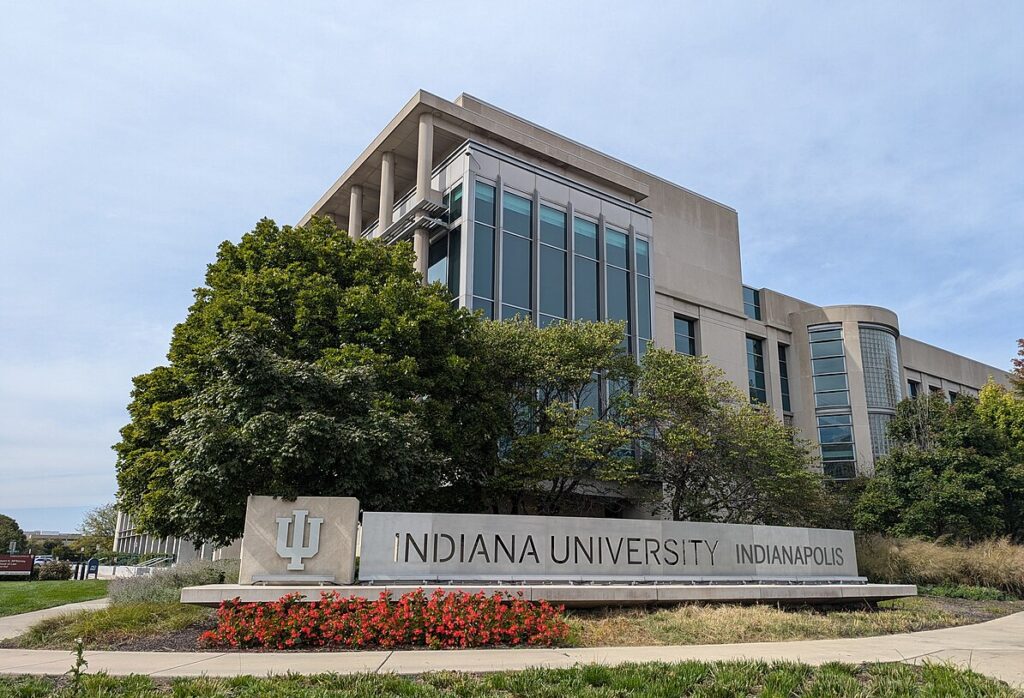
 The Indiana Commission for Higher Education, Indiana’s public-university-system leadership, has announced that the state’s public colleges are responding to a new state law by eliminating or merging more than 400 degree programs on the different university campuses, about 20 percent of the total number of degrees offered. Inside Higher Ed summarizes:
The announcement came just before a new state law took effect … setting minimum requirements for how many graduates individual programs must produce at the universities and Ivy Tech Community College, or face termination. […] [The law] says institutions can ask the commission for approval to keep offering degrees that don’t meet the threshold of average annual graduates. But the universities “voluntarily submitted” the first wave of hundreds of programs to be ended or consolidated, the commission said, meaning they didn’t ask for exemptions.
Programs consolidated or eliminated include
undergraduate and graduate degrees in fine arts, English, business, economics, philosophy, history, anthropology, sociology, journalism, public administration, social work, labor studies, political science, American studies, Africana studies, women’s and gender studies, religious studies, and classical studies.
Also affected are STEM degrees, including “some in health, biology, chemistry, math, computer science, computer engineering, electrical engineering and mechanical engineering.”
What’s happening in Indiana illustrates fundamental tensions in education reform. What’s happening in Indiana illustrates fundamental tensions in education reform. One good idea is increasing efficiency—requiring colleges to justify the programs they offer based on those programs’ return on investment (ROI). Such thinking suggests that government should apportion its support for postsecondary institutions based upon their effectiveness in preparing students for high-paying careers.
Indiana policymakers are doing the best job they can, given that they must deal with a higher-education establishment that has been derelict in its duty. Another good idea is to support a core liberal-arts education, including both core STEM knowledge and education in Western civilization, American history, and American government, in order to educate citizens who will preserve our republic and its ideals. Programs that support STEM and Western civilization may not meet an ROI justification. Thus, Indiana’s reforms may be excellent for ROI purposes but run at cross purposes with other education-reform imperatives.
Indiana’s higher-education administrators and professors are to blame. They were supposed to run their universities properly—to keep them depoliticized, to provide a general education in America’s enduring ideals and institutions, and to ensure that taxpayer money wasn’t diverted to subsidize radical activism. The older generation of educators merely failed to maintain higher-education standards; the younger generation actively seeks to subvert them. Indiana policymakers are doing the best job they can, given that they must deal with a higher-education establishment that has been derelict in its duty—a dereliction that goes a long way toward explaining the lack of student interest in, say, undergraduate anthropology.
Practically speaking, Indiana’s policymakers—and policymakers around the nation—must establish a discrete new higher-education structure, staffed with a new generation of administrators and professors who actively desire to provide a depoliticized liberal-arts education. Policymakers can then apply ROI principles to the public universities as a whole and preserve support for a core liberal-arts education within an administratively distinct structure.
Policymakers around the country, in other words, should pass legislation informed by the model General Education Act (GEA), jointly published by the Martin Center, the Ethics and Public Policy Center, and the National Association of Scholars. The GEA transforms public universities’ general education from distribution requirements to a core curriculum that is taught in an autonomous School of General Studies and focuses on Western civilization, American history, and American government.
General-education requirements generally take up about one-third of the course credits needed for a bachelor’s degree—ca. 40 semester hours out of 120. General-education requirements largely consist of introductory courses, so they have a formative and disproportionate effect on students’ education. When they are crafted as a core curriculum, the common education they provide bestows a unique, shared intellectual character to the university’s students and graduates. Colleges with core curricula also tend to select faculty capable of teaching that core and dedicated to the ideals embodied in that core.
The GEA also will make sure that politicized programs and courses, such as Introduction to Gender Studies, can’t get snuck into the distribution requirements and must justify themselves cleanly and clearly on ROI grounds. The GEA makes sure that ROI reforms remove politicized classes and preserve classes that actually provide a core liberal-arts education.
State policymakers need to transform the administrative class as a whole. State policymakers need to transform the administrative class as a whole. A School of General Studies, just like the smaller civics schools that have been created in states including North Carolina, Ohio, and Florida, will remain vulnerable to subversion, sabotage, or outright elimination by the radical bureaucrats who control our public-university systems. The University of Tulsa’s sudden removal, in June 2025, of Jennifer Frey as head of its Honors College illustrates how the education establishment works to destroy education reform.
General-education reform provides a practical framework for championing clearly defined and effective education reform. State policymakers must appoint mission-aligned university presidents, who in turn will appoint mission-aligned deans and provosts, to make sure that universities carry out the letter and the spirit of policymakers’ ROI and general-education reforms.
University presidents and deans also should draft and put into effect new strategic plans focused on general education as a whole, not just limited to a formal core curriculum. General-education reform provides a practical framework for championing clearly defined and effective education reform throughout the university. When universities voluntarily refocus university education on general education, when they are no longer derelict in their duty, state policymakers will not need to provide external reform for the university.
The first part of general-education reform of course should be reform inspired by the GEA. General-education reform also should include ensuring that departments and majors provide a core of several dozen intermediate and advanced courses that support and build on general education. Programs should teach a coherent body of intermediate courses that provide broad, systematic coverage of their disciplines and deeper instruction in the subject matters introduced in the core curriculum. These intermediate courses also should provide the foundation that allows students to place into the proper context their later explorations of specialized topics in advanced courses. Departments also should provide a range of advanced courses that provide advanced instruction in topics concerning Western civilization, American history, and American government, as well as mathematics, science, and composition. Departments should shift tenure-track lines to meet these new responsibilities.
If higher-education administrators and professors insist upon being derelict in their educational duties, then state policymakers will have to do their jobs for them. So far, state policymakers have prompted Indiana’s public universities to consolidate or eliminate one-fifth of all programs at Indiana’s public universities. Similar reform is likely around the nation. If higher-education administrators and professors don’t care for how policymakers go about fixing the ivory tower, then the answer is simple.
Do your jobs right.
David Randall is executive director of the Civics Alliance and director of research at the National Association of Scholars.
Author
David Randall