
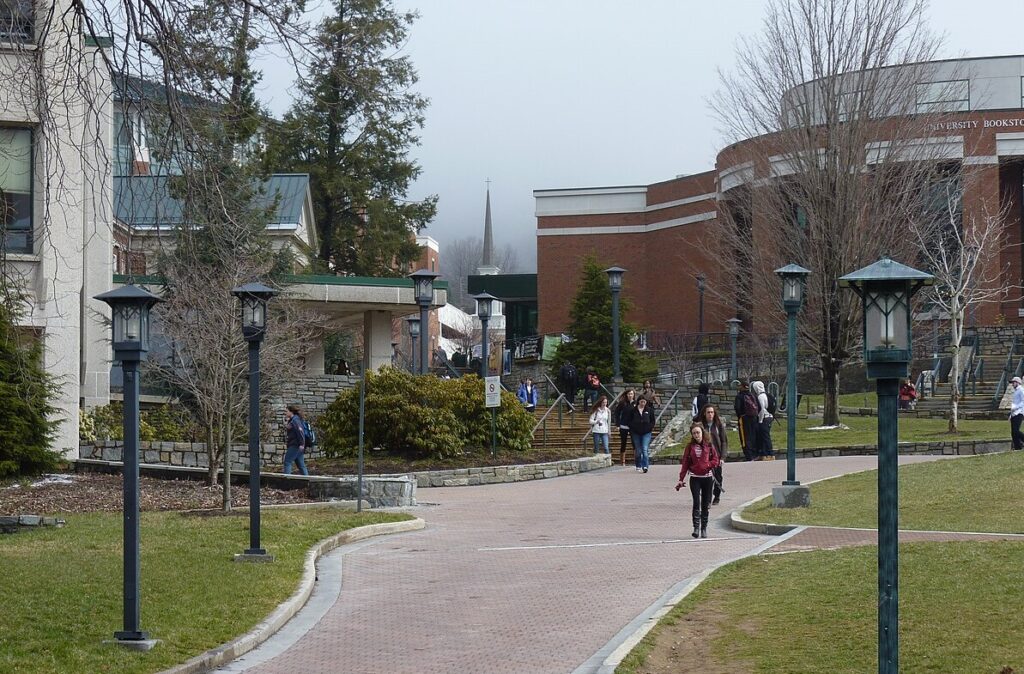
 Chucka_nc, Wikimedia Commons
 Of the many controversies currently raging in higher education, few arouse as much passion as the place of politics in universities. For years, the Right denounced the Left’s dominance over campus culture. After Donald Trump’s reelection, it was the Left’s turn to cry political interference. The North Carolina General Assembly has attempted to address this issue by mandating a policy of institutional neutrality in the University of North Carolina System, though even this policy is sometimes viewed with suspicion.
Overt campaigning on behalf of a candidate or party cannot be allowed in the classroom. Yet, amid this controversy, there has usually been agreement on one point: Overt campaigning on behalf of a candidate or party, though permissible on campus, cannot be allowed in the classroom. Most UNC campuses have explicit policies forbidding such activity. Yet some political organizations have found workarounds to avoid these prohibitions, allowing them to promote their interests in taxpayer-funded educational contexts.
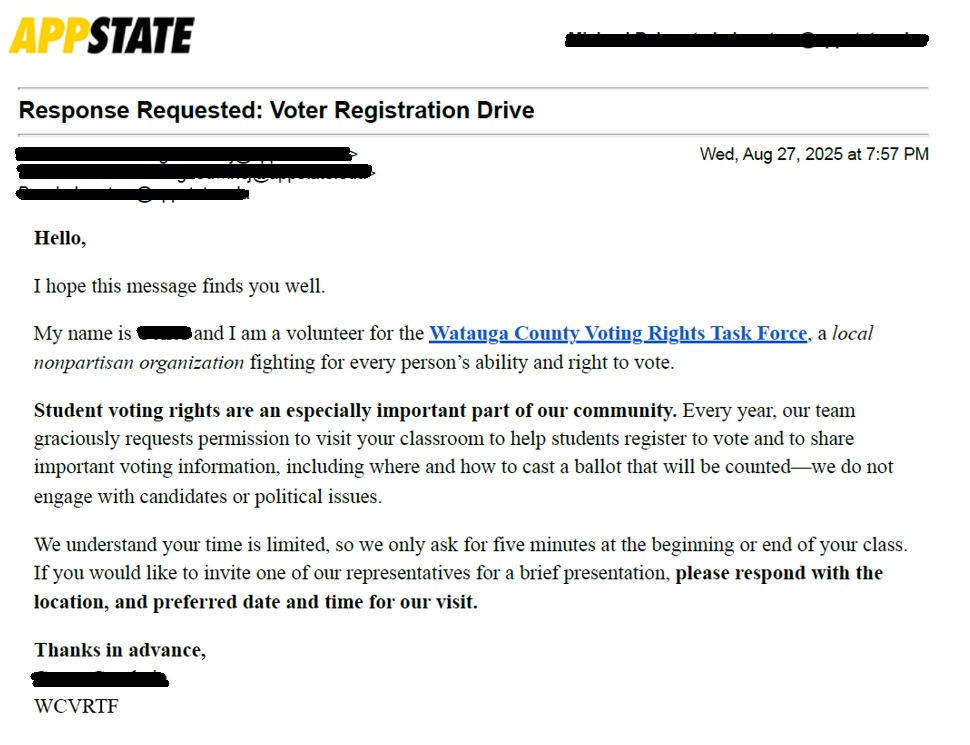
Yet some political organizations have found workarounds to avoid this prohibition. On Wednesday, August 27, I received an email that seemed to have been blind copied to other Appalachian State faculty, as well. It was sent from an App State email address to my App State email address. The sender identified himself as a student “volunteer” for the Watauga County Voting Rights Task Force, which he described as “a local nonpartisan organization fighting for every person’s ability and right to vote” (italics in original). The student noted, “We do not engage with candidates or political issues.” He requested permission to visit my class—and those of other faculty to whom the email was sent—to discuss how to register to vote. The email said: “We understand your time is limited, so we only ask for five minutes at the beginning or end of your class. If you would like to invite one of our representatives for a brief presentation, please respond with the location, and preferred date and time for our visit.”
The email included a link to the organization’s website, which describes its goals. The Watauga County Voting Rights Task Force is a “non-profit and non-partisan organization based in Boone, North Carolina.” It claims to “value nonpartisanship, respect, integrity, empowerment, and education, aiming to create a more inclusive and equitable electoral process in Watauga County,” and to “advocate for equal voting rights for all people, regardless of political persuasion,” while opposing “voter suppression tactics.”
A brief aside: Those interested in grasping the contemporary progressive mindset should take note of the quote this “non-partisan” organization displays on its website. It is from President Lyndon B. Johnson and reads, “The vote is the most powerful instrument ever devised for breaking down injustice and destroying the terrible walls which imprison people because they are different from others.” But that’s not an entirely accurate quote. What Johnson actually said, while signing the Civil Rights Act in 1965, was that “the vote is the most powerful instrument ever devised by man for breaking down injustice and destroying the terrible walls which imprison men because they are different from other men.” A “non-partisan” task force thus uses a Democratic president as political collateral, but only once it has scrubbed off all of the objectionable linguistic ticks belonging to an embarrassing earlier era—to which, apparently, even the civil rights movement now belongs.
Upon receiving the email, I googled the sender’s name. I quickly found his LinkedIn page, where he identified himself as a “student” and an “organizer.” In his bio, he noted, “I have been very involved in electing Democrats as an active member of the party.” He noted further that, in 2024, he served as the “Canvassing Director” for the Watauga County Democratic Party. This work “made [him] proficient in voter registration, frequently registering ASU students to vote.” He stated that he had worked in “the political department of Josh Stein’s campaign for Governor of North Carolina” and that he had “worked to mobilize students on [his] campus for the campaign.”
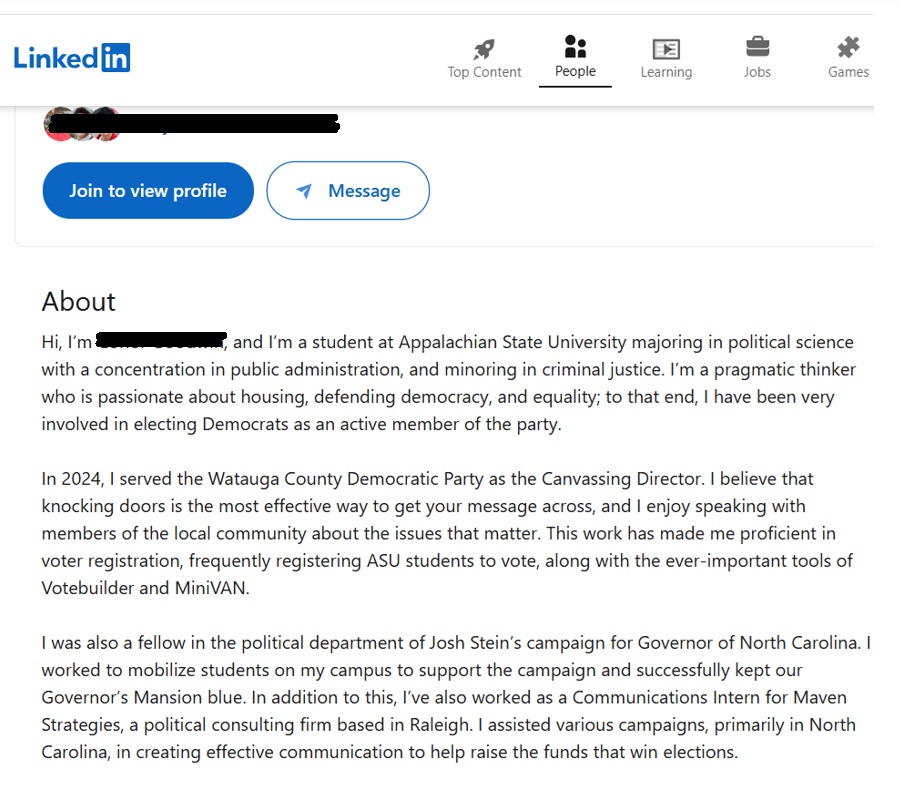
In short, the first thing one learns about the student representing a “local non-partisan organization” allegedly promoting (politically neutral) voting rights is that he prioritizes his ties to the Watauga County Democratic Party. Though his email to me asserted that “we do not engage with candidates or political issues,” his LinkedIn profile highlights not only his involvement in a partisan campaign but also his role in “mobiliz[ing] students on [his] campus for the campaign.” Finally, his LinkedIn page specifically states that his responsibilities in the local party have included “voter registration,” in which capacity he has frequently registered ASU students to vote.
The student had “worked to mobilize students on [his] campus for the campaign.” At minimum, the student was conceding that he performed the same task on a partisan basis that he was now allegedly performing on a nonpartisan basis by sending out his email. The claim that one can have a vested interest in an activity while simultaneously behaving disinterestedly flies in the face of the most basic conflict-of-interest standards.
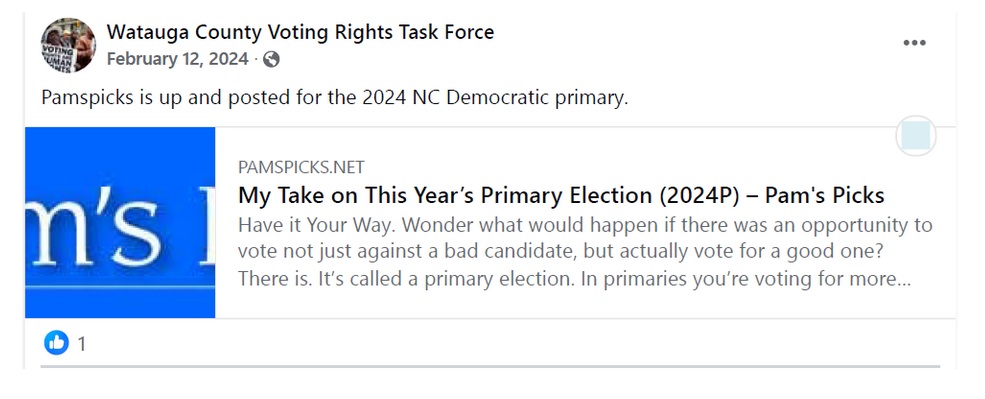
At minimum, he had performed on a partisan basis the same task that he was now allegedly performing on a nonpartisan basis. I checked out the Watauga County Voting Rights Task Force’s Facebook page. Since I started looking at it, it has ceased to be publicly available. I did, however, take a few screenshots at the time. One that stood out was a post from February 12, 2024. It announced that “Pam’s Picks” for the 2024 primary election were available and provided a link to the website. “Pam’s Picks” is the brainchild of a Watauga County activist, who for years has regularly provided extensive information about local, state, and national candidates in addition to making endorsements in most races. “Pam’s Picks” typically includes a marked-up sample ballot with her endorsements noted, which voters may take with them to the polls. A January 2023 article from The Appalachian, the App State student newspaper, quotes the author of “Pam’s Picks”: “I am a progressive Watauga resident and have long held interest in local politics and issues.” The same article notes that, in the 2020 Democratic primary, a candidate who received less than 10 percent statewide called the author of “Pam’s Picks,” puzzled that he had won Watauga. “Pam” explained: “Well, I got your story out.”
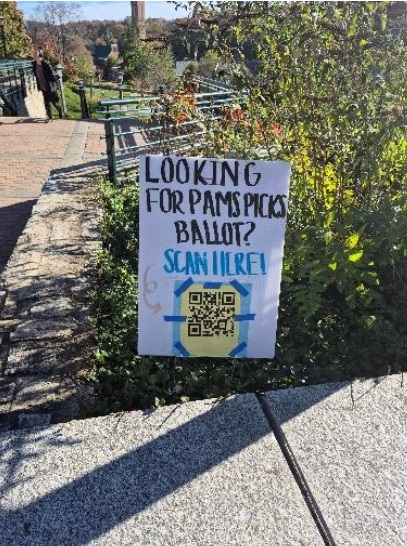
The Appalachian shows a “Pam’s Picks” ballot for the November 2022 election. For 15 races, she endorsed 10 Democrats, two Republicans (for uncontested judicial races), and made no picks in three races. The “Pam’s Picks” voting guide is regularly distributed on Appalachian State’s campus, including through posters with QR codes. The following picture was taken near the university library. “Pam’s Picks” was thus advocating for Democratic candidates for local office at roughly the time the “Pam”-allied Voting Rights Task Force was reaching out to faculty to speak in classrooms.
Close connections between the Watauga County Voting Rights Task Force and the Watauga County Democratic Party are evident in other recent actions, as well. The Watauga County Democratic Party has long prioritized the use of provisional ballots on election day, as they believe this increases student voting. After a bill passed by the North Carolina General Assembly changed the system for electing the county commission in a way that Democrats believed benefited Republicans (replacing a system in which all county residents vote for all five commissioners with one in which residents in commissioner districts pick their own commissioner), the task force submitted a proposal to the Watauga County Board of Elections that would have made all ballot styles available throughout the county. Essentially, this meant that voting precincts in one commissioner district would have also had ballots for other commissioner districts voting that day, ensuring that a voter voting provisionally could still vote in his or her district’s commissioner race if he or she were voting out of precinct. The person who made the proposal was the author of “Pam’s Picks,” speaking on behalf of the task force (as this article makes clear).
At the same meeting, the current chair of the Watauga County Democratic Party also spoke in favor of the proposal but as a member of the task force. (Full disclosure: At the time, I served as the Democratic-appointed chair of the Watauga County Board of Elections.) This fall, the Watauga County Voting Rights Task Force sued the Watauga County Board of Elections to challenge the new county commission districts. Most of the task force members who have commented on the lawsuit in the press (see here and here) are active members of the local Democratic Party.
Very simply, the Watauga County Voting Rights Task Force is a de facto branch of the Watauga County Democratic Party. Very simply, the Watauga County Voting Rights Task Force is a de facto branch of the Watauga County Democratic Party, dressed up as a “non-profit and non-partisan organization.” The membership and goals of the task force align exactly with those of the Watauga County Democratic Party. In some instances, as the above evidence indicates, the task force has made posts that endorse Democratic candidates on its social-media sites. Members who are active in both organizations make no efforts in their online profiles to present themselves as nonpartisan and, if anything, tend to prioritize their political activism. As long as they wear their task force hats, the Democrats have realized they can pursue their political interests under the guise of “non-partisanship.” I should note that, until recently, I was a registered Democrat and have at times been involved with the Democratic Party—which may explain why I received the email to begin with.
Members who are active in both organizations make no efforts in their online profiles to present themselves as nonpartisan. In its own defense, the Watauga County Voting Rights Task Force would presumably say that it is focused on voter registration and that, when it visits classrooms, it does not endorse candidates. No doubt. But the task force deliberately and exclusively targets audiences it expects to be Democratic—which is precisely why it targets college classrooms. To the best of my knowledge, task force members are not standing around with their clipboards and voter-registration forms in front of post offices and churches in the county’s more rural corners. Like gerrymanderers, the task force exploits allegedly nonpartisan processes (voting, for the former; voter registration, for the latter) by steering them towards partisan outcomes.
Why does any of this matter? In a sense, it doesn’t. Most citizens are already inured to the idea that, in our present context, expressions of partisan interest often present themselves as nonpartisan. When I described the Watauga County Voting Rights Task Force’s antics to a Republican friend, he laughed and commented, “I thought all nonpartisan groups were Democratic.” In fairness, the Democrats are in good company. They seem to believe that, as long as they are defending the right of their supporters to vote, they “can’t have a conflict of interest.” In the way that it bends rules to serve its political self-interest while touting its virtue, however, the Watauga County Voting Rights Task Force is decidedly Trump-like. Maybe there’s hope for partisan reconciliation after all.
Yet the deeper issue raised by the Watauga County Voting Rights Task Force concerns the place of politics in universities. I am not qualified to say whether the Watauga County Voting Rights Task Force broke the law. But its actions are clearly contrary to the intent of policies aimed at keeping partisan politics out of the classroom. On October 8, the general counsel of Appalachian State sent to all faculty and staff (as it does each election cycle) a memo on the political activities of employees. It states that “no employee may … engage in political activity during working hours.” Yet, by requesting to speak to their classes, this is precisely what the task force is encouraging Appalachian State professors to do. The memo further states that “no employee may use their position … to support … [a] party … in an election involving candidates for office.” Yet members of the task force who make no secret of their affiliation with the local Democratic Party are writing professors in their capacity as professors and requesting that they give “five minutes at the beginning or end of [their] class” for a presentation. Finally, the task force sent its request from a university email—that is, from taxpayer-funded property. Perhaps students are allowed to do this, but, if a similar request were made by faculty or staff, it could risk running afoul of policies that prohibit using university email for partisan purposes.
The university’s policies are consistent, moreover, with longstanding professional norms. In its foundational 1915 statement, the American Association of University Professors, the main professional association of college professors, declared that academic freedom follows from the distinct nature of academic institutions and the academic calling—to advance knowledge, provide instruction to students, and develop expertise in an array of fields. The statement observes that “the public may respect, and be influenced by, the counsels of prudence and of moderation which are given by men of science, if it believes those counsels to be the disinterested expression of the scientific temper and of unbiased inquiry,” noting that the public is unlikely “to respect or heed them if it has reason to believe that they are the expression of the interests, or the timidities, of the limited portion of the community” that funds or runs universities. But this respect is also threatened when political parties attempt to use classrooms to advance their interests. One of the main reasons that universities have fallen so precipitously in the public’s esteem is the belief that they are focused on advancing a political agenda rather than pursuing knowledge. When the Democratic Party employs the thin veil of nonpartisanship to address students in class, it is contributing to this very mistrust. At a time when the college-educated have become the Democrats’ core demographic, it is mystifying that they seem hell-bent on undermining the very institution with which they are so closely aligned.
It is the duty of universities to expose students to controversial issues that will allow them to develop into thoughtful citizens. It is perfectly legitimate for students to participate in political organizations and for these organizations to be active on campuses. Indeed, such activity is a sign of democratic health. But it is inappropriate for political organizations to advance their causes in classrooms and to use public resources in doing so. Such conduct undermines public trust in higher education, particularly when it falsely describes itself as nonpartisan. Democrats have had a lot to say in recent years about the importance of preserving democracy. They should follow their own advice.
Michael C. Behrent is a professor of history at Appalachian State University.
Author
Michael C. Behrent
