 Tamanna Rumee, Unsplash
 Public universities have spent years insisting that rising tuition is unavoidable. State funding, they say, hasn’t kept pace. Costs are up, and quality must be maintained. But a new brief from Higher Ed Insight (HEI) shows what has happened alongside those arguments: Public universities are quietly adopting pricing practices long associated with private colleges, relying heavily on tuition discounting to manage enrollment and revenue.
The brief, “Understanding Institutional Aid and Tuition Discounting at Public 4-Year Institutions,” documents a steady rise in institutional grant aid at public universities. Between 2014-15 and 2021-22, the share of first-time, full-time students receiving institutional aid (i.e., non-loan tuition discounts) grew substantially, as did the portion of tuition revenue that institutions “give back” in the form of discounts. In practice, this means sticker prices have climbed even as fewer students pay the full published rate.
Public universities are quietly adopting pricing practices long associated with private colleges. For families trying to understand what college actually costs, this approach creates confusion. Public universities advertise high tuition rates, then quietly reduce them for many students through institutional grants that vary by campus, by applicant, and according to institutional priorities. The result is a system in which students must apply, wait, and negotiate before learning the real price, hardly a transparent way to sell a public good.
In practice, this means sticker prices have climbed even as fewer students pay the full published rate. HEI’s brief identifies several reasons universities have turned to discounting: declining numbers of traditional college-age students, increased competition among institutions, uneven state funding, and pressure to enroll out-of-state students who bring in more tuition revenue. These pressures are real, but the solution universities have chosen raises important questions about mission and accountability.
Rather than lowering tuition or cutting costs, many public institutions have opted to raise sticker prices and selectively discount them (see figure below). That strategy may help stabilize enrollment in the short term, but it shifts risk onto students and families and obscures how much college actually costs. It also mirrors the private-college pricing model that public universities once avoided.
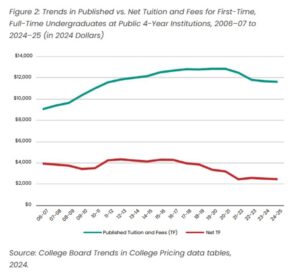
The brief also shows that discounting practices vary widely across institutions. Less-selective flagship and research universities, especially those enrolling large numbers of out-of-state students, tend to offer higher discounts. Doctoral institutions struggling with enrollment discount their tuition even more aggressively. In many cases, institutional aid is used not primarily to help low-income in-state students but to shape the student body or compete for tuition dollars.
Tuition discounting allows institutions to avoid hard conversations about who public universities are meant to serve. That should concern policymakers. Public universities are subsidized by taxpayers to serve state residents, yet tuition discounting can divert institutional resources toward students who are already more advantaged or who ought to pay higher out-of-state rates. When aid is used as a recruitment tool rather than a need-based support, the public mission becomes secondary.
The brief calls for greater transparency and clearer reporting around tuition pricing and discount rates. That is a necessary starting point. Families deserve to know what colleges actually charge, not just what they advertise. Lawmakers, too, need better information to evaluate whether institutional-aid strategies align with state goals.
But transparency alone will not fix the problem. Tuition discounting is ultimately a workaround, not a solution. It allows institutions to avoid hard conversations about costs, priorities, and who public universities are meant to serve.
As demographic and financial pressures continue, public universities face a choice. They can double down on complex pricing schemes that confuse families and dilute their mission. Or they can recommit to straightforward tuition policies that reflect their public purpose. The HEI brief makes clear that the current path is unsustainable—and increasingly indistinguishable from the private-college model.
Reagan Allen is the North Carolina reporter at the James G. Martin Center for Academic Renewal.
Author
Reagan Allen