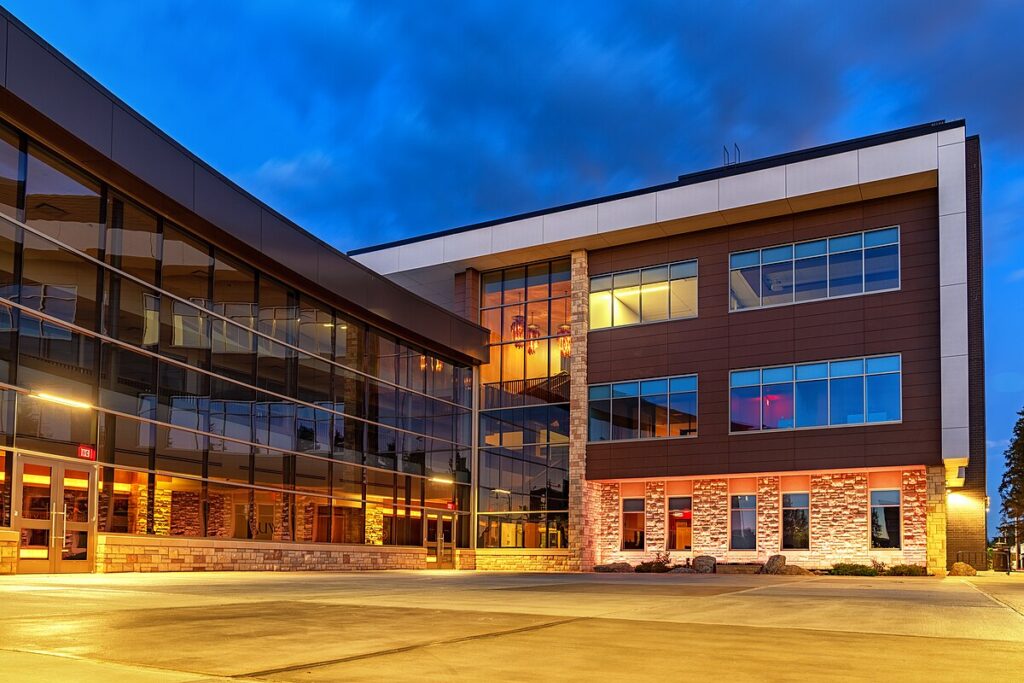
 Tony Webster, Wikimedia Commons
 Last week, Cowboy State Daily—Wyoming’s largest news outlet—published a piece titled “UW Seeks Extra $54 Million On Top Of Its $440 Million State-Funded Budget.”
Cowboy State Daily’s reporter did a solid job documenting University of Wyoming president Ed Seidel’s seemingly endless wish list, presented to the legislative Joint Appropriations Committee—one that seeks a “modest” $54 million on top of the more than $400 million already allocated from the state budget.
By contrast, news of two bills introduced to the legislature’s Joint Education Committee in November largely flew under the radar. Both aimed at expanding the Hathaway Program, the state’s flagship in-state scholarship, beyond public institutions.
Asking the state legislature for additional funds has become something of a tradition under outgoing president Seidel. Asking the state legislature for additional funds has become something of a tradition under outgoing president Seidel. That should come as no surprise in a state where many elected officials, wary of pursuing meaningful higher-education reform, treat the University of Wyoming as a “sacred cow” and grant its leadership near-infallible status.
During last Wednesday’s Joint Appropriations Committee meeting, President Seidel argued that an additional $54 million is needed for an artificial-intelligence program, a paid-student-internship initiative, a grant for the athletics department, equipment to train instructors in technical trades, and fundraising matching funds—to name just a few items.
Many elected officials, wary of pursuing meaningful higher-education reform, treat the University of Wyoming as a “sacred cow.” Governor Mark Gordon, who has long shown a soft spot for the state’s only four-year public university, endorsed most of the additional funding requests while rightly rejecting funds for the proposed AI initiative. Although Gordon gave no reason for the AI rejection, it is worth noting that UW already received $8.75 million in AI money this year, a sum that included $2.5 million from the state.
The University of Wyoming’s budget narrative says that it is “asking for $2.5 million … to cultivate ‘artificial intelligence expertise’ at the school.” President Seidel told the committee the funds would be “aimed at developing projects,” not staffing.
It’s hard to avoid the conclusion that UW’s president has caught the same AI fever afflicting so many college leaders, all eager to join the latest technological arms race. Not long ago, university leadership was fixated on achieving R1 status; this AI push feels like a rerun, another chase after the newest fad rather than a serious effort to serve the people of Wyoming.
President Seidel also requested $2.3 million to fund paid student internships, prompting some legislators to question whether the program would amount to “robbing young people of the reward” of finding and securing internships on their own. This raises a broader concern that the university is fostering a sense of entitlement among college-educated students at a time when the economy is increasingly shifting toward the trades rather than traditional four-year degrees.
The $2.3 million earmarked for paid summer internships would likely deliver a far better return on investment if directed toward career and technical education—especially in a state like Wyoming, which is facing a serious shortage of skilled trade workers.
President Seidel also asked the legislature for $5 million to renovate existing campus spaces into trades shops, along with another $1 million for woodworking, dust-mitigation systems, drones, rovers, welding equipment, power tools, lasers, robotics, plumbing, wiring, and other gear needed to train instructors in the trades—a role traditionally handled by community colleges or the industry.
Requests for additional funding for an AI initiative, paid summer internships, and a trade-teacher incubator read like a checklist of the latest trends. As a seasoned political operator—as every university president must be—President Seidel knows which way the winds are blowing. And with less than seven months left in his term (after announcing earlier this year that he will step down at the end of his contract), he appears eager to cover his bases ahead of whatever administrative or leadership role may come next.
By contrast, while President Seidel and state legislators casually toss around millions of dollars, the discussion last month about expanding the Hathaway Program to include the state’s private institutions drew little media attention and even less legislative enthusiasm.
The Hathaway Program is the state’s flagship—and notably generous—scholarship, named after former governor Stan Hathaway. It provides eligible Wyoming residents with financial support to attend the University of Wyoming or in-state public community colleges.
The discussion about expanding the Hathaway Program to include the state’s private institutions drew little media attention. The program distributes roughly $16 million each year to students attending those institutions. The Hathaway Scholarship has four tiers—honors, performance, opportunity, and provisional—with awards ranging from $840 to $1,680 per semester, depending on students’ high-school coursework and achievement.
Unfortunately, Wyoming students who choose to attend the state’s only private four-year institution, Wyoming Catholic College, or pursue technical training at WyoTech, a nationally recognized for-profit trade school, are excluded from the program—denied the same benefits afforded to students who enroll in public institutions.
The total cost to the Hathaway Scholarship program for this time-limited proposal is estimated at $800,000. Two draft bills—26LSO-0246 and 26LSO-0247—submitted to the Joint Education Committee aimed to change that.
Draft bill 26LSO-0246, Hathaway Scholarships for Career and Technical Institutions, offered $1,000 scholarships—capped at 1,000 students per year—for education leading to industry-recognized credentials or associate degrees. The goal was to recognize and validate career- and technical-education pathways.
Among the bill’s most vocal critics was Senator Chris Rothfuss (SD-09), the Senate minority whip and director of internships, entrepreneurial initiatives, and research opportunities at the University of Wyoming. One could hardly imagine a more reliable gatekeeper of the public higher-education monopoly.
Senator Rothfuss instead voiced support for Wyoming Works, a state grant program that provides resources for adult students to learn a skill and secure employment, positioning it as an alternative to the proposal laid out in 26LSO-0246.
The bill failed with six ayes, seven nos, and one excused vote.
The second draft bill, 26LSO-0247—Hathaway Private Postsecondary Institution Scholarships—would provide $500 per semester, capped at 200 students, for those attending state-accredited private, degree-granting institutions for up to eight semesters. The proposed $500-per-semester award falls below even the lowest Hathaway Scholarship tier, signaling a clear reluctance among legislators to place public and private higher-education institutions on equal footing.
The total cost to the Hathaway Scholarship program for this time-limited proposal is estimated at $800,000. The time is limited to students graduating between the school years 2025-26 and 2028-29, who qualify for the honors tier of the Hathaway Scholarship.
Unsurprisingly, Senator Rothfuss opposed the bill, arguing that it would divert funds from public institutions. “Any dollars that end up being captured by an expansion of availability to the private sector is going to take away from what can be given out [to UW or community college students],” he said.
The bill passed on a narrow vote—seven in favor, six opposed, with one excused. What happens next remains uncertain as the proposal heads toward the February budget session, particularly given constitutional questions surrounding the use of endowment funds for private institutions and an ongoing court challenge to Wyoming’s new school-voucher program, which has already prompted a judge to pause payments.
The bills and requests discussed above tell two tales about the future of higher education in Wyoming.
While many state legislators seem willing to hand UW a blank check and continue the cycle of endless funding, those same lawmakers balk at $1.8 million—the combined cost of the proposals in 26LSO-0246 and 26LSO-0247.
If lawmakers are serious about keeping Wyoming’s young people in the state, the answer is obvious. It’s clear the state has ample funds for higher-education initiatives at the University of Wyoming. What’s far less clear is why state legislators—many of them Republicans—oppose expanding educational opportunities for Wyoming students. Are they worried that such proposals might disrupt the monopoly long enjoyed by UW and the state’s public community colleges? Or do they simply lack confidence in private higher education altogether?
Between now and the February session, legislators should think carefully about the path they want to take. Will they continue to indulge the requests of a lame-duck, outgoing president who will no longer be at the helm of the university after July 1, 2026? Or will they choose a bolder, more innovative course by expanding the Hathaway Scholarship?
If they are serious about keeping Wyoming’s young people in the state, the answer is obvious.
Jovan Tripkovic is communications manager at the James G. Martin Center for Academic Renewal.
Author
Jovan Tripkovic