
 Engin Akyurt, Unsplash
 The National Association of Diversity Officers in Higher Education (NADOHE) has published its second “State of the Chief Diversity Officer” (CDO) report. Following up on the 2023 survey, the 2025 study shares some interesting findings. Have efforts to rid higher education of DEI’s influence been, from NADOHE’s members’ perspective, a decidedly undesirable success?
Only eight percent of those who indicated a change to their role noted that it had been discontinued outright. The report received responses from 394 CDOs and academic diversity officers (ADOs) and asked how these roles had changed either positively or negatively since 2023. Although one might expect such a study to illustrate that DEI is in danger on higher-ed campuses, the findings don’t convincingly indicate that. For those of us who support the downsizing of DEI in higher ed, in fact, the findings are actually pretty disappointing.
For example, due to the formatting of the report, it appears that NADOHE wants readers to focus on comments in a highly visible purple square implying that many DEI offices have been shut down, altered, or eliminated. In reality, however, the survey found that only eight percent of those who indicated a change to their role noted that it had been discontinued outright or that their responsibilities had been discontinued. In other words, only 12 of the 394 participants indicated having lost their DEI role in the past two years, despite the Trump administration’s attempts to cull DEI in higher ed.
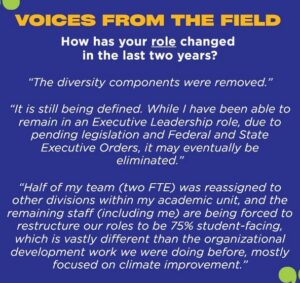
Instead, it appears that the majority of altered DEI offices on college campuses have merely been combined with different departments. Twenty-nine percent of DEI offices reported “office changes,” and, of that group, only 14 percent (17 survey participants) indicated that their office was dismantled or eliminated. Several reported that their offices had been merged with other offices, and still others reported a mere office name change. Of the 29 percent who reported that their actual work had changed, only 20 percent noted that the changes were due to “political and legislative impacts.”
Perhaps most surprising is the fact that 48 percent of participants said their annual operational budget had not changed since 2023. Of those who did report a change, over half (52 percent) said their budgets increased. In light of the recent federal crackdown on DEI operations in higher ed, it is both concerning and suspicious that such a large portion of respondents are seeing greater funding. The write-in reasons for budget increases included program expansion, the creation of new positions, new grant funding, and restructuring or strategic-alignment efforts.
Many of the changes in question were to the benefit of DEI officers. Meanwhile, those who reported budget cuts cited deficits, enrollment declines, and, in a few cases, federal policies or state legislation. Some reported frozen budgets due to “concerns that DEI spending will be heavily scrutinized by central administration and bring negative attention to the unit.”
With regard to salary, a great majority of respondents are bringing home the bacon with pay well over $100,000. “Thirty-three percent of men and women-identifying respondents earn an annual salary between $100,000 and $149,000, although 56% (n = 50) of men make more than $150,000 per year compared to 52% (n = 108) of women.”
While 31 percent of participants indicated that their roles had changed significantly in the past two years, it seems that many of the changes in question were to the benefit of DEI officers. The write-in responses for this section included new titles and even promotions that have CDOs rubbing shoulders with campus leaders. Of the write-in responses in this category, 24 percent reported that their job duties had been expanded, likely due to their reassignment to student-success or HR offices.
Some respondents (48 percent) noted “improved alignment,” presumably meaning that, instead of decreasing the overall role of DEI on campus, several schools have deepened their entanglement. Meanwhile, only 77 total respondents reported that support for DEI had decreased on campus.
One thing that most of the survey participants could agree on is that their jobs have become more distressing, as work is now “less predictable (68%), more stressful (87%), and more upsetting (77%) than it was in 2023.” Ninety-one percent of respondents reported that “the political climate is the most pressing challenge for future diversity, equity, and inclusion work in higher education.”
That’s the good news: Although recent anti-DEI actions are not yet having the desired effect, at the very least they are making waves.
Ashlynn Warta was the Martin Center’s North Carolina reporter from 2021 to 2025.
Author
Ashlynn Warta
