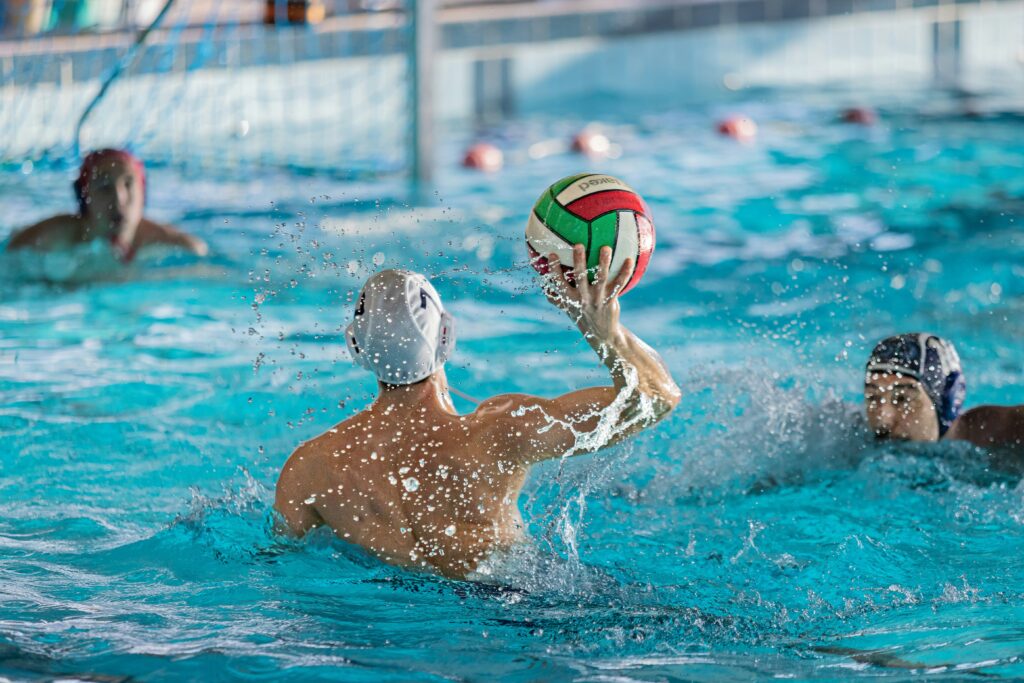
 Davide Buttani, Unsplash
 International student-athletes account for about 13 percent of NCAA Division I participants and about seven percent of Division II. Yet, despite their small numbers, international student-athletes may be bellwethers for the consequences of professionalizing American collegiate sports.
Many of the student-athletes in question know where that road leads: It’s the system they rejected when they decided to study and compete at an American university.
With a few exceptions, the road to becoming a professional American athlete passes through a university. That fact is uniquely American. Aspiring pro athletes around the world pursue their athletic ambitions through clubs and teams and pursue their education on a parallel track.
International student-athletes may be bellwethers for the consequences of professionalizing American collegiate sports. The NCAA historically presented an attractive alternative: obtain a university degree while still playing sport at a high competitive level, in the context of a traditional college experience.
The student-athlete experience now includes the transfer portal, marketing deals, salaries disguised as booster largesse, and agents taking their cut of the action. International student-athletes also have brokers and agencies as part of their recruitment pipeline. That’s all much closer to the traditional European experience than to American college athletics.
The student-athlete experience now includes the transfer portal, marketing deals, salaries disguised as booster largesse, and agents taking their cut. Dr. Anastasios Kaburakis came to the United States from Greece 25 years ago, “fascinated because college athletics was so different. I wanted to figure out how it could be so different and work so beautifully. Intensely competitive, but very much tied to education. You could play in a March Madness game and then go to class. That was not the experience most of us growing up in Europe had.”
It didn’t take long for him to realize that the grass wasn’t greener on this side of the Atlantic. Kaburakis has been a professor of management at Saint Louis University since 2010, while also managing an international sport consultancy. He worries that, “if we don’t figure out how to manage it strictly, we will see a lot of the bad and the ugly that I saw in the world that I was coming from.”
The first area he warns of is recruitment and representation agencies targeting international student-athletes. These agencies can get paid by the university for their assistance in scouting and recruiting, by the athlete for helping him or her get into the university and onto the team of his or her choice, or by the athlete again as a percentage of his or her Name, Image, Likeness (NIL) deals and any other athletics-derived revenue.
Says Kaburakis, “These agencies would normally charge 10 percent for an international contract, but now sometimes it’s up to 20-40 percent. In some sports, the top talent will make more in the NCAA than they would in a top international league.”
But that’s a low bar for most of the sports that have the highest percentages of international student-athletes: tennis, ice hockey, water polo, volleyball, and golf. Building a successful business off of recruitment fees and commissions in these sports becomes a volume game. The agencies need to increase the number of athletes they send to the NCAA and, worryingly, move around within the NCAA.
Pro-sports agents live for trades and transfers. Each time a player changes teams, he signs a new contract—which means another 10 percent for the agent.
The NCAA’s transfer portal brings this phenomenon to college sports.
I spoke with Kaburakis on the second day of the volleyball transfer portal, a sport in which he has a deep background.
“Just over 1,000 volleyball players are on the portal [in] week two. That will reach 2,000 by the end of the transfer window,” he says, using a term familiar to anyone familiar with professional European soccer.
Agents benefit most directly and tangibly from student-athlete transfers, but coaches drive the activity, too.
Recruitment is a major part of every coach’s job. That used to entail finding incoming freshmen to replace the graduating seniors. Coaches are now expected to play the transfer portal, attracting incoming high performers to replace unsatisfied players who wish to leave. There’s no excuse for a subpar season when coaches can “encourage” an underperforming athlete to seek opportunities elsewhere while recruiting a proven performer from the transfer portal.
International student-athletes shoulder and present a unique set of risks related to immigration policy. “The fundamental values should be training, coaching, mentoring, and talent development to help each athlete reach their full potential,” Kaburakis says. “If you are treating this work the right way, it shouldn’t be a volume business.”
Nevertheless, “every day some coach is saying, ‘I have to win. Feeding my family and their livelihood depends on it.’ They will absolutely go for the transfer or the international student. Whatever they can get for the money they can spend.”
Immigration politics and the transfer portal are the rock and hard place flanking college coaches. International student-athletes shoulder and present a unique set of risks related to immigration policy. Last summer, the Trump administration suspended entry visas from 19 countries. The restriction included student visas.
Kaburakis spoke about prospective international student-athletes who got “burnt” when this happened.
Those incidents left the coaches in the lurch, too. They had spent time, energy, and money recruiting international student-athletes and had planned their upcoming seasons around them. Then they were in limbo. The coaches didn’t know if they should hold out for the State Department to lift restrictions or grant exemptions to students, or if they should cut their losses and enter the transfer portal. The portal for some sports closed before the entry restrictions were resolved, leaving coaches with gaps in their rosters and few options.
Immigration politics and the transfer portal are the rock and hard place flanking college coaches. They have to play both games, but the risks are as substantial as the potential rewards.
And it’s only going to get more complicated.
Currently, international student-athletes can sign NIL deals only if the money comes through their home countries. Representative Valerie Foushee (D-NC) introduced a bill that would allow international student-athletes to have full NIL access while on their F-1 visas.
The situation will evolve further when student-athletes are—inevitably—salaried. Will international student-athletes still be on student visas? Or will an H-1B specialty-occupation visa or a P-1A professional-athlete visa be more appropriate and more accurately reflect their status? (Presumably such athletes are being recruited because the coach could not find an American player with the necessary skills profile.)
One group that could benefit from these uncertainties is sports-management graduates. “Chaotic times are good for you: they create more jobs,” Kaburakis tells his students.
Athletics departments will need specialized staff just to handle immigration and visa issues. Again, visas won’t be a one-time affair for an incoming first-year student. Every international student-athlete coming through the transfer portal will have visa-related paperwork. Same number of athletes, but higher administrative burdens.
That will not be a big deal for major universities such as the University of North Carolina or Stanford. But schools further down Division I and into Divisions II and III will not be easily able to afford another specialized athletics-department staff member. At least not without siphoning money from the university’s non-athletic budget.
Kaburakis’s Saint Louis University falls into that category. The school has cut academic programs while trying to balance a healthy athletics department that bolsters recruiting for the general student population and increases alumni donations, endowments, and corporate support.
Athletics departments will need specialized staff just to handle immigration and visa issues. Looking across the nation, Kaburakis wonders, “When is the academic enterprise in such extreme stress that the faculty revolts?”
All of these issues further stratify the college-sports landscape.
Some schools might commit themselves to the traditional student-athlete experience, eschewing the transfer portal as much as possible and basing their recruiting pitches on four years of steady athletic development. This might come at the expense of wins and titles but could attract student-athletes—both international and domestic—who are put off by the recent shifts in college sports.
By professionalizing student-athletes, the NCAA is diving into a global marketplace. Among the schools that go full-bore into the global sports marketplace, immigration-law specialists could be the next must-have staff members for athletics departments seeking a competitive edge. Those that can afford experienced, specialized immigration staff will have an advantage over those that can’t. The same goes for schools that have advanced scouting relationships and networks overseas, whether those come through agencies or American universities’ overseas campuses.
The “amateur student-athlete” model of collegiate athletics was uniquely American. The singularity of the NCAA framework isolated it from the rest of the sporting world’s troubles. College sports has had its scandals, but they were often as idiosyncratic as the system that engendered them. At times, and certainly in retrospect, some were almost quaint.
By professionalizing student-athletes, the NCAA is diving into a global marketplace. They are thrusting into that marketplace departments, administrators, and coaches who have minimal institutional knowledge of—and even less operational experience in—that realm.
University of Wisconsin women’s volleyball coach Kelly Sheffield underwent his initiation shortly after the Badgers concluded their season with a Final Four appearance. One of his rising stars—whom the school had recruited, then supported and developed through a serious injury—entered the transfer portal and emerged at Arizona State.
“I couldn’t get my head wrapped around what was happening here. We were clearly being sabotaged, and I didn’t understand why,” Sheffield said.
As for the player herself, she was “very upset that our incoming players were making more money than her. I said that is ludicrous. I don’t know where you’re getting this information, but our newcomers are not getting paid more than you. She was certain because somebody had told her that they were, which is made up because nobody knows how much anybody is getting.”
His conclusion: “It was just the agent”—an agent who represented three other players on the team.
We can expect to hear more of this from college coaches.
Meanwhile, Kaburakis is having difficult conversations with the families of teenage European athletes weighing their athletic and academic futures.
“Why should they spend money on agency fees to get recruited when they could spend that money to attend a Division III school where the athlete still gets to play at a competitive level? Or attend a school in Holland or Germany that has the emphasis on academics. The athletes I talk to can get a different experience in one of several countries now.”
Of all the parties involved, international student-athletes may have the best read on where all of this is going and decide not to tag along.
George M. Perry is a sports performance coach, sports businessman, and writer. Before going into the sports industry, he was a submarine warfare officer in the United States Navy and briefly attended law school.
Author
George M. Perry