
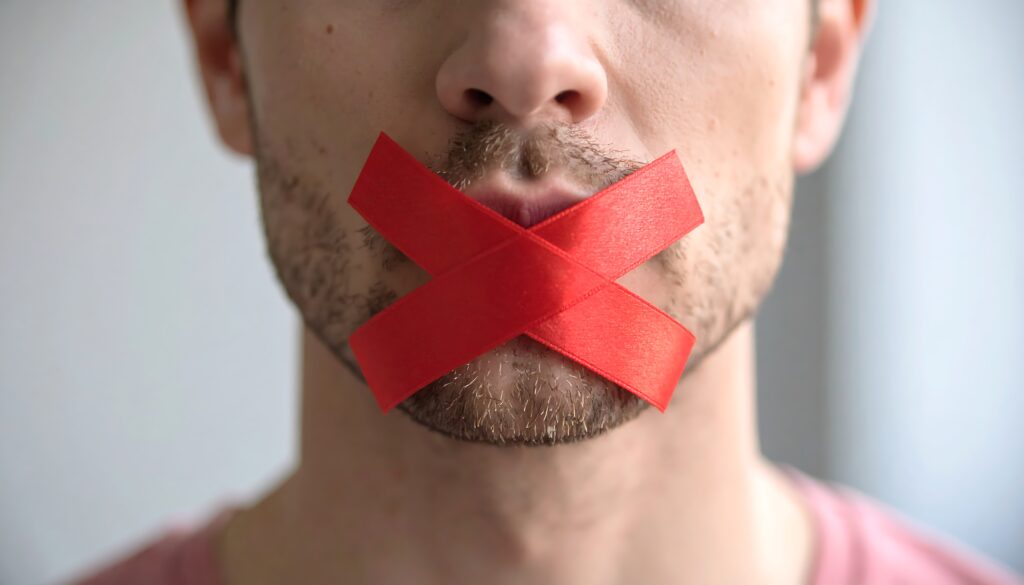
 Than, Adobe Stock Images
 If ever a case made plain the clash of values between freedom of speech and the desire of college administrators to compel everyone to support their “progressive” beliefs, Reges v. Cauce is it. This is an important First Amendment case, one in which the Martin Center joined in an amicus brief in support of a professor who was targeted with official retaliation because he spoke out against his university’s “land acknowledgement” policy and substituted his own views for the school’s.
What nerve!
Why do so many college leaders (and faculty members) use their influence to promote ideological points of view? Before getting into the details of the case, let’s examine the background. Specifically, why do so many college leaders (and faculty members) use their influence to promote ideological points of view?
They do so because they see it as their mission to undermine the legitimacy of Western civilization in the minds of students. They want students to reject everything in our culture because they see it as responsible for endless trouble: It’s destroying the environment; it’s exploitative of “marginalized people”; it favors the rich at the expense of the poor; it’s racist, sexist, and homophobic; and it stands in the way of social justice and equality. Progressives want everyone to regard America as utterly rotten—irredeemable. The only thing to do is to undertake a radical transformation of the nation by putting it under the control of those who are “woke.”
Campus progressives see it as their mission to undermine the legitimacy of Western civilization in the minds of students. That being the goal, dissent from the orthodoxy is unacceptable. Why allow anyone to say things that might cause students to question the supposed need to tear down our foundations and start over? Speech must be controlled.
Among the numerous clichés “progressives” use to attack the legitimacy of America is the idea that the country’s land was stolen from the native peoples who lived here before the horrific invasion of white settlers. If students accept that, they’ll be more willing to believe the notion that indigenous cultures are good, while white culture is bad. Therefore, many institutions have taken to propounding the “stolen land” idea, including the University of Washington.
In 2020, the Paul G. Allen School of Computer Science & Engineering at the University of Washington (UW) issued a statement encouraging its faculty members to include a “land acknowledgement” in their syllabi, with suggested wording to indicate that the university was occupying land that belonged to the Salish tribe. That was in line with the university’s Office of Minority Affairs & Diversity, which had for years been plaintively stating, “Our campus sits on occupied land.”
Of course, there was never any consideration of returning the land to the Salish; this was nothing but an empty gesture by officials who felt the need to go along with the “land acknowledgement” fad. Nor did it have anything to do with the content of any of the courses taught. But, to the “progressives” in charge, this pointless language makes UW “more inclusive.”
But computer-science professor Stuart Reges did not agree. Instead of obediently reciting the suggested “land acknowledgement” on his syllabus, he crafted his own, stating that, under John Locke’s theory of acquisition, the natives “can claim historical ownership of almost none of the land on which UW sits.”
Certainly a professor is free to disagree with a stance taken by his university on a matter of public concern—right? Wrong. Reges soon found out that officials in the Allen School and UW administration were angry that he had presented his own views.
The day after the first class of the January 2022 semester, Reges received an email from Magdalena Balazinska, director of the Allen School, ordering him to remove his unapproved statement from his syllabus, calling it “offensive.” She also emailed all of the students in Reges’s course, apologizing for his wrongful thoughts and telling them how to file official complaints against him.
She also created a new section of the course, inviting students to switch into it if they didn’t want to learn from Reges (who had won the university’s Distinguished Teacher Award in 2011). About 30 percent of the students did.
Within a few days, the Foundation for Individual Rights and Expression (FIRE) got involved in the dispute, sending a letter to UW president Ana Mari Cauce, informing her of the facts and explaining that the treatment of Professor Reges violated his rights under the First Amendment. That letter, however, had no impact. As in many other cases where college officials have been told that their high-handed, intolerant policies are illegal and will lead to litigation, UW’s leaders decided to continue them anyway.
Ponder the situation. A university prefers to harass and perhaps even fire a veteran professor rather than let him speak his mind. In March, Reges was summoned to a meeting with Balazinska to discuss allegations that he had violated UW policies. She warned him that the university has the right to take disciplinary action against professors for any conduct deemed “unacceptable or inappropriate” and stated that his syllabus statement was causing “disruption.”
After Reges rejected a proposed “resolution of charges” that would have required him to stop using his land-acknowledgement statement and to “maintain a positive, welcoming environment” for all, he was informed that UW intended to proceed with formal charges against him that could lead to dismissal.
The Ninth Circuit swatted aside the university’s excuses for its retaliation against Reges and upheld his free-speech rights. Ponder the situation. A university prefers to harass and perhaps even fire a veteran, award-winning professor and go to court rather than let him speak his mind. Such is the power of leftist ideology.
Reges decided not to give in to the university’s bullying and filed a lawsuit to uphold his First Amendment rights. You can read his complaint here.
The federal district court that heard the case sided with UW, holding that it had the right to retaliate against Reges for his speech under a convoluted, multi-part “balancing” test. Reges appealed that ruling to the Ninth Circuit.
The good news is that the Ninth Circuit, in an opinion by Judge Daniel Bress, reversed the district court’s decision on December 19. He swatted aside the university’s excuses for its retaliation against Reges and upheld his free-speech rights.
Here’s a key paragraph from the decision:
Reges did not speak about a private grievance or personnel dispute … but about a matter of public concern both within the UW community and more broadly. He included a parody land acknowledgement in his syllabus to comment on the propriety of land acknowledgements … and to question the factual basis for UW’s land acknowledgement. Reges also sought to situate land acknowledgements within a broad “agenda of diversity, equity, and inclusion,” which he opposes. […] Reges’s speech, however misguided one might regard it, was core political speech that merits the highest First Amendment protection.
But what about student distress and the “disruption” caused by Reges’s provocative disagreement with the “stolen land” notion? The Ninth Circuit’s answer was that colleges have to live with such inconveniences under our Constitution: “If student anxiety or outrage toward a professor’s academic speech could justify restricting what a professor says, then universities would cease to occupy any ‘special niche’ in our First Amendment traditions.”
The decision by the Ninth Circuit panel (2-1 with a whimpering dissent) is a ringing victory for free speech. UW can petition for a rehearing en banc (i.e., with all the judges participating), but, if that doesn’t happen, the district judge will have to enter judgment for Reges: that UW violated his rights and must pay money damages. This is a savory win, but how much difference will it make?
UW denies that it did anything wrong. A spokesman is quoted in this piece as saying that the university feels the obligation to “protect” students from supposedly hurtful views such as that university land was not stolen. As a result of the decision in the case, UW will have to stop harassing Professor Reges but can continue pushing faculty to put “land acknowledgements” in their syllabi, along with other “woke” messages aimed at students. The cost to the taxpayers of Washington of the university’s battle to defend its desire for ideological conformity won’t have the slightest deterrent effect.
All in all, Reges is a nice win, but, in the war against the abuse of university power, it amounts to just a minor skirmish.
George Leef is director of external relations at the James G. Martin Center for Academic Renewal.
Author
George Leef
