
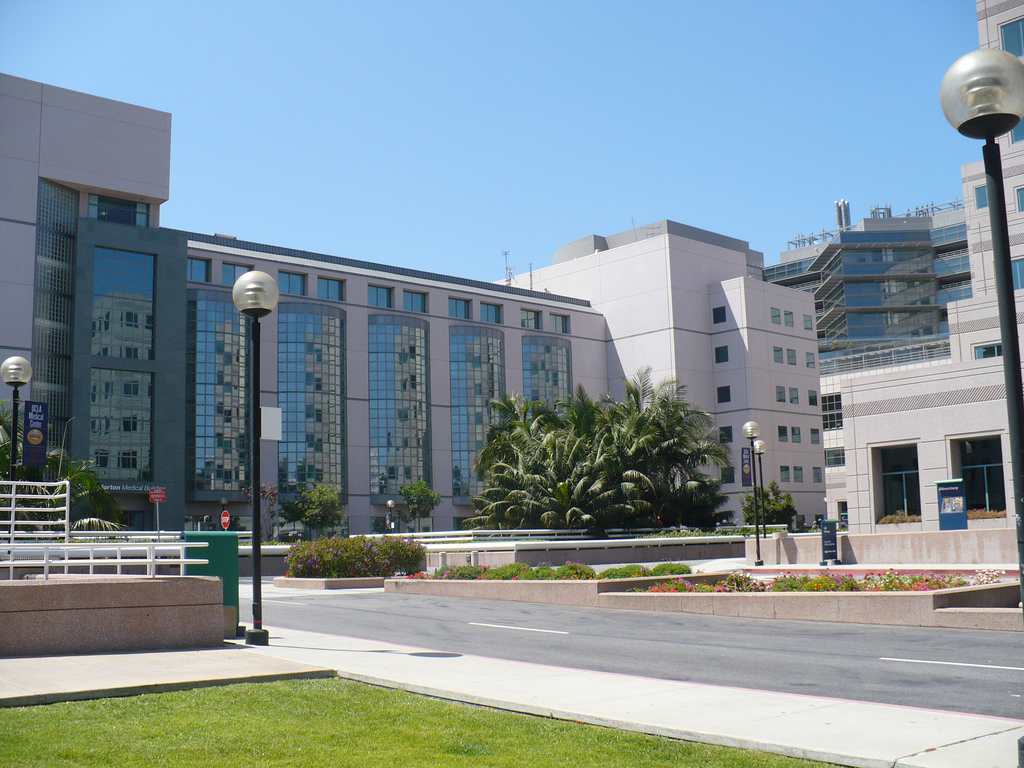
 Nikhil Kulkarni, Wikimedia Commons
 The DEI practices at America’s colleges and universities have been justly criticized for being anti-meritorious, unconstitutional, racist, and costly. However, a recent lawsuit against UCLA’s medical school suggests that its discriminatory admissions policies could potentially have negative public-health consequences, as well.
That’s quite an indictment against what has long been regarded as a premier medical school.
The Department of Justice argues that UCLA uses a “systemically racist” approach to med-school admissions. Last May, the groups Do No Harm and Students for Fair Admissions, as well as an unsuccessful white applicant, sued UCLA’s medical school, arguing that “various UCLA officials [had engaged] in intentional discrimination on the basis of race and ethnicity in the admissions process.” They have now been joined by the U.S. Department of Justice, which argues that the school uses a “systemically racist” approach in admissions, favoring Hispanic and black applicants over white and Asian ones. The government’s brief declares this to be a matter of public importance and seeks relief for future applicants who shouldn’t be forced to compete in a race-based system that may prejudice them.
The plaintiffs insist that UCLA must base admissions on individual ability and not on membership in some favored group. In short, the plaintiffs and the Justice Department insist that UCLA must base admissions on individual ability and not on membership in some favored group.
The university profile of the medical school’s associate dean for admissions, Jennifer Lucero, says that, “as a Chicana physician, she takes a special interest in diversity issues in medicine.” Like many other administrators, Lucero appears to be on a mission to impose her values on her school, the public and the law be damned.
According to the recent legal action by the federal government in this matter, UCLA and Lucero have openly flouted the Supreme Court’s decision in Students for Fair Admissions v. Harvard (2023) by continuing to practice race- and ethnicity-based favoritism in student admissions.
Not only is that illegal, but this Daily Mail story shows that these aggressive preferential policies have led to a precipitous decline in UCLA’s reputation among medical schools. Its headline reads, “Half of trainee doctors at UCLA’s prestigious medical school ‘are failing basic tests after dean who’s anti-white ignored affirmative action ban and terrorized staff with DEI rules.’” As many scholars such as Thomas Sowell have argued, there is a trade-off when schools elevate diversity over ability. That is especially troubling in the medical profession.
School officials should make changing it their top priority.
A more directly relevant question might be, “Does the MCAT entrance exam taken by all U.S. medical students and used in admissions decisions correlate meaningfully with subsequent performance in medical school and, later, as a physician?”
Hispanics and blacks historically have, on average, scores on the MCAT well below those of Asians and whites. As I briefly reviewed the evidence that this does correlate to subsequent performance, I first concluded that it appears rather scanty, with some of it suggesting that MCAT scores correlate only somewhat positively with scores from later exams required for physician licensure. And the Lucero era at UCLA has not been sufficiently lengthy to provide much insight regarding this matter at the school. But this is an important issue: Is the medical school ignoring the ability level of some students to admit them because of their “diversity”?
While I am not a lawyer, what makes the UCLA medical school’s apparently brazen contempt for the U.S. Constitution and the nation’s highest court so striking is that it is also directly in violation of the spirit and the letter of the expressed wishes of the voters of California. Twice, first in 1996 (Proposition 209) and again in 2020 (Proposition 16), state voters strongly rejected efforts to permit race-based discrimination (affirmative-action programs) in college admissions.
In both cases, voters rejected efforts by a woke legislative majority to engage in discrimination based on race, with the margin of rejection substantial (over 57 percent of voters statewide as late as 2020) in virtually all parts of the state.
Woke administrators (in this case apparently led by Lucero) seem to say, “The rule of law does not apply to me and my school.” Woke administrators (in this case apparently led by Lucero) seem to say, “The rule of law does not apply to me and my school.” California, arguably the most liberal large state in the Union, is still populated by inhabitants who believe in the basic principles of American democracy, which we are rightly honoring this year, the 250th anniversary of our nation’s founding. UCLA officials have no grounds for disregarding them.
The contempt shown by prominent parts of the academy to the laws of the nation have rightly led to attempts to rein in collegiate excesses. Ultimately, states and nations in democracies are governed by the will of the people, not by the small numbers of elected representatives who make laws. Other left-leaning states (Washington, Michigan) have similarly experienced voter revolts against legislatively approved race-and-gender affirmative-action practices involving public programs (with the legality of the Michigan vote affirmed by the U.S. Supreme Court).
All of this reinforces the view that the decline in public support for American universities largely has been brought about by colleges’ own arrogance, their sense of superiority and entitlement, and their contempt and estrangement from the values held by the bulk of the American populace, even including adherence to the rule of law. This should be especially apparent this year, when we reacquaint ourselves with the reasons 13 American colonies went to war to create a nation supporting the principle of democratic control over the body politic.
The woke administrators at UCLA and elsewhere remind me a lot of the contemptuous statement wrongly attributed to Marie Antoinette regarding France’s masses: “Let them eat cake.” It wasn’t too long before she was guillotined. We should not and will not guillotine Lucero or her superiors, but we might appropriately move her and her co-conspirators out of positions of collegiate responsibility.
More generally, the contempt shown by prominent parts of the academy to the laws of the nation have rightly led the Trump Administration, state legislatures and governors, and influential alumni contributors to try to rein in collegiate excesses. Students for Fair Admissions president Edward Blum said, “This lawsuit sends an important message to every institution of higher education: Any school … in defiance of the Supreme Court’s ruling … will be sued.”
The public is responding, too, as weak enrollments are adding to collegiate financial woes.
This case shows how higher education needs some adult supervision and administrators who won’t heap needless costs on their institutions by putting their own beliefs above the law. Let the UCLA experience be a wake-up call for colleges that leads them to embrace unbiased student admissions.
Writing in the Wall Street Journal, Dr. Stanley Goldfarb, chairman of the above- mentioned organization Do No Harm, hit the nail on the head, stating, “DEI has distracted medical schools from their purpose, and while it’s vital to cure the ideological disease, it’s just as important to refocus medical education on its lifesaving mission.”
Richard K. Vedder is an emeritus professor at Ohio University, senior fellow at the Independent Institute and Unleash Prosperity, and author of Let Colleges Fail: The Power of Creative Destruction in Higher Education.
Author
Richard K. Vedder
