
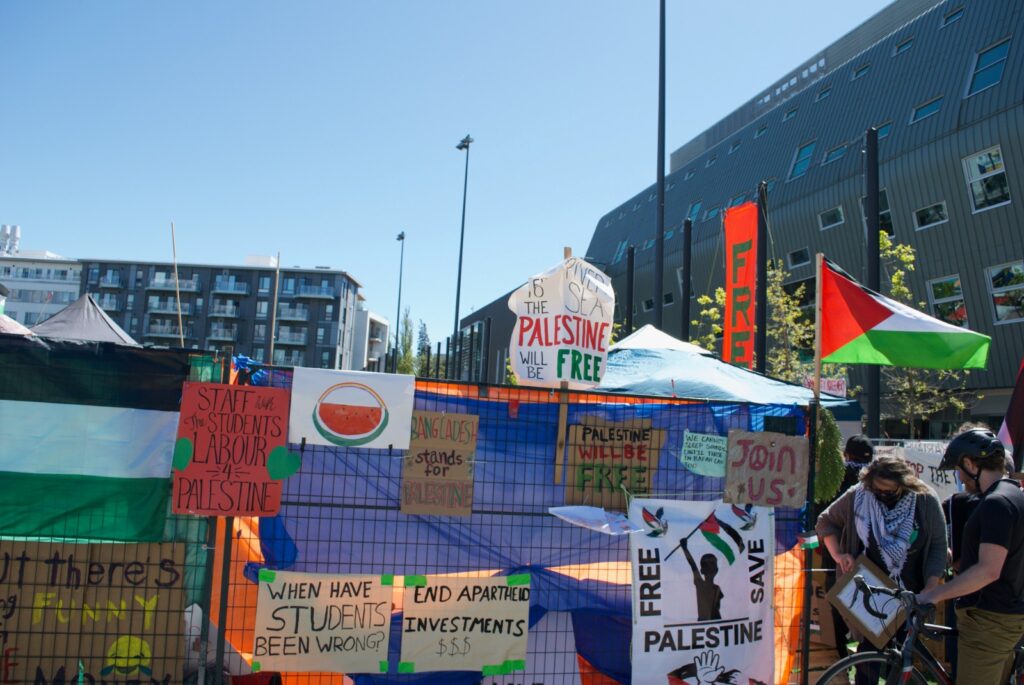
 Joseph Bouchard, personal photo
The leadership of the “Student Intifada,” the National Students for Justice in Palestine (NSJP), has escalated its war against normalcy and decency in academia. Its incrementalist approach to taking over every campus (as it has haughtily claimed is inevitable) began with targeting students, moved on to targeting faculty, and has now put university presidents and trustees in its cross hairs. The following cases represent only a subset of their recent activities.
Cornell University President Targeted
The post-October 7 attacks against Jewish students are well-known and widely-documented. So too are efforts to isolate and stigmatize Jewish and Zionist faculty members. Only recently, however, has the focus on university presidents become apparent.
For many observers, it began in April 2026, when Cornell University President Michael Kotlikoff found himself the target of his anti-Israel student body after he refused to play along with their antics following a debate at the Cornell Political Union.
Video footage shows the president walking to his car, badgered by students making demands and treating him like their employee instead of the president of an Ivy League school. Eventually they surround his car and try to block his egress by standing in his path. As he slowly backs up, one student shouts that the president ran over his foot.
President Kotlikoff rightly called it “harassment and intimidation.”
University of Michigan President Targeted
We are just now learning that in the Spring 2024 semester, the University of Michigan’s Student Intifada targeted university officials, including the university’s president, Santa Ono, as well as its provost, members of the board of regents and their places of business, and the Jewish Federation of Metropolitan Detroit.
On June 10, 2026, the Department of Justice unsealed indictments of eight of the student leaders. According to the FBI agent in charge of the Detroit Field Office, Jennifer Runyan, “hooded defendants allegedly threw noxious chemicals through the windows of families’ homes and taped demand letters to their front doors.”
More alarmingly, they also “caulked doors shut, bike-locked entryways, broke windows, and threw glass jars filled with butyric acid and dye into the homes.”
Trustees Targeted
NSJP’s newly-published Marxist-Islamist “position paper” describes universities as “parasitic fronts for a ruling class dedicated to the preservation of a racial-capitalist system built on land theft, class warfare and, globally, imperial domination.” And since “universities function as rentiers or landlords, in combination with the direct presence of the ruling class in the form of the Board of Trustees,” the most effective targets are at the top of the hierarchy.
Indeed, point number seven in the manifesto of hatred’s seven-point plan emphasizes the need “to unseat our Boards of Trustees as the dictators of our universities.”

Perhaps the NSJP leaders believe that the trustees are the most vulnerable targets. Perhaps they even believe their rhetoric that trustees are “the dictators of our universities.”
Board of Butchers Campaign
In October 2025, to commemorate the second anniversary of the October 7th attacks, NSJP launched an Instagram campaign that began calling the boards of trustees the “Boards of Butchers.”
Obedient campus SJP chapters took the NSJP template, added distinguishing details about locations and events, and then posted them on their own Instagram accounts.
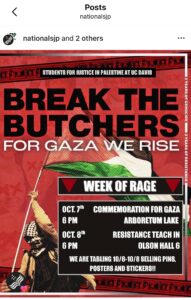

When NSJP went after the trustees at George Washington University, it identified individual board members as enemies.

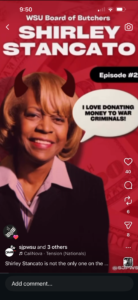
In January 2026, NSJP portrayed Shirley Stancato, a member of the board of governors at Wayne State University, as a devil.
Trustees tend to be wealthy, sometimes high-profile, business leaders. They donate their time, and often large sums of money, to colleges and universities. They offer their guidance and expertise in planning for the future. To be targeted by the end-users of their largesse must be particularly aggravating. Who would blame any trustees that decided to devote their resources and talent elsewhere—somewhere they would be appreciated?
What will happen to American academia when the Student Intifada drives away the philanthropists who support it?
Conclusion
With every new Instagram post, campus event, statement, and now “position paper,” SJP identifies itself as toxic and violent.
To paraphrase Martin Niemoller: First, the Student Intifada came for Jewish students, and no one spoke out. Then they came for faculty members who wouldn’t go along with their childish demands and their “genocide” and “apartheid’ hyperbole,” and again no one spoke out. Now that they’re coming for university presidents and trustees, maybe someone will finally speak out—someone with the power to do something about it.
A.J. Caschetta is chief political correspondent at the Investigative Project on Terrorism, Milstein writing fellow at the Middle East Forum, and principal lecturer at the Rochester Institute of Technology.
Author
A.J. Caschetta
