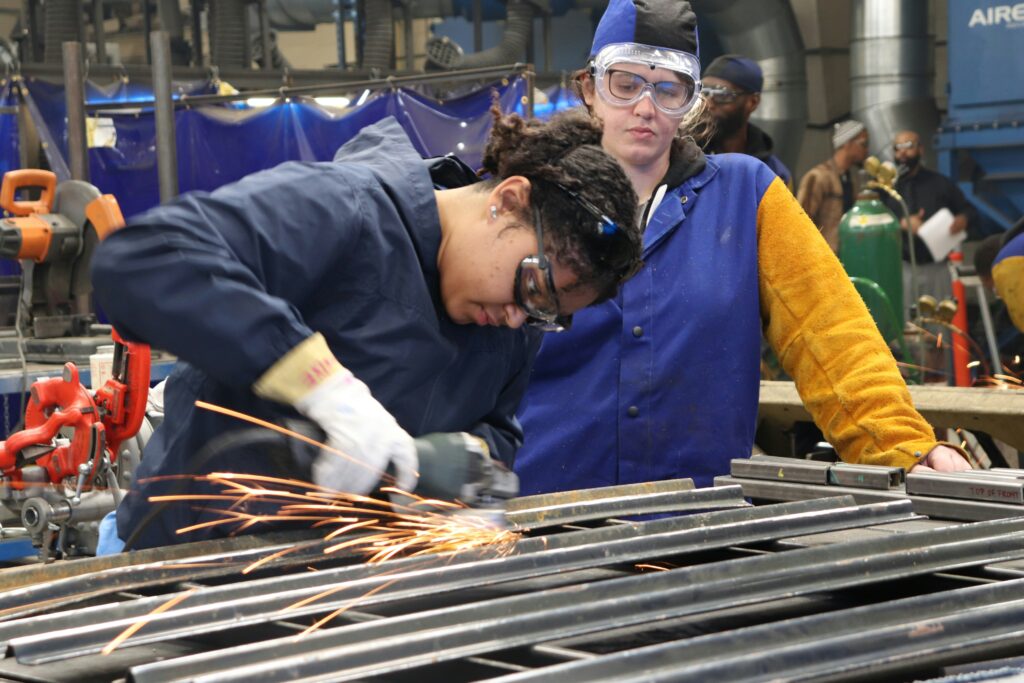
 PTTI EDU, Unsplash
 Community colleges play a specific role not only within our educational ecosystem, but also that of the communities that they serve. They are community colleges, after all.
Before the community college model was established in the late 1940s, America had “junior colleges.” Modeled after higher education institutions in Germany, junior colleges were designed as filters to ensure that only the most academically prepared students advanced to four-year institutions. The modern concept of the community college repositioned these institutions around the needs of the area where they are located.
Today’s community colleges provide advanced training tailored to the needs of local industries and, somewhat like junior colleges, serve as a bridge to higher education for first-generation and low-income students.
Community colleges, like public vocational centers, provide technical training needed in their communities. The distinction between them is often overlooked by policymakers whose goals are to fill specific statewide labor gaps and make higher education more accessible. Public vocational centers provide technical training in fields like auto mechanics, welding, and heavy equipment operation to high school students during the day and to adult learners on evenings and weekends.
In the Mid-Ohio Valley, where I grew up, many of my high school peers elected to spend part of their days at the Washington County Career Center. These students graduated high school with a technical certificate, which qualified them to enter the workforce directly. All that is well and good.
However, emerging programs such as Michigan Reconnect, a fully-funded degree completion program for adults, risk diverting scarce resources toward programs and students who are least likely to advance these core goals of community colleges.
Michigan Reconnect commits tax-payer dollars to pay the full tuition for students over 25 years old going back to school for an associates degree. Several other states are considering similar programs. They have the purported goal of equipping citizens for better paying jobs and closing gaps in demand for skilled workers. But all these programs have high rates of part-time enrollment and low rates of graduation.
This is unsurprising since only 20% of students enrolling exclusively part-time complete their degree or certification. In Michigan, for example, enrollment at community colleges has increased by 38%, yet the number of students who have earned a credential through programs like Michigan Reconnect remains modest.
In fact, only about 8.2% of students who enrolled through this program have completed a degree or certificate. This completion rate is well below the thresholds used for institutional eligibility for federal student aid, which require a completion rate above 30% for three consecutive years to avoid sanctions. If Michigan Reconnect was a federally-funded program instead of a state-funded initiative, participating community colleges would almost immediately lose funding.
If Michigan Reconnect was a federally-funded program instead of a state-funded initiative, participating community colleges would almost immediately lose funding.As I noted above, community colleges are meant to serve the needs of their communities in two ways: training workers for local industries, and providing a bridge to students who lack resources to pursue four year degrees and beyond. Community colleges are shaped by the specific needs of the community, and in return, those that benefit serve the community through increased specialization in local industry, earning higher wages, and providing services.
Programs like Michigan Connect subject community colleges to mission drift as the student body and its needs change. Government intervention like this comes without the local knowledge that can make a community college an important part of a community because it imposes a one-size-fits-all solution not fit for the problem.
In the shadow of such a grand and visible program like Michigan Connect, participation and completion rates at Michigan public vocational schools, called Career and Technical (CTE) programs in the state, have reached record levels. Despite the success of these programs and Governor Whitmer’s recommendation to expand funding, the state House did not approve full CTE funding for fiscal year 2026, while the Senate approved only 40% of the proposed budget. The State Board of Education urged legislators to increase funding to establish new career centers for school districts located in “CTE deserts” so that more students could participate in state-approved training.
These high-demand programs often operate on a shoestring budget. The cost of purchasing and updating equipment is a significant expense for these schools. The funds that they receive from local, state, and federal sources are not always sufficient to cover even basic operating expenses. Geographic, transportation, and funding barriers also limit access to this type of training. These types of schools already achieve the stated goals of Michigan Connect more effectively and efficiently than the community colleges eligible for Michigan Connect funds. Allocation of resources to vocational school updating and expansion seems to be better for all citizens. Community colleges also serve as an educational bridge for many students to four-year universities.
Vocational schools that rely on public funding and student enrollment could face financial challenges such as cuts or closures if state programs such as Michigan Reconnect shift resources toward community colleges.Vocational schools that rely on public funding and student enrollment could face financial challenges such as cuts or closures if state programs such as Michigan Reconnect shift resources toward community colleges. As community colleges continue to expand, so do their program offerings, and therefore, rising educational expectations for many technical occupations. For example, certificates in respiratory therapy, automotive technology, and welding were once enough to enter into these fields. Now, employers favor or expect these applicants to hold specialized associates degrees.
Simply offering free tuition to all-comers does not necessarily assist the students who need the most help, nor does it necessarily serve the needs of the community. In fact, according to the data we have so far, it seems to be a waste of resources. State legislators serious about serving citizens and communities through community colleges and community-based education should invest in programs that equip these institutions to do what they do best. Programs like Michigan Connect press community colleges into drifting away from their core mission.
Morgan Miller is donor relations director at the Ayaan Hirsi Ali Foundation.
Author
Morgan Miller