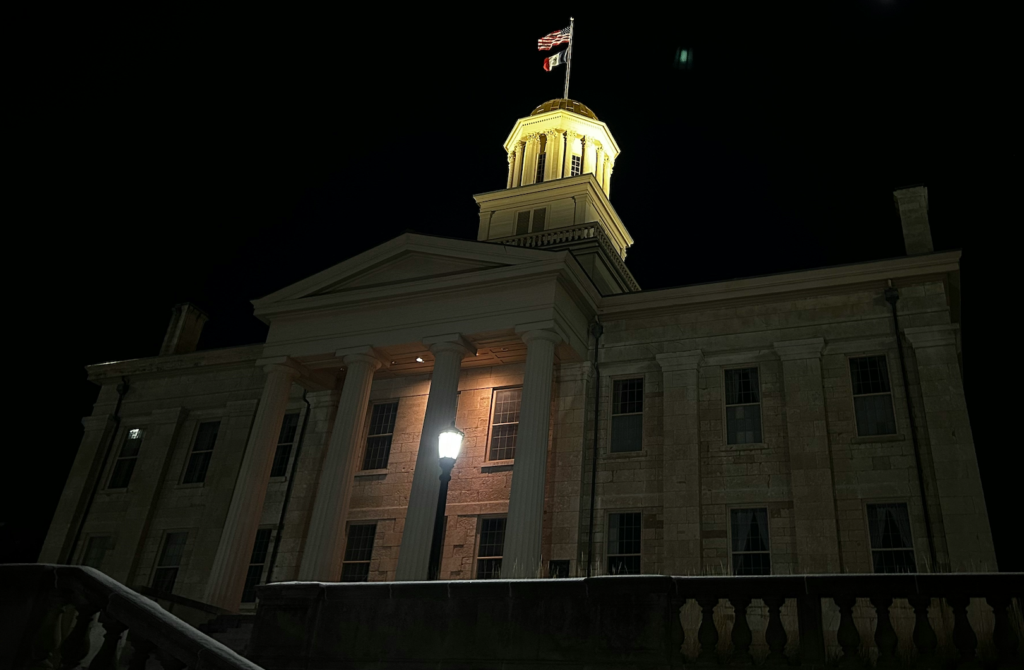
 Stephen Ogunnubi, Unsplash
 Editor’s Note: The author’s opinions are his own, and do not reflect those of any public entity or agency.
In just a few weeks time, college students and their parents will descend upon Iowa City, IA, eagerly awaiting a new semester of learning on a safe campus.
But recent reports suggest that the University of Iowa may be failing them on both counts. As a correctional officer for the state of Iowa, I have seen firsthand the impact that crime can have on every member of our state. The University of Iowa is not doing enough to protect their students from this impact, nor are they solely focused on campus safety.
Over the summer, the University released their annual campus safety report, outlining the number of crimes reported to university police from 2022-2025.
During the years 2022-2025, the University of Iowa received 14 reports alleging rape, 55 reports alleging unwanted fondling, and over 64 reports of aggravated assault. While these numbers may seem relatively insignificant given the number of students on campus, the University has also been plagued by several high profile crimes that directly imperil student well-being.
Earlier this year, a mass shooting at the Pedestrian Mall near campus seriously injured five people, including three University of Iowa students. Just a month later, an Iowa student was formally charged for the rape of a woman in his dorm room. It’s safe to say that the University of Iowa has a bit of a crime problem.
It’s safe to say that the University of Iowa has a bit of a crime problem.Amidst all this bad news, the Board of Regents announced that they would begin reviewing their general education curriculum for any diversity, equity, or inclusion (DEI) content. This follows on the heels of a failed legislative effort earlier this year to ban DEI content in state higher education.
These topics may seem unconnected on their face, but for University of Iowa students on campus, they could not be more linked. Students are made to endure hours of critical theory—as university officials find ways around the state’s rules—and in the evening face the threat of sexual assault, aggravated assault, or even a mass shooting on a campus and in a city they trust is safe. While not every incident is entirely the fault of university officials, it is clear that, at minimum, their attention is split between the two.
In all fairness, the University of Iowa has rolled out a few new public safety initiatives. For example, late last year, they moved their “Nite Ride” late bus service to a fixed stop service, hoping to make the service faster and reliable. However, while the number of riders has increased, students still report 30 to 60 minute wait times between buses. The University has also partnered with Flock, installing 26 of its license plate readers across campus to create a digital perimeter of sorts. But Flock cameras are not without controversy, leading organizations like the ACLU to lead community efforts to ban them.
But these initiatives have made seemingly little headway into fixing the crime problem on campus. The University of Iowa averages 15,000 calls for service every year. WIth a population of roughly 6,500 students, that average far outpaces a much larger city such as Coralville, which averages about 33,000 calls for service each year despite having four times the population. Headlines like the viral hazing video captured on police bodycam in 2024 do not help the general feeling that the campus is unsafe.
They say you can tell what someone values based on what they spend their time, money, and energy on. The University of Iowa—whose budget grew by $22 million annually as a result of a tuition hike—seems intent on spending money on controversial topics rather than investing in public safety. Skirting rules by (allegedly) including DEI language in job postings only cements the perception that the University clearly has their priorities elsewhere, even as crime continues to plague campus.
High profile misses, such as the murder of a woman by a University student known to campus police for previous serious allegations, do little to assuage fears and prove officials are serious about protecting their student body.
There are actions that the University can and should take to better protect their student body. More cameras, improved lighting, and the hiring of more campus security personnel are just a few ways a university with a greatly increased budget could begin to solve their crime problem. One thing is for certain—university employees spending their time trying to skirt state DEI laws is not one of them.
A “diverse” workforce will not eliminate a single instance of sexual assault or aggravated assault on campus.DEI will not keep students safe on campus. A “diverse” workforce will not eliminate a single instance of sexual assault or aggravated assault on campus. The Board of Regents would do well to remember that as they decide where to spend their time and their money. Students from all over the country come to the University of Iowa to participate in the state’s flagship marketplace of ideas. But they can only do so when they feel physically secure. The University has a ways to go to ensure that safety.
Adam Burnett is a corrections officer in Iowa. He was previously a communications manager for the Texas Public Policy Foundation and the Pacific Legal Foundation.
Author
Adam Burnett