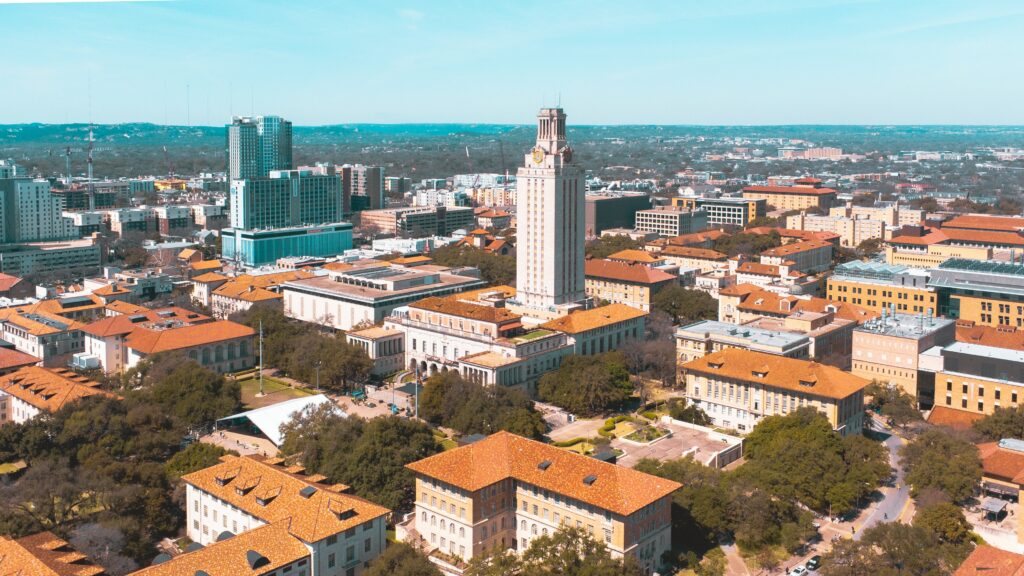
 Chirag Tripathi, Unsplash
 For decades, the American university has been drifting away from its most important purpose: giving students a common education in the knowledge and principles they need to become educated citizens. The core curriculum was supposed to provide that common ground. Instead, it became a collection of distribution requirements—a little History here, a little PoliSci there, a Science course somewhere else—with students free to assemble a curriculum that can have little coherence.
That’s why UT-Austin’s decision to rethink its Core Curriculum deserves attention. UT is trying to bring back something that has been largely missing from higher education for a long time: a sense that some things really are worth knowing.
The old Core had grown into hundreds of courses of widely varying quality and purpose. A student could satisfy the state’s American-history requirement without necessarily studying the American Revolution, the Constitution, the Civil War, or other events that every educated American should recognize as central to our nation’s story.
UT deserves credit for recognizing the problem. Its new framework is organized around three broad areas—Arts and Humanities, Social Sciences, and STEM—but the more important change is what the university proposes to put inside those categories. Students will encounter courses on the “Great Questions of Human Life,” rather than being confined to narrow academic specialties. They will study Masterworks of Literature, whether British, American, or World, and encounter major works of poetry, prose, and drama across different periods. Western Civilization courses will address subjects such as the Renaissance, Reformation, Enlightenment, the rise of modern science and industry, and the emergence of liberal democratic nation-states.
American history will also be treated as a story rather than a collection of isolated episodes.American history will also be treated as a story rather than a collection of isolated episodes. Students may take a broad survey of the American experience or a thematic course that covers a major subject across substantial stretches of the nation’s history. Either approach is preferable to the narrow specialization that can leave students knowing quite a lot about one small corner of American history while missing the larger story. The social-science requirements point in the same direction. “Principles of American Politics” will ask students to think about constitutionalism, liberty and equality, individual rights, federalism, and the principles underlying the American political order. World Politics and Cultures will put those questions into a wider context, while Foundations of Social Science will introduce students to the methods used to study human behavior and institutions.
Even the STEM requirements reflect a welcome effort to move beyond vocational training. “Great Ideas in Science and Computer Science and AI” is intended to introduce students not simply to today’s technologies but to the larger questions raised by scientific discovery and technological change—including their limits and their consequences.
All of this good news invites comparison with the General Education Act (GEA), the model legislation advanced in 2023 by Stanley Kurtz, Jenna Robinson, and David Randall under the auspices of the Ethics and Public Policy Center, the James G. Martin Center, and the National Association of Scholars, respectively. The GEA would establish an independent School of General Education at a selected public university and charge it with teaching a fixed, 42-hour core of thirteen courses. GEA’s proposed curriculum includes Western history and humanities, Great Books, American history and government, American literature, world civilizations, rhetoric, mathematics, laboratory science, and economics.
The GEA is more ambitious than UT’s plan in one important respect: it seeks to change the institutional structure as well as the curriculum.The GEA is more ambitious than UT’s plan in one important respect: it seeks to change the institutional structure as well as the curriculum. The proposed school would have its own faculty and authority over general education. Its purpose would be to protect the core from the pressures that, over time, have weakened general education elsewhere—the proliferation of specialties, departmental interests, and academic fashions.
In contrast, UT has not created a separate school with sole responsibility for general education. The new courses can still be proposed and taught by faculty throughout the university. The curriculum is organized around broad areas and criteria rather than a fixed list of thirteen courses.
To be sure, none of these differences makes UT’s reform unimportant or unwelcome. But I think that they do matter. Why? A good curriculum can be weakened over time even when everyone involved initially has good intentions. Administrators change; faculty turn over; and political and intellectual fashions change. What began as a serious effort to establish a common curriculum can, a decade later, become another box-checking exercise.
That is the GEA’s strongest insight. Curriculum reform needs institutional protection if it is going to last.
For now, UT will rely on its administration and faculty to maintain the standards it has established. That’s a significant improvement over the status quo. The university is also responding to Texas Senate Bill 37 (2025), which calls for greater attention to foundational knowledge, civic relevance, and breadth in general education. UT should not stop here. The university has taken an important step. It should now think seriously about how to make that step long-lasting.
There is also a larger point here. A genuine liberal education is not politically or civically indifferent. Education has always been connected to the kind of polity a society hopes to preserve. The American Founders understood this. Jefferson believed that citizens needed to know history, political philosophy, and the classics. Washington wanted education to cultivate character as well as intellect. Lincoln repeatedly called on his countrymen to return to the moral principles of the Declaration if they hoped to preserve the American experiment.
None of this means that a university should tell students what political opinions to hold.None of this means that a university should tell students what political opinions to hold. Quite the opposite—students cannot learn to deliberate intelligently about public questions if they have never encountered the ideas, historical events, and Great Books that shaped those questions in the first place. UT’s new curriculum recognizes something that has become unfashionable in higher education: students are not simply consumers choosing among courses. A 19-year-old shouldn’t have to invent his own education from a catalog of 10,000 courses.
And no, that doesn’t mean every tradition or every civilization must be treated as interchangeable with every other (because they aren’t). And it doesn’t mean that every intellectual question has an equally good answer (they don’t). A university should expose students to serious disagreement while also giving them the intellectual equipment to judge competing claims. That’s a far different mission from making sure everyone feels “represented” in the course catalog.
Critics can be counted on to complain that UT’s new Core reduces “student choice.” Perhaps it does—and it’s about time. More choice is not necessarily more education.
Imagine a restaurant that offers a thousand dishes, but no menu designed to constitute a meal. The customer may have plenty of freedom, but the result is not necessarily a good dinner. The same is true of a university curriculum. A thousand courses do not add up to a liberal education simply because students are free to choose among them.
The more important question is: What should every educated student know? UT’s new Core at least takes that question seriously. That alone marks a significant change in direction.
The more important question is: What should every educated student know?As with all pioneering projects, the real test will come later. The new framework is scheduled for phased implementation, beginning in 2027. UT will have to decide which courses actually meet its standards, resist the temptation to let every department turn the Core into a vehicle for its own specialty, and make sure that “breadth” means more than simply attaching new labels to old courses.
As a former university professor and administrator, I know that, in the end, a curriculum is only as good as the people who teach it. Institutional structure matters, which is why the GEA’s proposed safeguards deserve consideration. But faculty judgment matters, too. A perfectly designed curriculum can be undermined by mediocre teaching, just as a good curriculum can be brought to life by teachers who understand why it matters.
UT has made a promising beginning. It has begun to recover history, literature, political thought, science, and the enduring human questions that make education more than mere job preparation.
The GEA points toward an even more ambitious reform—one that would give general education its own institutional home and greater protection from the pressures that have weakened it elsewhere.
UT need not copy the GEA wholesale. But it would do well to learn from what I deem to be its central lesson: if we want a common education to survive, we have to build institutions capable of preserving it.
For a university that has spent decades expanding the meaning of general education, rediscovering the idea that there are some things every student ought to know is a welcome change.
Here’s hoping that other universities go and do likewise.
Thomas K. Lindsay, Ph.D., is a senior fellow and the higher-education policy director for Next Generation Texas at the Texas Public Policy Foundation.
Author
Thomas K. Lindsay