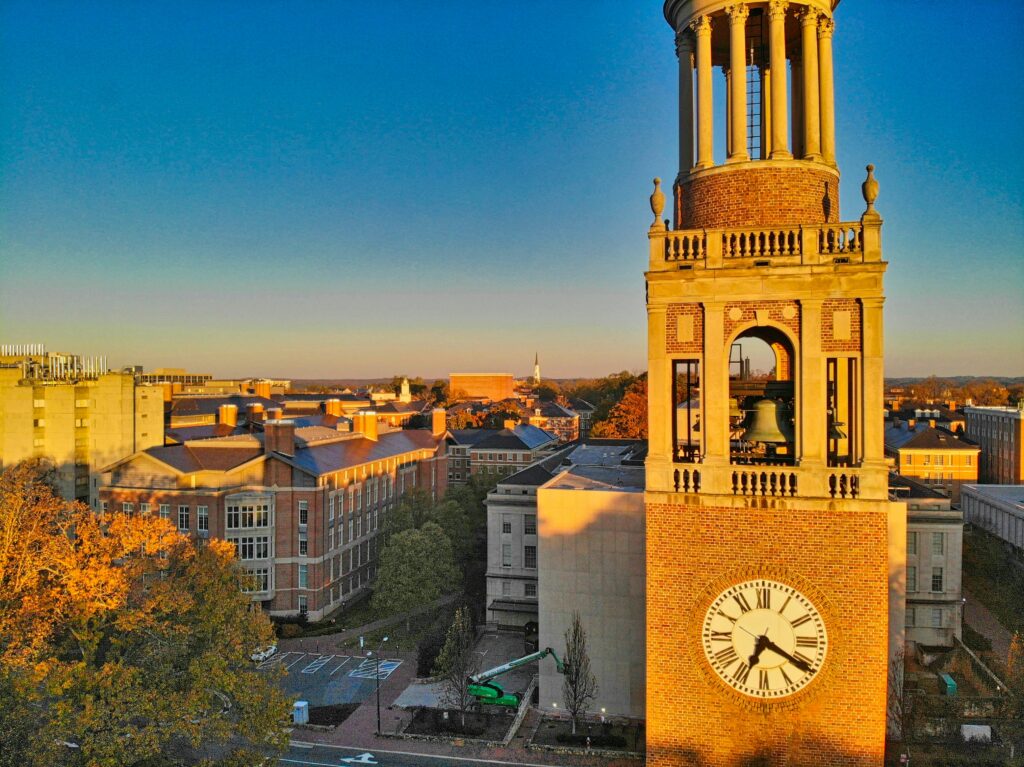
 Gene Gallin, Unsplash
 It is today widely acknowledged that face-reading—the belief that you can work out the character of a person from the look of their face—is impossible. But what about institutions? Can you read the character, the values, of a university from the face it projects to the world—from its campus?
It is interesting to consider this question when looking at the University of North Carolina at Chapel Hill. Its vast campus, its “face,” is uniquely old, but has undeniably aged with beauty and grace—an impression that is offset only slightly by some jarring modern piercings.
Old East remains the oldest state-university building in the country: its doors opened during George Washington’s second presidency, in 1795. Despite repeated expansion and renovation, it retains the Georgian flavor that signals its age. South Building, begun just a few years later and finished in 1814, similarly retains an elegant demeanor despite constant refurbishment. Old West (finished 1823 and expanded in 1844) is also worth mentioning.
Nothing that is made by human hands, least of all a building, can last without conscious preservation.Nothing that is made by human hands, least of all a building, can last without conscious preservation. Times change, generations come and go, but the desire to preserve must remain constant for anything to survive. This desire is harbored in culture, in the values of people and the institutions they make up. This might seem trivial, but a consideration of history shows that it is not.
In the interwar years, born from the revolutionary swirls of the time, a new movement in architecture emerged in Europe. This would grow into what we now call architectural “Modernism”: a movement that decreed the irrelevance of history, the obsoleteness of the old, and the barbarous nature of tradition. It inaugurated a blank slate: something wholly new was needed for our “modern times.” It would come not just with new ideas, but also with sledgehammers.
The European ideas began proliferating in America from the 1930s onwards, at first appropriating, but eventually displacing, a native “modernist” tradition associated with the Empire State Building and Frank Lloyd Wright. A portent of the times to come was the construction of a new, impeccably Modernist campus for the Illinois Institute of Technology, overseen by the Modernist prophet Mies van der Rohe, which began in earnest in the early 1940s: the “factory-aesthetic” was coming for higher learning.
After the Second World War, Modernism went from ascendant to hegemonic in the world of architecture. This might be read also on the face of UNC Chapel Hill. Even this self-consciously old campus, dotted with Georgian and Neoclassical works, sporting venerable names (“Old this,” “Old that,” …), eventually jumped on the fashionable bandwagon; it “got with the times.”
This brings us to one of those “jarring piercings” that I mentioned earlier. For although Modernist dogma is visible in many post-war additions to the UNC campus, none disturb the eye like that building known as Morehead Labs, an icy-cold Brutalist dungeon more at home in a Soviet steel mill than a center of learning.
Thankfully, Morehead Labs is, on the whole, the exception. Unlike in Europe, where large swathes of urban fabric were razed to build something “modern,” these Modernist creations dot UNC like annoying pimples supplementing (in a negative way) the venerable beauty of the main features. With its rich buildings and exquisite (and award-winning!) landscaping, UNC has made it through peak Modernism in amazing condition.
This, I think, brings us back to values. In much of the Western world, what we might call a neomania, walking hand-in-hand with a condescension for The Old, has long been in control of the commanding heights of most institutions. This same general disposition, which razed cities in Europe, also led universities in America to venture down novel, and ultimately unsustainable, paths, with deep roots and time-tested tradition gleefully severed in the name of progress.
This self-consciously and triumphantly old face…belongs to one of the healthiest, most stable universities in the United States.But not so at UNC, at least not enough to remake its campus face—perhaps the clearest expression of the values nurtured within. Many might disagree, but it does not, then, seem a coincidence to me that this self-consciously and triumphantly old face, this campus, belongs to one of the healthiest, most stable universities in the United States.
Simply put, campuses across the United States—if not the world—could learn a thing or two from UNC.
Simen Høseggen is a journalist and writer from Norway, as well as a master’s student in history at the University of Oslo. He specializes in traditionalism, architecture, and the history of ideas.
Author
Simen Høseggen