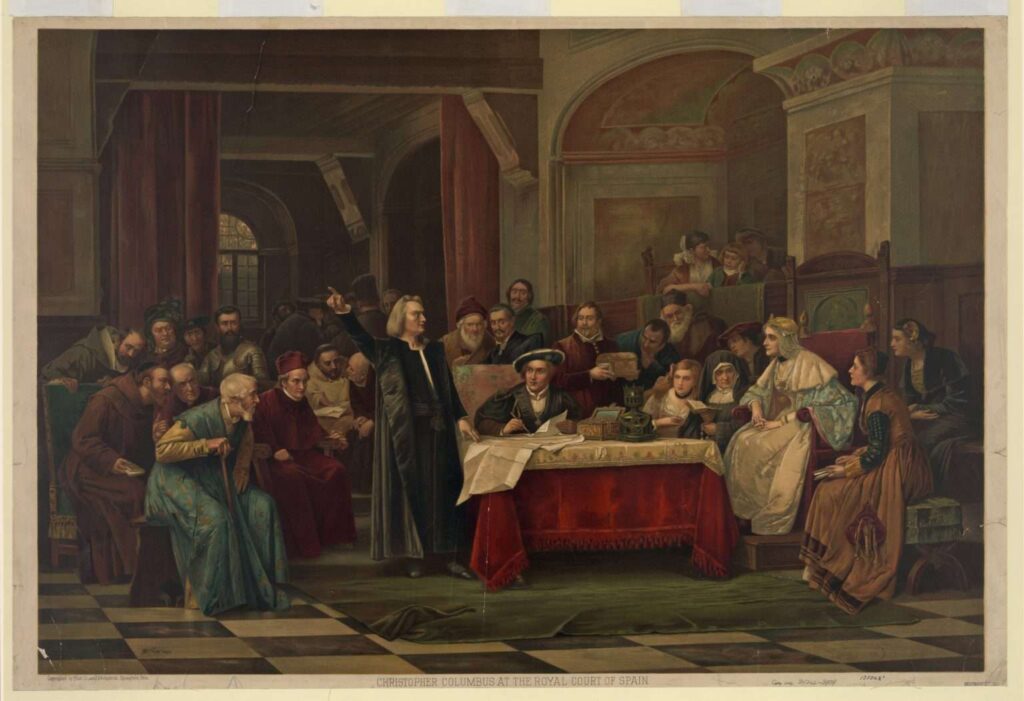
 Christopher Columbus at the Royal Court of Spain, Wikimedia Commons
Great nations have always told their children great stories. From Homer and Virgil to the Bible, inherited narratives teach courage, duty, sacrifice, faith, and belonging. But this inheritance is predicated on an understanding of the world rooted in truth. History, in particular, must educate with facts—not reduce America and the West to caricatures of corruption and oppression. When subverted by corrosive indoctrination, history education becomes a tool of civilizational suicide.
That, unfortunately, is what we often now see in our universities.
Let’s begin with Harvard, where historical study has given way to activist indoctrination. The Harvard Guide to American History (1954) was an excellent work of traditional scholarship. It was broad, learned, and serious about evidence. It treated American history as a complex field. Students had to understand political institutions, diplomacy, economics, religion, war, biography, ideas, and social change.
Harvard course offerings over the past decade show how far the center has moved. Rather than survey American history in its institutional and civilizational breadth, many courses adopt axiomatic anti-Western assumptions as their governing framework.
One example is the recent course Harvard and Native Lands, cross-listed by the English and History departments. Its description declares that “Harvard’s endowment included Native lands expropriated through war, theft, and coercion” and presents the course as an inquiry into “Indigenous dispossession and resistance.” That framing is not academic but accusatory: before students have weighed evidence or historical context, the institution is condemned through the vocabulary of criminal appropriation and colonial oppression.
Before students have weighed evidence or historical context, the institution is condemned…The blanket “stolen land” narrative is historically misleading, indicative of activist polemics rather than scholarly scrutiny. Conquest, migration, intertribal warfare, negotiated transfers, and shifting territorial control were common throughout human history, including precolonial North America. The concepts of “native” and “indigenous” are historically relative: the peoples living in North America before European arrival descended from populations that had migrated from Asia. Every human population ultimately came from elsewhere, with different peoples establishing communities in particular regions at different times.
Relations between American Indian nations and European Americans also included multiple instances of goodwill and cooperation. During the Lewis and Clark expedition, for example, the Corps of Discovery pursued diplomacy and trade with numerous nations, while tribal communities supplied food, geographic knowledge, guides, horses, and other assistance essential to the journey. On the other hand, peaceful indigenous communities were routinely threatened by brutal and violent neighbors prior to any European presence; evidence also suggests that some indigenous societies practiced cannibalism, and others human sacrifice.
Columbus’ account of his first voyage likewise describes his men exchanging goods in a spirit of friendship and records islanders’ reports that people from neighboring islands raided them and took captives.
The “stolen land” narrative imposes modern legal concepts retroactively on societies that did not share the Western tradition of private property, land use, and sovereignty. It substitutes a predetermined ideological framework for the accurate assessment of all relevant facts—a pattern that extends well beyond this single subject.
The same pattern recurs in course offerings shaped by destructive critical theory in the post-Marxist tradition: “queer theology,” transgender studies, race and identity, intersectionality, and the decolonization of history, literature, religion, museums, and other institutions. Critical theory became the darling of leftist academics in the second half of the 20th century, and its subsets proliferated during the recent explosion of “woke” sensibilities. Its stated aim is to “disrupt” systems of oppression and change the social order. Ideology supplies the verdict; evidence is rearranged to support it.
Professor Howard Zinn gave the prosecutorial view of America its most influential popular text, A People’s History of the United States. Mary Grabar described it as “polemic disguised as history,” marked by selective quotation, distortion, and the subordination of evidence to activism. Rooted in the radical movements and revisionist scholarship of the 1960s and 1970s, the book grew exponentially in influence over the following decades.
Zinn recasts the past as having been nothing but exploitation and resistance: American principles become hypocrisy, achievement becomes domination, reform becomes camouflage, and the West has no redeeming values.
American principles become hypocrisy, achievement becomes domination, reform becomes camouflage, and the West has no redeeming values.Traditional history placed events in sequence and context. Political, military, economic, religious, and cultural developments were studied together. In contrast, today’s specialized studies programs replace a coherent civilizational narrative with identity-defined fields organized around race, sexuality, colonialism, and power.
At Harvard, the fragmentation is institutional as well as curricular: students may pursue Studies of Women, Gender, and Sexuality or secondary fields in Ethnicity, Migration, Rights and Latinx Studies. Recent course offerings include Power to the People: Black Power, Radical Feminism, and Gay Liberation, 1955–1975; Afterlives of Violence: Race, Gender, & Colonialism in LatinX Studies; and Queer Interventions in Latinx Studies. Such courses are intended to stoke feelings of grievance against the U.S.
Other recent Harvard courses, for example, portray museum collections as mere products of “imperial desires” and “the violence of colonialism.” Students rarely, if ever, hear anything positive about the West, such as how Western influence expanded liberty under law and helped bring peace and prosperity to places where natives had never enjoyed either.
Such claims extend far beyond Harvard, saturating educational, cultural, and media institutions. They depict Western civilization as uniquely evil while minimizing or excusing the far graver crimes of other cultures. They would collapse under serious scrutiny, yet they thrive in academia, brainwashing young minds—often at least partly at taxpayers’ expense.
The paradox was visible before the Soviet bloc had even finished collapsing. In an October 25, 1989, New York Times article, “The Mainstreaming of Marxism in U.S. Colleges,” Felicity Barringer observed that, even as Marx’s political heirs in communist countries struggled to remake his discredited legacy, his intellectual heirs on American campuses had moved from the margins into the academic mainstream.
At the very moment Eastern Europe was overthrowing communist shackles, American higher education was normalizing critical theory and Marxist analysis—often recast through culture, race, feminism, and literary studies rather than orthodox economics.
Today, intersectionality supplies much of the academy’s governing vocabulary, sorting people into predetermined categories of privilege and oppression and interpreting institutions through them. As a survivor of communism, I recognize the impulse: the terms are newer, but individuals again become group representatives, all motives become power, and guilt is assigned before evidence can be examined. American and Western history becomes a simplistic struggle between ever-proliferating categories of victims and oppressors.
The same ideological pattern is evident in anti-Israel courses and campus activism that falsely cast the Jewish state in the language of colonialism and oppression while excusing terrorism and antisemitism. Here again, a complex history is reduced to a farce in which, to paraphrase Melanie Phillips, terrorist genocide becomes legitimate “resistance,” while legitimate Israeli resistance becomes “genocide.” The target is not merely Israel or America, but the legitimacy of the Western political and cultural tradition itself.
Students lose more than facts. They lose chronology, comparison, context, respect for primary sources, and the willingness to revise a conclusion when evidence contradicts theory. Ideological courses reward denunciation and substitute slogans for argument.
Ideological courses reward denunciation and substitute slogans for argument.The civic cost is even graver. A free society needs citizens who understand why its institutions deserve loyalty. Students taught that America merely symbolizes oppression will neither defend constitutional liberty nor reliably recognize its enemies. A nation cannot survive when its miseducated elites treat patriotism as ignorance and Western history as a catalogue of crimes.
Restoration must begin with reviving the classical liberal arts, American civics, and our Judeo-Christian inheritance. These traditions train students to read closely, reason from evidence, distinguish argument from assertion, and confront permanent human questions.
History should teach that the West’s failures were not uniquely Western. Slavery, conquest, religious persecution, and unequal rights afflicted other civilizations in much harsher and longer-lasting forms. What distinguishes the West is not freedom from such evils but the development of principles and institutions capable of exposing, condemning, and overcoming them: individual liberty, equality before the law, freedom of conscience, representative government, scientific inquiry, and peaceful reform.
Honest comparison must also confront the alternatives. Socialist theory and practice produce famine, collectivization, terror, censorship, and one-party rule, while Islamic movements and states impose religious coercion, suppress dissent, subordinate women, persecute minorities, and attack liberal democracy. To catalogue every Western fault while ignoring its achievements and sanitizing rival systems is propaganda by omission and destruction by subversion.
The three hundred Spartans sacrificed their lives for Greece because they had inherited an inspiring civilizational story of courage, duty, and belonging. We cannot expect our children to defend America—the “last best hope of [E]arth”—when, from kindergarten onward, they are taught a story of shame and demoralization rather than truth, gratitude, and enlightened patriotism.
Nora D. Clinton is a Research Scholar & Project Manager at the Legal Insurrection Foundation.
Author
Nora Clinton