
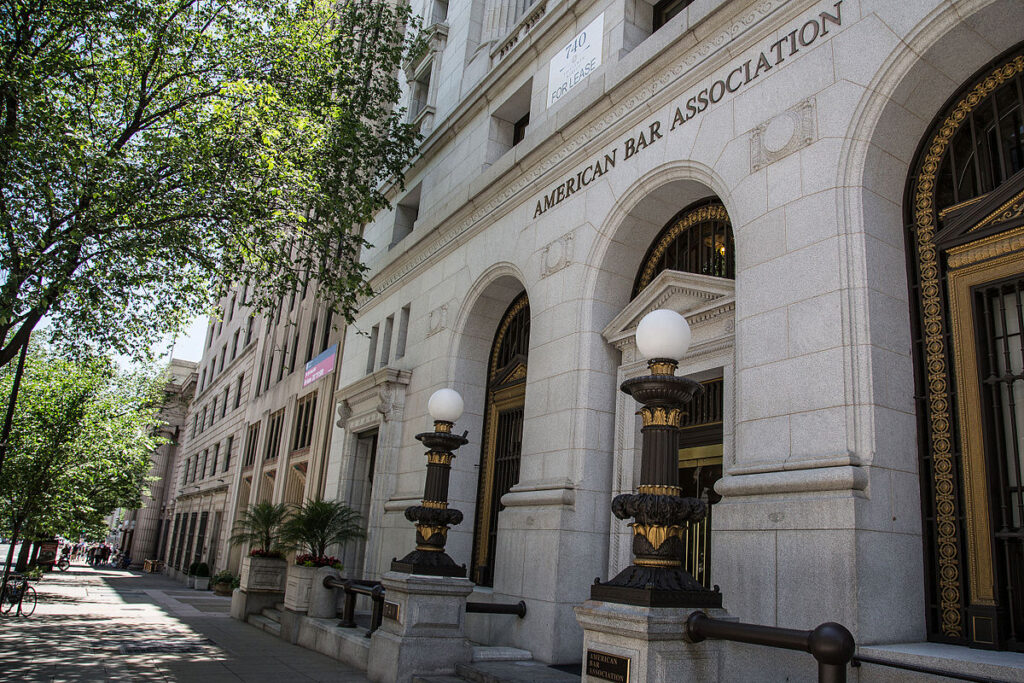
 Tony Webster, Wikimedia Commons
 A number of “sacred cow” beliefs regarding higher education are (finally!) coming under scrutiny. One of them is that it is important for the American Bar Association (ABA) to oversee law schools via its power of accreditation. In all but a few states, any individual who wants to enter the legal profession must graduate from an ABA-accredited law school before being allowed to sit for the state’s bar exam. That restriction has long been defended as a measure to protect consumers, both students (who might otherwise attend an inferior law school) and people in the community (who might take their legal business to an incompetent practitioner).
So, is the ABA just looking out for the good of the people? No—it’s looking out for its own interests, with government doing its dirty work by imposing regulations that needlessly interfere with competition and the market’s search for efficiency. The good news is that the ABA’s position is starting to crumble. Let’s focus on events in Texas.
The ABA is looking out for its own interests, with government doing its dirty work. In April, the Supreme Court of Texas published an order inviting comments on the role that the ABA should play in accrediting law schools in the state. That order no doubt caused consternation in the legal establishment. For the Supreme Court of one of our biggest states to be thinking about changing the status quo with a diminution or elimination of the ABA’s power is a chilling prospect for an organization not used to being challenged.
All ABA approval does is to keep costs high and competition down. Among the comments the Court received was one from Professor Josh Blackman, who teaches at the South Texas College of Law Houston. In his comment, Prof. Blackman argued that the Court should end the ABA’s accreditation power in the state since there is “no demonstrable connection between the ABA’s onerous regulations and promoting high-quality … legal education.” He was countering the response from several law-school deans who put forth the canard that ABA accreditation is an essential component of quality assurance. Blackman argued that all ABA approval does is to keep costs high and competition down.
He’s correct. Accreditation of law schools is no different than accreditation of other educational institutions. The standards imposed by outside bodies do not serve to ensure high quality. Just as students lacking in basic knowledge and skills can graduate from accredited colleges, so too can law students, many of whom fail the bar exam. And because the bar exam provides a benchmark for comparison among schools, every law school has a strong incentive to do the best it can to prepare students to take it. No law school would omit material that will help students pass. The ABA can’t improve upon the incentives that law schools have to do their best with the students who enroll.
In their letter, the nine law-school deans express concern that, in the absence of ABA accreditation, some law schools might have low bar-passage rates. Some already do, but so what? If students try law school and find that, after their three years of coursework and bar-exam preparation, they still are not able to pass the bar exam, that isn’t a matter of concern for the state. People often make poor decisions about the use of their time and money.
The ABA doesn’t want control over legal education for the good of the public. It wants control for its own benefit. Making law school needlessly long and expensive helps to minimize competition among lawyers.
That is why the ABA sought control over legal education and admission to practice starting in the 1920s. Until that time, most lawyers learned their trade by apprenticing in law offices. Law school was not mandatory, and some famous lawyers never set foot in one, such as Abraham Lincoln. Clarence Darrow enrolled at the University of Michigan Law School but decided to leave in his first year, figuring that he would learn what he needed more rapidly by working in a law firm. When he thought he was ready, he took and passed the bar exam.
In those days, law schools had to compete with other forms of legal education, so they didn’t make unnecessary demands on students, often allowing them to graduate after just a year of study. But, as the legal profession saw things, the relative ease of entry was undesirable because it meant too much competition—too many lawyers chasing the limited number of billable hours. So the ABA undertook “reforms” by lobbying states to enact laws stating that only graduates of ABA-approved schools could take the bar exam. To become ABA-approved, a law school had to have a three-year course of study, along with other costly requirements. Law school became a huge barrier to entry into the legal profession.
Law schools once had to compete with other forms of legal education, so they didn’t make unnecessary demands on students. One result of the ABA’s success in this regard is that many Americans are unable to afford the legal help they need. That is a point emphasized by another law professor, Andrew Morriss. In a recent symposium essay, he wrote that Texas “could lead the nation in expanding access to justice by abolishing this archaic, anticompetitive accreditation requirement and allowing competitive forces to drive innovation in the preparation of lawyers.”
ABA accreditation means that law schools are subject to pointless and costly “micromanagement” to suit ideological demands. Morriss points to Britain, where people can enter the legal profession with far less cost in time and money than here.
Another good reason to drop the ABA is that it has gone “woke,” with demands for “diversity” in admissions, hiring, and curriculum. Manhattan Institute legal scholar Ilya Shapiro emphasized that point in this essay. He writes, “Beyond its judicial evaluations, the ABA has used its accreditation monopoly to bend law schools to its ideological will. For example, in February 2022, the ABA instituted a new rule that all law schools must ‘provide education on bias, cross-cultural competency, and racism’ through compulsory ‘orientation sessions, lectures, courses, or other educational experiences’.” All of that merely creates make-work for administrators, faculty members, and outside consultants without doing anything to better prepare students for legal practice.
And as Professor Derek Muller of Notre Dame Law School comments, ABA accreditation means that law schools are subject to pointless and costly “micromanagement” to suit the ideological demands of ABA bigwigs. He suggests a better path: “One promising solution is to empower existing schools to create legal programs outside the ABA’s purview and permit graduates of those programs to pass the bar exam.”
That’s a good idea—let innovation work to find the best alternatives to the hidebound, monopolistic status quo in legal education. Professor Richard Vedder has long argued (for example, in his latest book, Let Colleges Fail, which I reviewed here) that we need the force of creative destruction in higher education, and that’s emphatically true about law schools. It’s time for the ABA’s control to end.
The Supreme Court of Texas should heed the advice of Prof. Blackman and his colleagues who want it to pull the plug on ABA accreditation. In my opinion, it should do that but go further and permit anyone to take the state’s bar exam, no matter where or how he or she might have learned the material. If that requires legislation, then the state legislature should rewrite the law. Yes, let’s “turn the clock back” to the days of Abraham Lincoln and Clarence Darrow, when law school was just one way for people to learn what they need to know if they want to practice law. Everyone will be better off, except for the American Bar Association.
George Leef is director of external relations at the James G. Martin Center for Academic Renewal.
Author
George Leef
