 Matthew Benoit, Adobe Stock Images
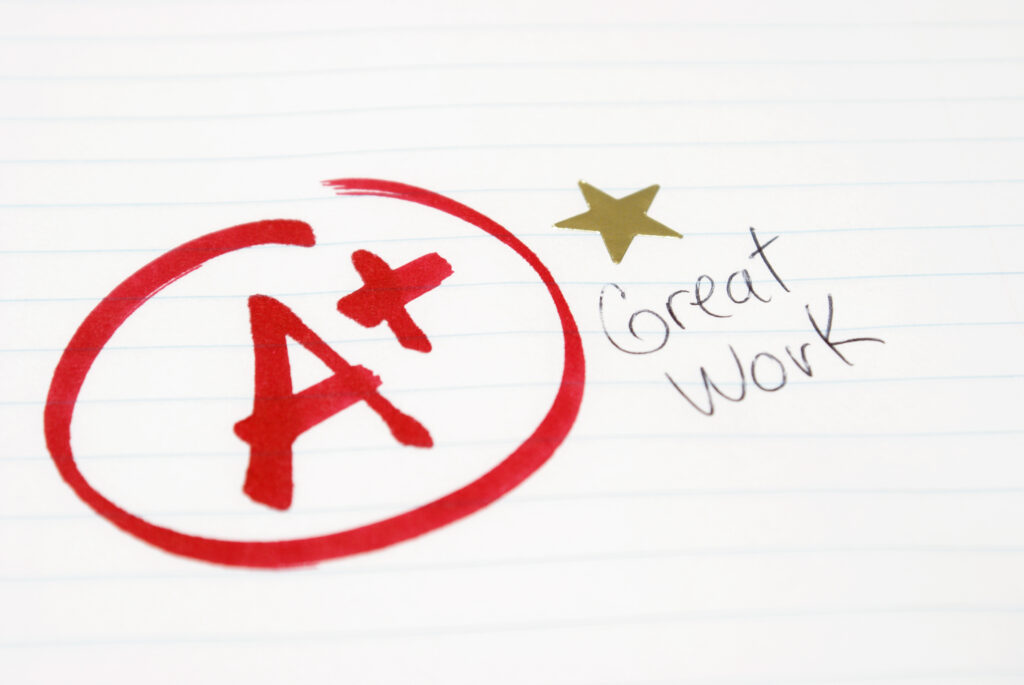
 At many of the country’s most prestigious universities, an “A” has become a default instead of a distinction. It used to be a mark that indicated academic excellence and proficiency, yet lately it seems like almost everyone is “exceptional.” Now, Harvard’s much-remarked-upon grade-inflation report, released late last month, confirms what many have suspected for years: Grades at elite colleges have lost their meaning.
According to the report, in 2005 “A’s” accounted for 24 percent of all grades given at Harvard College. In 2025, that number jumped to over 60 percent. Even the cutoff mark for summa cum laude status has been forced higher, standing at a 3.989 GPA as of this year, lest everyone achieve the honor. If everyone’s exceptional, is anyone really?
Grades used to motivate learning and measure mastery. Now they’re just polite checkmarks for finishing the work at all. Harvard’s own faculty aren’t happy about it. Many believe there is little “resolving power at the top,” which leaves students without an accurate sense of how they’re performing compared to others. Teachers struggle to distinguish between merely “satisfactory” and “outstanding” work, and prize committees find it harder to differentiate between students with identical GPAs. Grades used to motivate learning and measure mastery. Now they’re just polite checkmarks for finishing the work at all.
Faculty who want to return to proper grading standards worry that administrators wouldn’t have their backs. Why have standards changed? According to the report, professors feel pressure to maintain high enrollments and avoid low “Q-scores,” Harvard’s course-evaluation metric. Teaching fellows worry that poor “Q-scores” will limit their job prospects. Students who typically earned “A’s” in high school expect the same leniency at college. Administrators, eager to show compassion for stressed or struggling students, have unintentionally helped erode academic rigor. Faculty who want to return to proper grading standards worry that administrators wouldn’t have their backs. The result, as one faculty member put it, is a “race to the bottom.”
Enrollment is another huge factor that impacts students’ grades. High enrollments help secure teaching positions for graduate students and can even influence the resources given to departments. This motivates instructors to keep undergraduates signing up for their courses. Because students often compare workloads and grading patterns across departments, lenient grading can become a competitive advantage—no professor wants to be the “tough grader” whose classes empty out. To maintain high enrollment numbers, professors award higher grades.
For an institution revered for its academic rigor and prestige, the report represents a remarkable confession. Grade inflation isn’t a new issue, but Harvard’s admitting to it is a new step forward. The college has proposed some modest remedies: allowing a limited number of “A+” grades, recording each course’s median grade on transcripts, and reintroducing seated exams. Other institutions can, and likely will, follow suit.
Ironically, if the median grade for a course is an “A,” this can lead to its own kind of stress. If students sense that earning an “A” is no longer enough to allow them to stand out, then they have to look for other alternatives, such as extracurriculars. Grade inflation also hollows out academic confidence, as students begin to feel as if they’ve earned fake achievements. To get into Harvard is a real achievement, of course, and Harvard students know what that feels like and worked hard to get there. They should support a report that calls for cultural change, a re-centering of academics in campus life, and a recommitment to honest evaluation.
The steps Harvard has taken thus far are sensible, but they reveal a deeper truth: If even Harvard struggles to uphold rigor, what does that mean for the rest of higher education? Grade inflation isn’t occurring in the Ivy League alone. Public and private universities have shifted toward the same leniency, often under similar pressures: student-satisfaction metrics, tuition-driven enrollment competition, and the idea that academic failure harms self-esteem. Grade inflation isn’t just a numbers issue; it’s a symptom of higher education’s slow drift away from its academic mission. Restoring integrity to grading will require universities to value truth and knowledge over comfort and image.
Reagan Allen is the North Carolina reporter for the James G. Martin Center for Academic Renewal.
Author
Reagan Allen