
 Tada Images, Adobe Stock Images
 Conservative politicians have often made their careers in part by fixing higher education. Both Richard Nixon and Ronald Reagan leveraged the campus radicalism of the 1960s to expand their voting coalitions—Nixon in his successful 1968 bid for the presidency and Reagan in his successful 1966 and 1970 campaigns for California governor. Reagan in particular seemed to revel in butting heads with the smart people on campus who were so plainly out of touch with ordinary Americans. “The people of California, who have contributed willingly and happily to educational growth, do have some right to have a voice in the philosophy and principles that will go along with the education they provide,” he asserted over the catcalls of students who had descended on Sacramento in 1967.
Not to be forgotten, Margaret Thatcher abolished tenure in the British higher-education system, replacing it with renewable contracts, and punctured the snobbish pretensions of the professoriate by allowing polytechnics to become universities, delighting her middle-class coalition.
DeSantis has in effect called foul on an assumption that has never had to withstand scrutiny. President Trump has returned to this rich area of electoral potential with his proposed compacts with federally funded universities and colleges. Yet his mandate will end in a few short years, and the eternal project of correcting la trahison des clercs will require a new schoolmaster in 2028. The 2028 presidential election is thus shaping up to be another instance where higher ed could be a dealmaker for aspiring candidates, even on the Democratic side.
The governor clearly views the academic blob as ripe for electoral gain. Florida governor Ron DeSantis clearly views the academic blob as ripe for electoral gain. He is testing the assumption that no amount of vigor in the retaking of the academic fortress will be in political vain. In the struggle for the torch, DeSantis is laying out his credentials by showing vigor in three key areas of higher education, all of them attracting the sort of censure from the faculty lounge that is a godsend around the kitchen table.
His efforts in these areas—DEI indoctrination, university governance, and foreign hiring—are notable because they shatter the idea that conservatives will always play nice and hope their arguments are given a fair hearing by the academy, a notion that DeSantis frequently calls “braindead.” Instead, going beyond the Trump approach of cutting deals like a consigliere, he has put higher education in the state of Florida into receivership until such time as it can be trusted again. That is a form of vigor that many believed had ended with Reagan and Thatcher, which rather bolsters DeSantis’s claim for national leadership.
DeSantis’s policies to ban the teaching of racial inferiority (i.e., the evils of “whiteness”) through the 2022 Stop W.O.K.E. Act have been enjoined by a federal court pending appeal. But it is a winning message for the ordinary American to say that no group should be stigmatized. His recentralization of higher-education governance in Florida, meanwhile, has affirmed an important democratic principle of public control, a delicious message to take to the faculty sans-culottes claiming to “defend democracy.” These reforms complement responses in other states to the creeping authoritarianism of the professoriate.
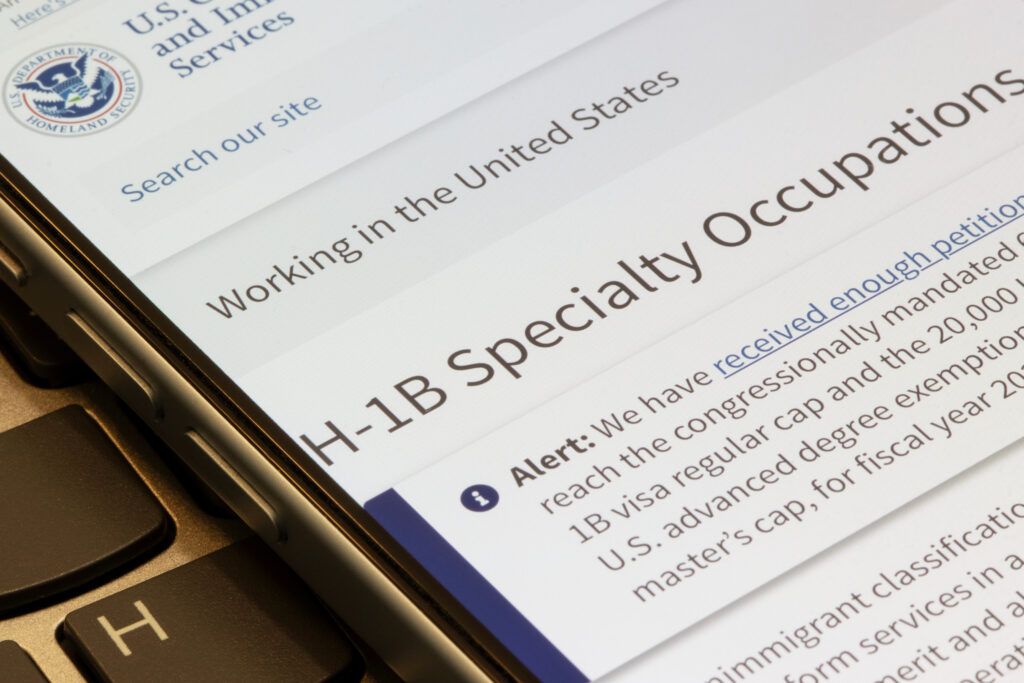
A new proposed ban on foreign-faculty hiring, however, is novel. DeSantis has in effect called foul on an assumption that has never had to withstand scrutiny: that the most powerful country on earth is unable to produce professors and teachers in fields as diverse as social work and biotechnology. This assumption crept into the progressive ethos of universities in the 2000s with all the highbrow arrogance that academics can muster. DeSantis, who has ordered Florida universities to stop hiring faculty using the H-1B visa loophole, is right in seeing widespread abuse in this system.
The numbers speak louder than words. In the 10 years to 2025, American universities (and some K-12 schools) imported an astounding 131,000 foreign scholars and teachers on H-1B visas. The top 10 visa schools accounted for over 14,000, or 11 percent of the total. The College and University Professional Association for Human Resources (CUPA-HR) estimates that three percent of all faculty in U.S. higher education are on H-1B visas, 70 percent in tenure-track positions that are expected to become permanent.
The abuse of this backdoor for not hiring American scholars is well known. The federal government has merely accepted until now that institutions have tried to hire U.S. scholars when it is clear that they have not. Oddly, the CUPA-HR data show that business schools are the most frequent users of H-1B visas, as if the U.S. were a global laggard in matters capitalist. The social sciences also figure in the top-10-users category, surely a joke. The data show that over this same period only 3,000 H-1B visa applications were denied in education—or a mere two percent of all applications.
The abuse of this backdoor for not hiring American scholars is well known. Let me offer two examples. I am Canadian by origin, but, by the time I was on the academic job market in 2006, I was already a U.S. permanent resident by marriage. When I interviewed for a job teaching Chinese politics at St. Lawrence University in upstate New York, my rival was a Canadian of Taiwanese origin who did not speak or read Chinese (I am fluent thanks to a prior career as a journalist in Asia and had also published three university-press books on the subject by then). The department wanted me, but the ultra-woke provost insisted that only a Chinese face could teach Chinese politics. In the event, they failed to secure the H-1B visa for the Taiwanese-Canadian and the search failed. That was, however, an outlier. In the 10 years to 2025, St. Lawrence succeeded in securing H-1Bs for 23 other candidates.
We are worse off importing labor that stymies the formation of domestic human capital. More recently, I spent a year at DeSantis’s higher-ed demonstration project, the New College of Florida. During my time there, a great disruption occurred to science teaching because of the faculty’s decision to hire two biologists from Argentina. Without going into details, suffice it to say that the time and effort required to hire gaucho biologists of the pampas rather than any of the excellent candidates on the market just up the road in Tallahassee or Gainesville made it seem like the Manhattan Project was at stake. In fact, it was pure personalities that made the decision. Florida universities alone graduate over 100 Ph.Ds. in biology and related fields per year, and the institutions are chock-full of domestic postdocs seeking jobs. In any case, New College is a teaching institution where research plays second fiddle to student engagement. Importing faculty in this instance was bizarre. In the 10 years to 2025, New College brought in 24 other scholars on H-1B visas for a faculty that never exceeded 100.
One counterargument goes that many of these H-1Bs go to research scholars, including postdoctoral positions. An astounding 17 percent of non-tenure-track research scholars in the U.S. are on H-1B visas, according to CUPA-HR, and no wonder. They are cheap labor. As they might Mexican gardeners, the universities like them because they come cheap. It has nothing to do with their unique skills. The same academics who complain about being underpaid are contributing to the problem by undercutting themselves with foreign workers.
A second and related argument charges that any restrictions represent a form of intellectual protectionism. But labor is an input not an output. Flooding the economy with cheap labor reduces productivity and wages and stifles technological innovation. Americans may be better off importing shoes, and we should certainly not put tariffs on the consumption of foreign intellectual outputs. But we are worse off importing labor that stymies the formation of domestic human capital.
Moreover, I am not convinced that the values we import with these scholars strengthen the unique foundations of the Western intellectual tradition. As I have written elsewhere, scholars from China continue to toe the party line even from abroad. At the same time, to use the words of one scholar from China at Hamilton College, the “diversity” claims made to justify Chinese scholars’ hiring lead many to believe they have a duty while guests of the American people to “decenter White, middle-class cultural norms.” Scholars from South Asia, meanwhile, typically bring the most extreme anti-Western outlook, the soft totalitarianism of leftist thought that dominates South Asian intellectual life. China and India accounted for 83 percent of all H-1B visa approvals in 2024, although their share in higher education is unreported. These indirect costs of the H-1B program may be the steepest of all.
DeSantis is on to something in calling foul on H-1Bs in higher education. Florida’s state-university governors have promised to take up his appeal in the new year. Reconsideration is long overdue.
Bruce Gilley was recently presidential scholar-in-residence at the New College of Florida and is the author of The Case for Colonialism and other books.
Author
Bruce Gilley
