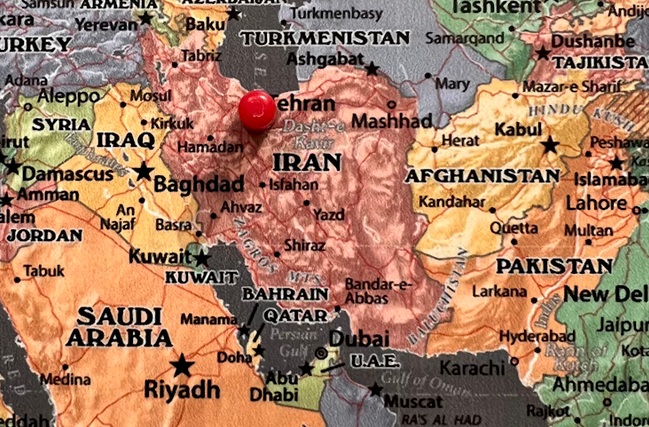
 Mana5280, Unsplash
 On Wednesday, March 18, during the third week of the war with Iran, the New York Post broke a striking higher-education story. According to the report, the children of six Iranian regime leaders are teaching at some of America’s most prestigious universities.
While this may come as a surprise to many Americans, it is only the tip of the iceberg when it comes to foreign meddling in U.S. higher education.
U.S. higher education has developed an overly welcoming openness to foreign tuition dollars. Since the end of World War II, American colleges and universities have been premier global destinations for the best and brightest—and, of course, the wealthiest—foreign students. For the past 80 years, U.S. higher education has developed a longstanding—and at times overly welcoming—openness to foreign tuition dollars.
Struggling to attract domestic students, colleges and universities have turned to foreign applicants in search of new revenue. In the process, many institutions have loosened their admissions and ethical standards, accepting the children and family members of anti-American foreign leaders and corrupt businessmen.
The foreign-student system’s naïve openness no longer aligns with today’s geopolitical reality. With the end of the Cold War, the rise of a multipolar world, and growing competition with China and other nations, it’s time to rethink the foreign-student system. Its naïve openness no longer aligns with today’s geopolitical reality. Yet, beyond the geopolitical concerns, American taxpayers should also ask whether they want to support through their taxes institutions that are in the business of educating America’s strategic competitors.
Educating Foreign Elites
Throughout the 20th century, the United States was the top destination for foreign students. Educating them at American universities was seen as a tool of soft power and diplomacy. Enrollment was relatively limited, and the technological stakes were far lower—universities were not the global research hubs they are today.
During the Cold War, the arms race was accompanied by a competition for talent, which drove an increase in foreign students coming to the United States. Alongside exchange programs with the Soviet Union, the U.S. also pursued broader cultural exchanges with other countries.
These programs operated within a controlled framework, shaped by a clear awareness of the ideological rivalry between East and West and the resulting risks to national security. They were marked by strong government oversight and a clearly defined purpose.
The fall of the Berlin Wall and the collapse of the Soviet Union temporarily removed the ideological barriers between East and West, ushering in a rapid globalization of American higher education. Public intellectuals—most notably Francis Fukuyama—proclaimed the “end of history,” a mindset embraced by American political elites who assumed that former adversaries would integrate into the Western rules-based order and adopt liberal democracy.
American universities became hubs for global talent, operating without meaningful national-security guardrails.
Scope and Structure of the Foreign-Student System
Over the past 25 years, the number of foreign students in the United States has doubled. In the 2024-25 academic year, American universities hosted nearly 1.2 million international students. The majority—more than 600,000—came from countries that are America’s primary strategic competitors for global economic dominance: India and China.
Foreign students typically come to the United States through two visa programs: the F-1 visa for full-time students and the J-1 visa for exchange visitors. Neither program is meaningfully aligned with national-security priorities. The J-1 visa, in particular, has drifted far from its original mission of mutual and cultural exchange and, in many cases, has become little more than a pathway for affluent foreign students to spend a semester in America.
The J-1 visa has become little more than a pathway for affluent foreign students to spend a semester in America. Many foreign students enroll in STEM fields that are critical to national security. They take part in federally funded research projects and grants, often with access to cutting-edge labs and advanced technologies.
Beyond the presence of foreign nationals from adversarial countries in sensitive research environments, American universities have developed a growing dependence on international tuition as a key source of revenue. Foreign students make up 64 percent of enrollment at Northeastern, 58 percent at Columbia, and 44 percent at New York University, to name just a few affected institutions.
Administrative and financial incentives favor near-unrestricted openness over caution and the national-security interest. At the same time, enrolling foreign students has become a marker of prestige, as academic rankings are often tied to global enrollment. It is clear that administrative and financial incentives favor near-unrestricted openness over caution and the national-security interest.
Foreign students were once a marginal phenomenon—an added benefit to American colleges and universities. Today, they have become a structural feature of the system, bringing with them significant national-security and economic risks.
National-Security and Economic Risks
The sheer number of foreign students in the country—and their participation in STEM programs and research critical to national interests—poses a significant national-security and economic risk to the United States.
Since the late 1980s, American universities have played a growing role in the transfer of advanced knowledge and expertise to rival states such as China, India, and Iran. In many cases, foreign students enroll in graduate and research programs with clear dual-use implications—fields where civilian research can also have military applications.
Instead of attracting the best and brightest, American universities are now operating as a reverse talent pipeline, educating students who then return home to strengthen their own economies instead of ours and, in some cases, to improve their birth nations’ military capabilities. Meanwhile, the federal government lacks a clear policy to distinguish legitimate academic exchange from strategic vulnerability.
How else do you explain cases such as Zeinab Hajjarian’s (University of Massachusetts Lowell) pursuit of a Ph.D. in electrical engineering or Zahra Mohaghegh’s (University of Illinois) receipt of funding from the U.S. Department of Energy, the National Science Foundation, the Nuclear Regulatory Commission, the nuclear power industry, and even the International Atomic Energy Agency—all while being nationals of a country actively working to develop an illicit nuclear arsenal?
Both professors completed their undergraduate studies in Tehran and were featured in a recent New York Post story.
It is worth noting that many bad actors on American campuses come from China. Last year, a student newspaper at Stanford University published an investigative report on espionage on campus. Later that same year, a citizen of the People’s Republic of China pleaded guilty to smuggling a biological pathogen into the United States while working in a laboratory at the University of Michigan.
The Chinese Communist Party has a track record of using Chinese students in the United States to advance Beijing’s interests. Even those who come in good faith often face pressure to cooperate through organizations such as Chinese Students and Scholars Associations. That reality underscores a broader point: Welcoming into a democratic system actors tied to hostile regimes is not sustainable in the long run.
Welcoming into a democratic system actors tied to hostile regimes is not sustainable in the long run. In Service of American Adversaries
For centuries, the mission of American universities was rooted in the Western intellectual canon and the nation’s founding principles. But with globalization and the mass expansion of higher education, these institutions have become increasingly market-driven. Many administrators have put financial interests ahead of the national interest.
Iranian faculty members are only the latest in a long line of figures from adversarial regimes with ties to American universities. Given the loss of institutional clarity, the constant pursuit of revenue, and the left-leaning tilt of much of the faculty, it should come as no surprise that American universities are educating America’s adversaries.
Iranian faculty members are only the latest in a long line of figures from adversarial regimes with ties to American universities. Among the most prominent is Sayyid Qutb, a leading figure in the Muslim Brotherhood and a key Islamist thinker. In the late 1940s, he received a scholarship to study the American education system at Colorado State College of Education (now the University of Northern Colorado) in Greeley. His seminal work, Social Justice in Islam, was published during his time in the United States.
Anwar al-Awlaki, a prominent recruiter and spokesman for al-Qaeda, was also educated in the United States, earning degrees from Colorado State University and San Diego State University. But it doesn’t end there.
Xi Mingze, the only child of Xi Jinping, chose, despite all the talk of China’s “miracle” and economic “progress,” to study in the country of the “foreign devils,” pursuing her undergraduate degree at Harvard University.
Other foreign figures educated in the United States include Berat Albayrak, the Turkish president’s son-in-law who has been accused of authorizing torture at a black site, as well as numerous relatives of Venezuelan regime officials who are believed to be living in the country.
Since the October 7, 2023, attack on Israel, we’ve also seen several cases of foreign students openly supporting Hamas, including Mahmoud Khalil at Columbia University and Rumeysa Ozturk at Tufts University—both of which highlight weaknesses in the current foreign-student system.
Realignment with National Interest
Given a rapidly changing world and new geopolitical realities, it is only a matter of time before American universities—working with the federal government—realign their approach to foreign students to better reflect the national interest.
But before that happens, leaders and lawmakers in both parties will need to develop and adopt a clear, forward-looking national strategy to address the security and economic risks posed by foreign students in American universities.
The first step should be reforming the foreign-student visa system—tightening screening for all applicants and restricting visas for citizens of countries hostile to U.S. interests. The State Department and Department of Homeland Security should also impose field-specific limits, especially in sensitive STEM areas tied to national defense and security. And the government should draw clear distinctions between allies and adversaries when it comes to both admissions and access to research.
During the Cold War, America’s foreign-student system balanced openness with clear strategic and national-security goals. Today’s system, by contrast, prioritizes globalization and revenue generation over what’s in the country’s long-term interest.
Realigning American higher education with the national interest should be a no-brainer. Colleges and universities should serve American students—not educate America’s adversaries.
Jovan Tripkovic is communications manager at the James G. Martin Center for Academic Renewal.
Martin Center content may be reproduced with permission. Please write to republish@jamesgmartin.center. All republished articles should include our reporter’s byline and must prominently name the Martin Center as the original publisher.
Author
Jovan Tripkovic