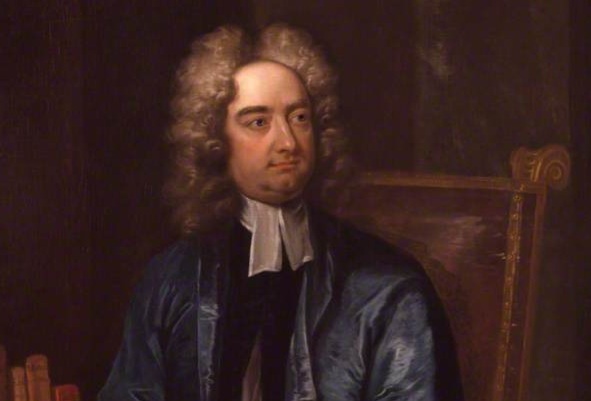
 'Jonathan Swift' by Charles Jervas, National Portrait Gallery (London)
 I am not a lawyer, nor am I a product of the American legal academy. But a patriotic higher-education policy cannot leave the legal profession to the lawyers alone. We all rely on them to manage the legal and constitutional operating system of the Republic.
A patriotic higher-education policy assumes that the goal of government intervention in higher education is to make public and publicly privileged universities advance the cause of America. From that standpoint, there are two features of legal education that need to be taken into account. First, there is the external test of the quality of a law school and its graduates: the rate at which those graduates pass the bar exam and are admitted to the bar. Second, legal education has an important public benefit, as we rely on educated lawyers to represent our interests in court and out of it, draft our laws, and judge our civil and criminal disputes.
The fight about law-school admissions assumes that merit is sufficiently captured by LSATs and GPAs. The fight about law-school admissions, grown more complex and nastier after the Supreme Court banned racial preferences in university admissions in the 2023 case Students for Fair Admissions v. Harvard, assumes that merit in law-school admissions is sufficiently captured by LSATs and GPAs. The quarrel, as usually conceived, assumes that, apart from merit thus understood, the other central question is how law schools can promote “diversity,” that is to say racial diversity: How can law schools admit an adequate number of black and perhaps other visible minority students?
Patriotic higher-education reformers should think differently about both merit and diversity. Patriotic higher-education reformers should think differently about both merit and diversity. Bar-passage rates give us an external check on the quality of legal admissions and education, but, above a certain floor, differences in grades have little predictive value either for bar passage or professional success, especially when compared to other markers of individual merit. And diversity is valuable to the country not so much in distributing the ostensible rewards of entry into the legal profession (and especially the elite legal profession) but in ensuring that our laws are made and enforced in ways that take account of a diversity of backgrounds and perspectives—crucially, all from people who show a basic commitment to advancing America according to their own lights.
From that perspective, I would like to propose a radical notion of how to reform admissions into America’s law schools and the legal profession. I propose that there be three distinct modes of entry:
1) The Open Market (the California Rule): In the interests of equity and fairness, we should nationalize the rule that allows any person to study for and take the bar exam regardless of whether they graduated from an accredited law school. Abraham Lincoln was a good enough lawyer even though he merely read for the bar and never attended a law-school class.
2) Mainstream Accredited Law Schools: These must set an admissions floor that predicts a 60-percent bar-passage rate on the first attempt, and they must be legally required to admit every single student who meets that criterion.
3) Elite Accredited Law Schools: These institutions may remain highly selective in their class sizes, but they must set an LSAT and GPA floor and admit only those students who possess one of four additional qualifications:
a) a term of military service, honorably completed;
b) a STEM degree;
c) a varsity letter in college athletics;
d) a term of teaching in an accredited public or private school, eventuating in successful completion of a probationary period of at least three years and the grant or offer of tenure or the equivalent renewable contract.
Students admitted to the study of law at an elite law school under 3a) and 3d) would have demonstrated their commitment to serving America’s future, either its national-security future or its human future. Students admitted under 3b) would have demonstrated their commitment to mastery of a difficult field whose skills and content would, for many of them, be relevant to their actual practice of law. Students admitted under 3c) would have demonstrated their commitment to competitive excellence and their willingness to drudge for long, hard hours in that competitive pursuit.
Even so-called private higher education is, in its relevant part, publicly privileged. Some might contend that law schools, especially private law schools, would have a First Amendment right against this kind of intervention. But even so-called private higher education is, in its relevant part, and as I have shown elsewhere, publicly privileged, through accreditation, federal-loan eligibility, and governmental recognition of nonprofit and charitable status.
This reform would pass constitutional muster because it has a strong rational basis in public needs. Moreover, this reform would pass constitutional muster because it has a strong rational basis in public needs: It would force elite law schools to prefer students of unusual competitiveness, scientific background, or commitment to the nation’s service. It would force mainstream law schools to adopt equitable and reasonable admissions criteria without leading on students with poor chances for success either at the bar or at lawyering.
While a broadly humanistic understanding is valuable, elite law schools are currently designed to teach law, not lawyering. No law school has figured out how to teach the actual practice of lawyering effectively. Law schools can teach only the cases and the doctrines with, at the elite level, more or less amateurish forays into public policy and philosophical jurisprudence. The academy should focus on the former: teaching the cases and the doctrines and assessing success through bar-passage rates. They must leave the assessment of actual lawyering to the ruthless shaking out of the competitive market and leave the assessment of a student’s character to the crucibles of the military, the K-12 classroom, or the playing field.
In the wake of SFFA’s overturning of racial preferences, elite universities have predictably retreated into the black box of “holistic review.” But holistic admissions put the weighing of individual merit behind the veil of administrative mystery. To evade the Supreme Court’s mandate, law schools now rely on subjective personal statements, “adversity scores,” and ideological signaling. Evaluating these narratives requires an army of diversity deans and admissions bureaucrats, a compliance-industrial complex whose primary job is to maintain institutional control over the racial composition of the American elite. Because this “holistic” process is deliberately opaque, it is impossible to assess what its real workings are and how those comport with national needs.
Holistic admissions inherently reward applicants who have been socialized into reflecting the exact ideological preferences of the admissions committee. By forcing elite schools to base their selectivity (above the LSAT and GPA floors) on four criteria—the military, the K-12 classroom, STEM, or athletics—we replace the subjective, easily gamed metrics of university bureaucrats with transparent criteria that reform the student body to advance America.
My goal is to produce an elite-law-school graduating class of 2038 or so that resembles more its predecessors of 1948 than its predecessors of 2018. The class of ’48 included the first of the returning veterans of the Second World War. These were tough, pragmatic men who helped build the grey-flannel world of American business life and legal practice that made possible America’s eventual Cold War victory, as well as the civil-rights revolution that made America worthy of that victory. Some of them, but not many, were conservative; more were progressive; and a few were socialists or communists. But all of these law graduates and lawyers shared a commitment to advancing America, in the different ways they deemed it desirable and feasible to do so.
Michael S. Kochin is an associate professor of political science at Tel Aviv University and a visiting scholar at the Van Andel Graduate School of Government at Hillsdale College in D.C. and in the School of Philosophy at the Catholic University of America.
Martin Center content may be reproduced with permission. Please write to republish@jamesgmartin.center. All republished articles should include our reporter’s byline and must prominently name the Martin Center as the original publisher.
Author
Michael S. Kochin