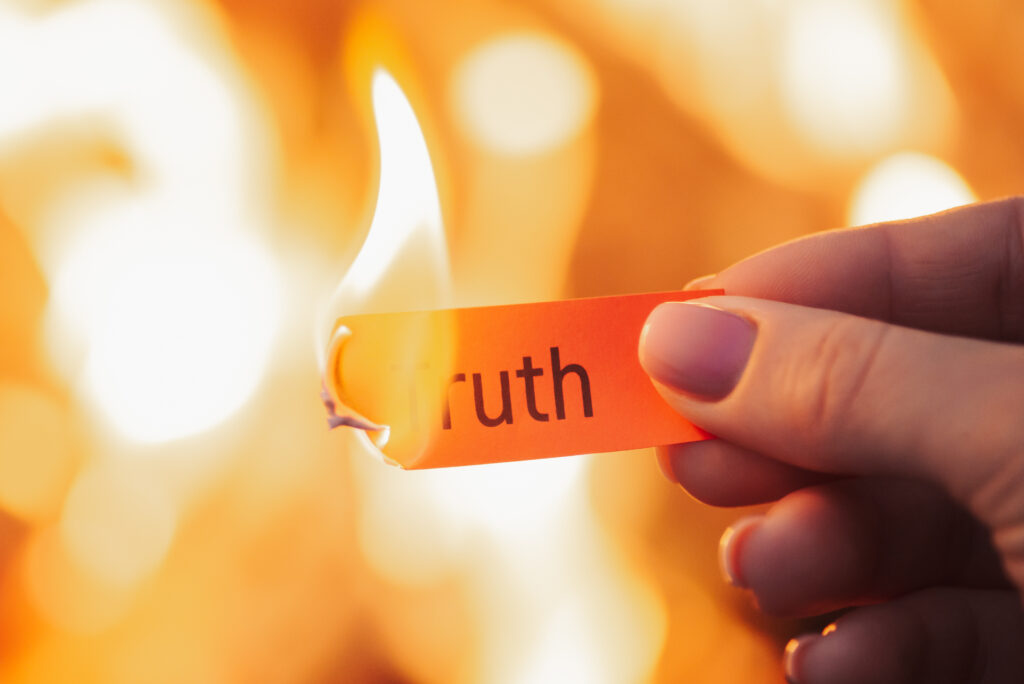
 Vitalii, Adobe Stock
 It is a running joke with my repeat students that “it depends” is the phrase most likely to set me off during a classroom discussion.
Don’t get me wrong, I understand context matters, and we should strive to see as much of the picture as possible. Still, repeated appeals to “it depends” by the same student reveal a very different intent. In most cases, the student is using “it depends” as an excuse not to think carefully, substituting feelings for reason.
Such students risk nothing in class discussion, insulating their beliefs and ideas from challenge in precisely the place where they are supposed to be challenged. Too often, professors allow them to get away with it.
It is the truth that lays claim to us, not the other way around. In a similar vein, you’ve probably heard people appeal to “my truth,” but this phrase gets the relationship between the self and truth exactly backwards. It is the truth that lays claim to us, not the other way around. Worse, it suggests to the student and their peers that the truth is radically subjective, that is, the truth of an idea depends on the individual’s willingness to accept it. This is becoming common in various “soft” academic fields where academics want to escape rigorous examination of their ideas by saying “That’s my truth.”
When the university tolerates or encourages this kind of behavior in students and faculty, it suspends the principles and values that give the university legitimacy and authority, which are intrinsic to the educational enterprise.
For most of their history, universities operated on the assumption that truth exists independently of our preferences. For most of their history, universities operated on the assumption that truth exists independently of our preferences, and scholarship is the disciplined attempt to understand it. Different fields developed different methods, for example, clinical trials in medicine, archival research in history, and quantitative analysis in sociology.
Crucially, all shared a commitment to standards external to the scholar. Those standards made peer review possible. When, e.g., a historian submits an article, the editor determines if the article fits with the focus of the journal, then de-identifies the manuscript so it can be evaluated on its own merits. Finally, the editor locates other historians who study the same or a similar topic and asks them to review the article.
The peer reviewers evaluate if the sources are reliable, whether the argument follows from the evidence, and whether alternative explanations were fairly considered. Disagreements occur, sometimes fiercely, but they occur within an objective framework of evaluation.
Most discussions of academic freedom begin by elaborating the American Association of University Professors (AAUP)’s 1915 Declaration of Principles on Academic Freedom and Academic Tenure. Among these principles is the idea that university professors are subject matter experts who must be allowed to follow the truth wherever it leads them. This is a noble idea, but without an established professional ethic that specifies one’s duties as a scholar and teacher, it invites abuse.
In recent decades, this traditional defense of academic freedom has been hollowed out as key assumptions of the original 1915 principles have been undermined. One example of this is the rise of a new qualitative research method known as autoethnography. An autoethnography is a retelling and analysis of one’s own lived experiences. The goal is to consider the context of the experiences to better understand the behaviors, thoughts, and feelings of the self.
This shift from external standards to internal authority did not emerge in isolation. Personal narratives might be enlightening, but the problem is that there’s no way for an autoethnography to meaningfully undergo peer review. The reviewers cannot dispute your experiences, and they only “see” what parts of the context you choose to share. The purpose of the peer review process is to critique an author’s work to make it better, that is, better conformed to the standards of the discipline. Unfortunately, a discipline that adopted “my truth” as a norm ceases to be a coherent discipline. All approaches then become equally valid and all claims equally true, rendering them meaningless.
This shift from external standards to internal authority did not emerge in isolation. It coincided with a broader transformation in the social sciences and humanities. The former Notre Dame sociologist Christian Smith wrote an excellent book in 2014 about the “sacred project” of American sociology. Smith demonstrates that much of modern sociology integrates progressive political thinking into research design and teaching.
That shifted the focus of the discipline from trying to understand how society works to actively trying to change society. The changes proposed by this new crop of sociologists were focused on progressive political values like equity, diversity, and social justice. This is significant because sociology has deeply influenced a whole array of fields, including Whiteness studies, gender studies, women’s studies, Black studies, Latinx studies, and LGBTQ+ studies.
Scholarship in those areas is not evaluated primarily on methodological rigor, but on whether the findings support approved moral conclusions. Scholarship in those areas is not evaluated primarily on methodological rigor, but on whether the findings support approved moral conclusions. The measuring tool, to borrow a simple analogy, is no longer an external ruler but a political frame. Scholarship that aligns with that frame is rewarded; scholarship that challenges it faces hostility—regardless of the evidence. This creates an unspoken rule in academia: certain conclusions are acceptable while others are not.
The consequences of this rule become clear when scholars produce findings that can be useful to political conservatives. For example, Rodney Stark, a sociologist of religion, openly acknowledged in his postscript that his criticism of anti-Catholic historical narratives would have been dismissed as “special pleading” had he written from within a Catholic institution or identified as a Catholic himself. The implications are profound. When one’s institutional and personal identity can disqualify scholarship before it is even read, academic rigor has been replaced by right thinking. Disqualification, not debate and discussion, becomes interwoven in the peer review process. This atrophies the guardrails that academic freedom was premised on.
Some readers might shrug and say: if certain academic fields want to play by different rules, why should the rest of us care?
Universities do not exist only for themselves. The answer is that universities do not exist only for themselves. They educate future professionals, certify expertise, advise policymakers, and consume billions in public funds. When disciplines abandon truth-seeking norms, they undermine the credibility of the entire institution. Even worse, they weaken the very justification for academic freedom.
Historically, the federal and state governments have granted universities autonomy because they believed scholars were pursuing knowledge, not enforcing ideology. When that trust erodes, academic freedom becomes vulnerable to legislative interference, donor pressure, and administrative micromanagement. Ironically, those who most loudly invoke academic freedom are often the ones who have hollowed out its intellectual foundations.
Academic freedom does not mean freedom from criticism or freedom from standards. It depends on disciplines maintaining clear, rigorous methods while remaining open to unexpected conclusions. Universities do not need to purge controversial fields or ban uncomfortable topics. They need to welcome viewpoint diversity and remain neutral amid political and social turmoil. Yes, neutrality would be taking a position, but it is a position on the sideline rather than within the political arena.
All of this hinges on a renewed commitment to the fearless pursuit of truth and the passionate belief in truth. When higher education replaces “What is true?” with “Whose truth?” it loses not only public trust, but its reason for existence. If universities wish to reclaim that trust, they must retire the reflexive appeal to “it depends” and demonstrate the virtues that they claim to develop in their students: prudence and fortitude.
John M. Kainer is associate professor and department chair of sociology at the University of the Incarnate Word in San Antonio, Texas, and an affiliated scholar with the Veritas Center for Ethics in Public Life at Franciscan University in Steubenville, Ohio. His work has been featured in a variety of scholarly and popular outlets, including First Things, The American Spectator, Minding the Campus, Catholic Social Science Review, the Journal of Sociology and Christianity, and William James Studies. You can follow him on X @JohnMKainer.
Author
John M. Kainer