
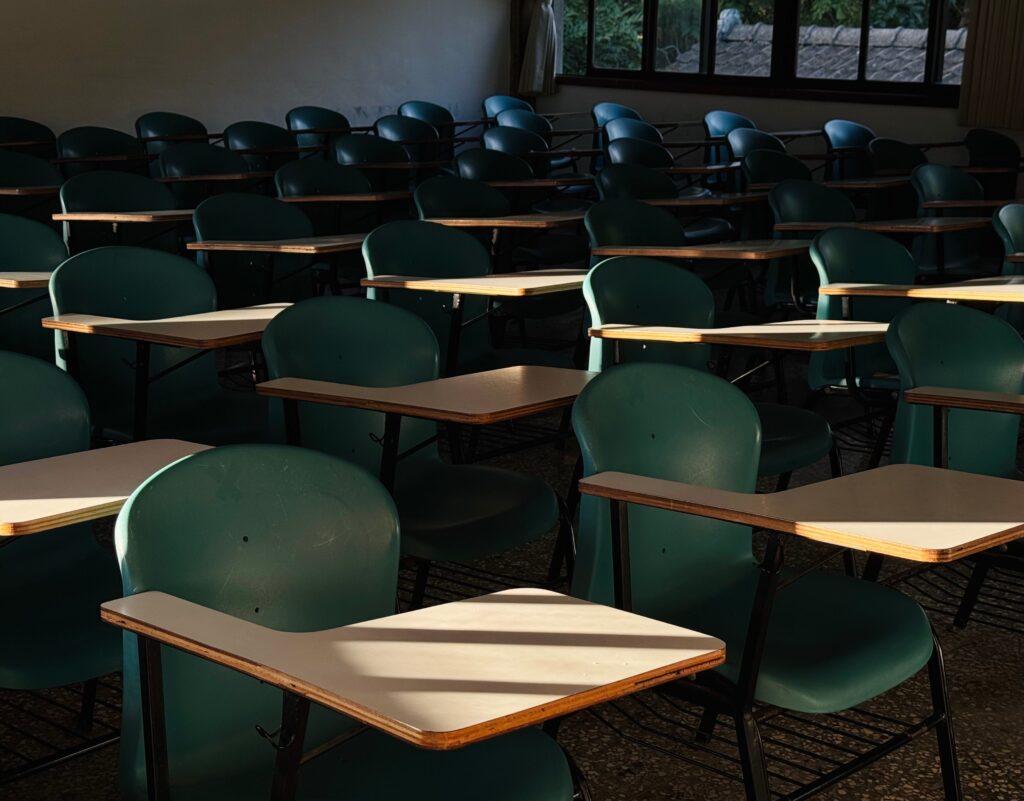
 Oliver Hung, Pexels
 Suppose you have a friend who knows little about American higher education but is eager to learn about it. You might want to recommend to him a book that introduces the subject with readily understood essays covering the range of problems we face. A good choice would be Higher Education in America: It’s Worse Than You Think. The book consists of nineteen essays by people who have been on the front lines in the battle to rescue our colleges and universities from the menaces of mediocrity and politicization.
So, what has gone wrong with American higher education?
One theme that recurs throughout the book is that most of our colleges and universities have lost their sense of mission. As Hillsdale College president Larry Arnn writes in the foreword, they have converted the “sublime activity of education” into a “manufacturing operation.” Rather than working with young minds to help them learn how to discover truth, most colleges just want to process through as many graduates as possible. And worse, instead of enlightenment, students are often steeped in conflict, taught that certain groups are oppressors and others oppressed.
In his introduction, Christopher Rufo observes, “The great project of liberal education, designed to inculcate knowledge of the truth, appreciation of the beautiful, and the civic virtue necessary to advance both, has been replaced by bureaucracies, activism, anti-Western ideology and empty credentialism.” College degrees that used to betoken a wide range of knowledge and skills now signal nothing. Rufo argues that education and liberty are inextricable and we need to worry for our civilization because many students now graduate without the slightest appreciation for liberty.
College degrees that used to betoken a wide range of knowledge and skills now signal nothingAmong the reasons why college has become such a poor value is the way the federal government makes it so easy to borrow to pay for it. In his chapter, Preston Cooper concludes, “For too long, colleges have taken advantage of an opaque and dysfunctional financial-aid system to strong-arm students into paying higher tuition than they would in a free and competitive market.” That’s what we need.
Can’t American students depend on colleges for a high quality education? Supposedly, our accreditation system ensures that they do, since colleges and universities (at least those that accept federal funds) have to obtain accreditation from an agency approved by the Department of Education. Unfortunately, obtaining the stamp of approval from an accrediting agency does not ensure that students receive a sound education. In their chapter, Jonathan Butcher and Madison Marino Doan disabuse readers of the notion that accreditors ensure that students receive a good education. Accreditors, they observe, don’t actually investigate courses to see if they have serious academic standards, but instead focus on institutional inputs—and sometimes those inputs are the wrong types, such as “diversity” among faculty.
That many American students receive a weak education in college is the theme of the chapter by Adam Kissel and Madison Marino Doan. They investigated the course offerings at many of our supposedly finest schools and found that it would be easy for students to avoid intellectually challenging ones and coast along taking courses that focus on pop culture and politics. And, generally, colleges have cashed in by luring in students with weak academic preparation by dumbing down the curriculum and offering lots of enjoyable amenities. Kissel and Doan conclude that it’s time to make college hard again and to stop subsidizing it with easy government loans.
One of the most frequently heard complaints about our colleges is that they allow faculty members to substitute political advocacy for objective teaching. In “The Leftist Monopoly Problem,” Andrew Gillen shows that this is a serious concern. Many academic fields are now completely dominated by professors who embrace a leftist worldview that is hostile to individualism, limited government and free enterprise. Such professors usually want to hire only ideological allies by screening out applicants who might voice differing views. Gillen makes it clear why this matters, writing, “When one side dominates, only truths that conform with that political ideology will be acknowledged. Inconvenient truths will be ignored, dismissed, or explained away.” Academic fields thus become hidebound and intolerant.
Many academic fields are now completely dominated by professors who embrace a leftist worldview that is hostile to individualism, limited government and free enterprise.What is the experience of college like for today’s students? In his chapter, Kyle Washut argues that it is far different from what it used to be. He writes, “For many students, going to college at a legacy institution involves faculty who do not teach, the students themselves spending little time on learning (and what time is spent studying is on classes of little rigor or in slanted “studies” departments) and immersion in terrible experiences of loneliness and anxiety, all while spending vast amounts of money and garnering large quantities of debt.” In short, we have lost sight of the purpose of education. He argues that one step in the right direction would be a law that would empower universities with large endowments to create smaller colleges under their umbrellas with a traditional academic focus.
At the heart of our drift away from the serious, useful college education of the past into the often feeble and politicized education of the present is poor leadership. Few college and university presidents have been willing to say “no” to the ruinous trends. In his chapter, George Harne drives that point home. He writes, “Unfortunately, leaders of colleges and universities frequently derive their leadership not from the natures and highest purposes of their institutions but from the worlds of leftwing politics, moralistic-therapeutic culture, the corporate book trade, or some combination of the three.” If we are going to restore academic standards and integrity, we will need to choose leaders who are deeply committed to the educational enterprise, not to promoting themselves or their personal views.
And there is also the faculty problem, which John Sailer discusses in depth. He writes, “Today, an increasing number of faculty have come to see their scholarship as a means for advancing a political agenda. These scholars—more accurately, scholar-activists—place primacy on the categories of race, sex, and ethnicity. They often invoke faculty-lounge neologisms, such as ‘racial capitalism’ and ‘decolonization.’” Over the last several decades, the pipeline into academic life has been altered so that it greatly favors candidates from “underrepresented” groups, so long as they favor leftist activism. Those who don’t fit are filtered out.
Our college leaders love to spend money but much of their spending is on projects and programs that are inimical to the nation’s long-run good. For that reason, Jay P. Greene argues, donors ought to stop ladling money carelessly into college coffers. He suggests that billionaires direct their educational giving toward the founding of new institutions that will once again provide higher education that is untainted by politics. As for wealthy Americans who don’t have the funds to start new universities, Greene suggests that instead of trying to establish good programs at existing schools, which are apt to be taken over by leftists eventually, they direct their money to help programs at those new schools, such as the University of Austin.
Our college leaders love to spend money…on projects and programs that are inimical to the nation’s long-run good.Kenneth Marcus, in “Antisemitism on College Campuses,” shows how virulent that has become, as student organizations, faculty committees and even administrative programs spout anti-Semitic rhetoric and commitment to intifada. This has come about, he argues, because “ideological movements have gained influence in the humanities and social sciences, replacing the older ideal of the university as a neutral forum with a model in which higher education serves as an instrument for social and political transformation. When that view takes hold, the safeguards against bias and partiality weaken.” They certainly have.
There is much more in this hard-hitting book, which I recommend to anyone who wants to know the truth about what has happened to higher education in America.
George Leef is director of external relations at the James G. Martin Center for Academic Renewal.
Author
George Leef
