
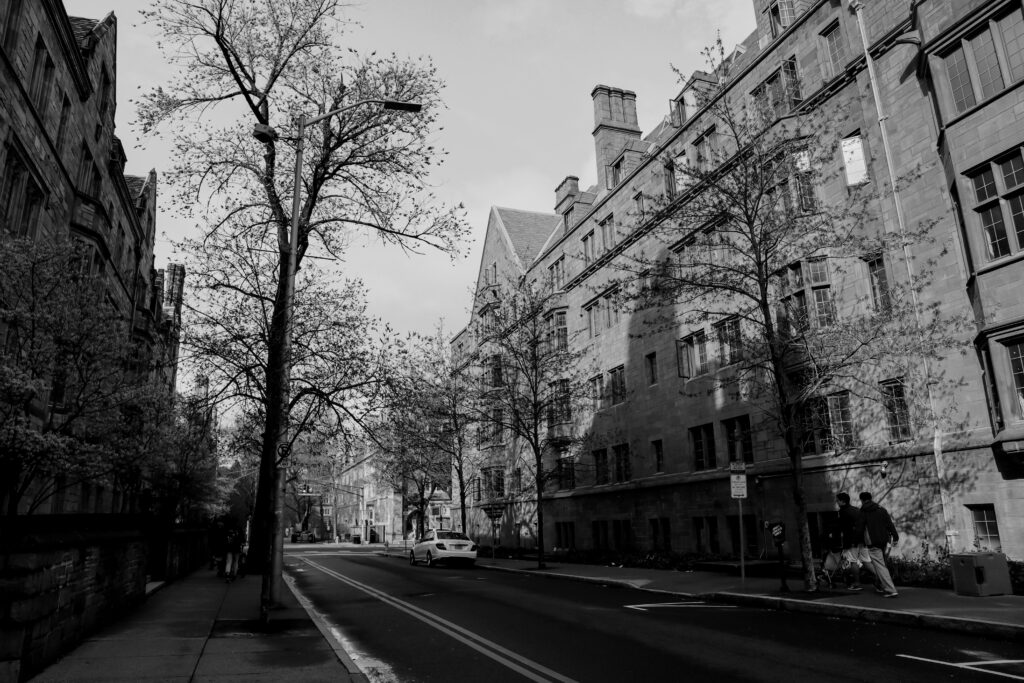
 Gela delrose, Pexels
 A point that has generated much discussion is the decline in confidence in and support for higher education. Over the last ten years or so, the percentage of Americans who say they have a high degree of confidence in our colleges and universities has fallen, while the percentage who say they’re skeptical about the value of higher education has risen sharply.
Many in the higher education establishment have dismissed this as having no importance—merely the result of increasingly vicious right-wing polemics aimed at one of the nation’s great engines of “progressive” influence, they say. Nothing to be concerned about.
Some academic leaders, however, have decided to take this matter seriously. One is Yale’s president Maurie McInnis, who, in 2025, convened a faculty Committee on Trust in Higher Education to study the question. Its report was released in April and acknowledges that our higher education has created a real problem by allowing ideology to shove aside fairness and objectivity. It notes that “echo chambers do not produce the best teaching, research, or scholarship.”
It notes that “echo chambers do not produce the best teaching, research, or scholarship.”The report recommends that the university work to enhance open debate on campus. One way to do that is for each department to critically assess “the openness of its hiring and admissions practices to dissenting or underrepresented traditions.” Those will be unwelcome words for the many on Yale’s faculty who relish their ideological activism and believe that dissenting voices are being kept out for good reason.
Will Yale follow through on this excellent idea, or will it die quietly, as professors who like the status quo just fine continue to exclude dissidents from the faculty?
Yale’s report also makes the important observation that the university has lost its sense of purpose. It states, “Universities exist to preserve, create, and share knowledge.” Rather than focusing strictly on scholarship, Yale wandered away from that with a mission statement that made the university’s goal “improving the world today and for future generations.” To many activist faculty, that was an invitation to shape their teaching and research to promote their belief systems; they reacted by creating departments and courses where leftist orthodoxies excluded other points of view. After all, that improves the world by cementing correct views into young minds.
The idea that Yale should return to academics and stop trying to improve the world didn’t sit well with some higher education spokesmen. Former Macalester College president Brian Rosenberg, writing for Inside Higher Ed, deplored what he sees as Yale’s “shrinking mission.” To hear Rosenberg tell it, the public has lost confidence in higher education not because it is trying to do things that depart from academia’s scholarly mission, but rather because it hasn’t done a good enough job of selling its expanded and glorified view of its role.
The idea that Yale should return to academics and stop trying to improve the world didn’t sit well with some higher education spokesmen.Rosenberg’s piece drew this sharp rejoinder from Professor Samuel Abrams. “Rosenberg’s camp holds that universities failed to persuade the public of their broader mission, so the answer is more engagement and more ambition. The alternative—the one Yale’s revision embraces—is that universities lost trust precisely because they strayed from the work only they can do.”
Abrams has by far the better argument. The notion that universities should give their faculty members carte blanche to promote their opinions on improving the world has led to their blatant politicization. In many courses, students are told what they must believe if they want to pass, and academic departments sometimes issue proclamations on contentious issues. As more and more Americans have become aware that our universities have been captured by educators who preach rather than teach, support for the higher education enterprise has fallen.
Yale, a private university with a huge endowment, is making the right move in dedicating itself again to scholarship and that move makes even more sense for public colleges and universities that depend on state legislatures for their funding. If they want to take the steam out of conservative attacks and budget cuts because they’ve allowed ideology to override true scholarship, they’d be well advised to follow Yale’s lead.
Another component of the Yale report is its argument for a “device-free policy” in classrooms, acknowledging that phones and similar electronic gizmos have become a terrible distraction. It recommends that faculty members implement a device-free policy from which they can only deviate for “compelling pedagogical, research, or practical reasons.” That will probably be hard to implement, as many professors have adopted a “whatever” approach to classroom discipline, but it’s worth the effort. As Rick Hess noted here, the result has been “distraction-filled classrooms, where students spend more time sending texts, checking social media, or betting on DraftKings than taking notes.” I agree and, again, it’s just as important for other colleges and universities to try creating distraction-free classrooms.
Finally, Yale deserves applause for returning to the old idea of a shared curriculum rather than just allowing students to pick and choose from a vast smorgasbord of classes. The report advocates “the creation of a civic education initiative that would reach every first year undergraduate on a regular basis.” The goal: “a core dimension of informed citizenship.” Of course, the activists will attempt to hijack that initiative for their own purposes, but if that can be avoided, the idea is sound.
The other report that merits attention is State of Scholarship. It had its origins in 2025, when Daniel Diermeier, Chancellor of Vanderbilt University and Andrew Martin, Chancellor of Washington University in St. Louis, commissioned a study on the state of research in social science and the humanities. They chose Professor Paul Boghossian of New York University to lead the project, and Boghossian then chose other scholars to contribute as well.
Has scholarship been corrupted by political agendas? The report finds that, in many fields, it has. It states, “Philosophers have worried about the unquestioning embrace of problematic views, especially those concerning truth, evidence, and knowledge. More recently, many different voices have suggested that humanistic disciplines have allowed background ideological values to distort the objective pursuit of knowledge….”
The report scrutinized several fields in the humanities, concluding that to some extent they all show a deterioration of academic standards because they have substituted political criteria for long-standing standards of rigor and objectivity.
Anthropology comes in for the most severe criticism. The report quotes prominent members of the discipline who proudly proclaim that its “political project is to challenge the cultural domination of capitalist consumerism.” While individual scholars may have personal agendas like that, a scholarly field should not embrace any political project—it should seek to understand and explain reality, not to challenge or change the world.
The report quotes prominent members of the discipline who proudly proclaim that its “political project is to challenge the cultural domination of capitalist consumerism.”The authors of the report see the problem with politicized scholarship, such as where academics stake out an objective such as social justice: “If scholars committed to social justice believe that the cause can only be advanced by finding, for example, that there are no behavioral differences between men and women traceable to biology, they will be under enormous pressure…to find no such differences. Either the research will not be done, or if it is done, or done and the results look bad, the finding will be suppressed or the evidence reinterpreted so as to obscure it.” And what about those who dare to question the academic consensus? The report correctly notes that those who publish anything “unfavorable to the cause” will face an array of punishments.
All of that is an accurate diagnosis of the problem. An analogy it draws is that the situation is as though astronomy had morphed into astrology.
The report’s recommendations for dealing with politicized scholarship, however, are timid. It suggests that university leaders undertake an “intensive study” of academic units where the problem of ideology shoving aside scholarly standards is evident, calling upon scholars in “adjacent disciplines” to examine them with “a measured view.”
Suppose that were to happen. Then what? It’s hard to imagine any painful consequences for, say, anthropology departments that declare they’re out to undermine capitalism. As David Randall said of this report “It’s nice that Diermeier and Martin have sponsored even a smidgeon of critical self-reflection about the academy. If they’re serious about reform, they will act rather than sponsor more faculty gab-fests.”
It’s usually the case that the first step to dealing with a problem is admitting that you have one.It’s usually the case that the first step to dealing with a problem is admitting that you have one. By pointing out that many fields have abandoned intellectual standards in favor of political activism, Diermeier, Martin, and their committee have at least done that service to the academic community. It is a good thing for prominent scholars to rebuke, however mildly, the way other academic leaders have allowed activists to undermine the integrity of the university
Regarding these two reports, we might borrow a line from Churchill: “This isn’t the beginning of the end, but perhaps it’s the end of the beginning.”
George Leef is director of external relations at the James G. Martin Center for Academic Renewal.
Author
George Leef
