
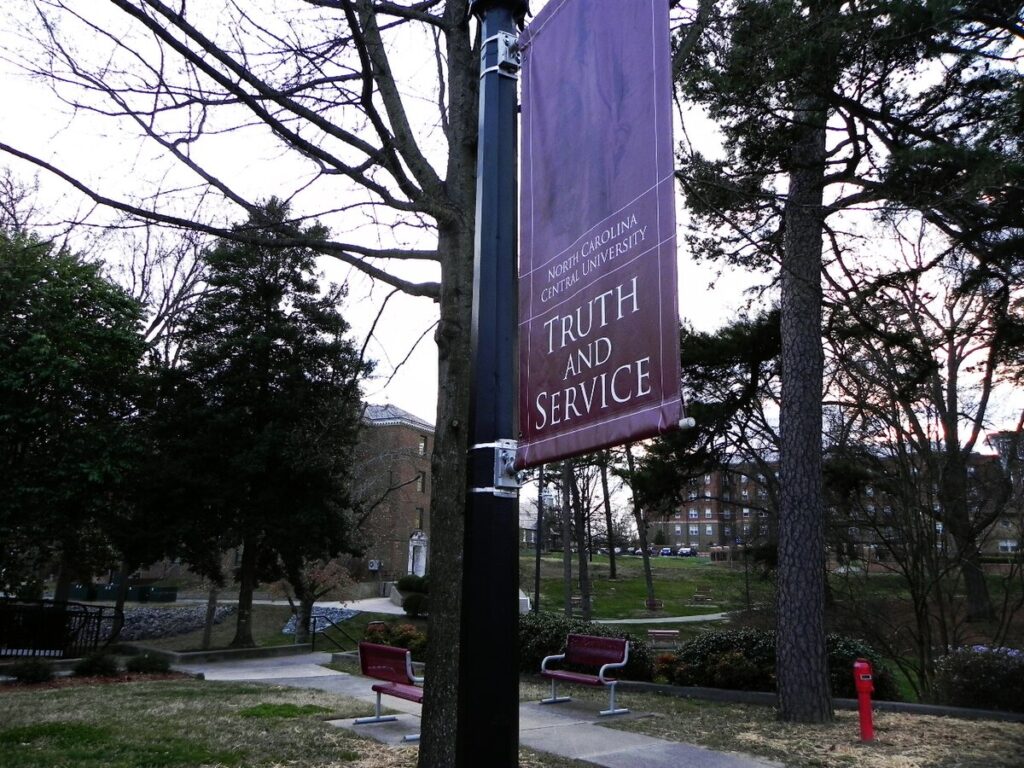
 RDUpedia, Wikimedia Commons
 Following complaints about unhealthy residence-hall living conditions, as well as protests that resulted in the arrests of a professor and others, N.C. Central University has completed what it calls “one of the most extensive” campus upgrades in its long history.
Residential students who talked to the Martin Center had mostly positive comments about the new and improved dorm life after $2.9 million in upgrades, while conceding some minor maintenance problems and infrastructure annoyances remain. Far more top of mind was the exploding student population. It created a case of housing-assignment musical chairs this fall that hit a sour note for many.
Residential students who talked to the Martin Center had mostly positive comments about the new and improved dorm life after $2.9 million in upgrades. The University of North Carolina System announced on Sept. 17 that it had achieved record enrollment this fall. The total number of students shot up 3.4 percent over 2024, from 247,927 to 256,438, according to preliminary figures. It was the first time North Carolina’s public universities surpassed a quarter of a million students. All but one of the 16 universities recorded enrollment gains. The University of North Carolina Asheville, still reeling from devastating after-effects from Hurricane Helene, experienced a six-percent decline this fall.
The UNC System’s historically black universities posted some of the largest percentage increases, including North Carolina Central University at 6.8 percent. This is how that enrollment growth looked, year-over-year, by the numbers:
- Elizabeth City State University: 2,258 – 2,357 (4.4-percent)
- Fayetteville State University: 7,107 – 7,623 (7.3-percent)
- N.C. A&T University: 14,311 – 15,275 (6.7-percent)
- N.C. Central University: 8,579 – 9,160 (6.8-percent)
- Winston-Salem State University: 4,782 – 4,972 (4.0-percent)
A major contributor to the student-population surge is a recent policy shift raising enrollment caps on out-of-state students. N.C. Central raised its cap to 35 percent, leading to a watershed event—for the first time in its 115-year history, the institution topped 9,000 students, according to the Journal of Blacks in Higher Education.
But sophomore social-work major Lamar Glanton of Columbus, Ohio, believes the soaring growth came at a cost.
“It’s definitely been hectic. They’re accepting a lot of people, so it makes sense” officials were scrambling with housing assignments this fall, Glanton said.
“They reset everybody. They reset the freshmen and the upperclassmen. They redid all our housing and some people still got messed up. It is what it is. I got lucky. Some other people got lucky. But then, of course, [there were] some people on the other side who didn’t get so lucky. A lot of people didn’t get housing. I know a lot of people who were sophomores living off-campus” as a result, Glanton said.
UNC System spokeswoman Jane Stancill punted most questions about university residence halls.
“Housing is managed at the campus level,” she said, directing questions to individual campuses. “The UNC System does not track the percentage of students living on- versus off-campus at the institutions.”
“I got lucky. Some other people got lucky. But then, of course, some people on the other side didn’t get so lucky.” “Demand for an NCCU education is very strong, as evidenced by two consecutive years of record-setting enrollment,” said Stephen Fusi, chief brand officer at N.C. Central University. “At the same time, we currently house 36 percent of our student population, above the averages for UNC System institutions and nationwide four-year public institutions of 28 percent and 24.8 percent, respectively.” Excluding students enrolled exclusively in online degree programs, the percentage of NCCU students housed on-campus spikes to 46 percent.
“The university has actively expanded housing options through partnerships with local apartment complexes and contractors.” “For the class of 2029, all first-year students who confirmed enrollment and paid required deposits by our May 30, 2025, guarantee date received on-campus housing assignments ahead of the start of classes. The university was later able to offer housing to all first-year students who confirmed enrollment after that guarantee date,” Fusi said.
“The university has actively expanded housing options through partnerships with local apartment complexes and contractors,” he added.
“We have partnered with an apartment-finding and roommate-matching site called NCCU College Pads … that offers off-campus housing listings, sublease options and roommate matching, where students can actually search for other NCCU students who are seeking off-campus roommates,” Angela Coleman, vice chancellor of student affairs, told WRAL News in August. CollegePads offers a website to find student rentals.
Coleman said the university has revised its housing policy so that sophomores no longer must live on campus, and some freshmen are exempt from the mandate under limited circumstances.
Zoe Austin, a freshman criminal-justice major from Frankfort, Ky., does not think pushing students into the community to find housing is a great remedy to the housing crunch. For one thing, she said, friends living off campus are paying much higher rent than what it costs her for a dorm room.
“This campus is a safe campus, but it definitely does raise concerns when you’re having students that are off-campus. I don’t really think Durham is that safe of an area, in my perspective,” and she feels unsafe just blocks from campus, she said.
Austin said freshmen students who are required to live on-campus are being blamed by upperclassmen who can’t secure campus housing.
“That’s not really our fault that [the] school’s not rationing out the housing as they should,” she said. “We don’t have control over that.”
Joshua Bryant, a sophomore IT major from Raleigh, said the housing dilemma, exacerbated by expanding freshman classes, puts a damper on the campus vibe.
“I’ve been one of the lucky few who’s been able to get housing. But I do know other people that were not as fortunate as me to get housing,” Bryant said. He doesn’t have a recommendation for what he likens to a housing lottery. “If we did have the answer for that then we would have done it.”
Most students who spoke to the Martin Center had no complaints about the quality of on-campus housing at N.C. Central. Twin freshman nursing students Aniyah and Laniyah Wheeler of Raleigh gave typically positive responses.
None of the interviewed students observed bug infestations, mold, or flooding. “I honestly don’t have any problems. I actually love it. The shower’s nice, I don’t get any bugs, the AC works, I can control it if I’m hot or cold,” Laniyah said.
Others, like freshman architecture major Nason Taylor, had minor complaints.
“Our building, we (didn’t) have any hot water” for a week, Taylor said. “It just turned on today, but I’m not sure if it will stay on. In my room, the thermostat is broken. It’s stuck at 60.”
“Enhancing the student experience is central to NCCU’s new strategic plan.” None of the students interviewed observed the recurring bug infestations, mold, and flooding that sparked boisterous student-housing demonstrations and marches last spring. Three individuals and then-adjunct history professor Daniel Atwood were arrested. Charges against them were dismissed on Sept. 23.
Fusi, NCCU’s brand officer, said the university has since done major remediation and repair.
“Enhancing the student experience is central to NCCU’s new strategic plan,” Fusi said. “Over the summer, NCCU made significant renovations and repairs to residence halls to improve the student experience.”
In a Sept. 9 online post, N.C. Central said, “Nine of the university’s 13 residence halls were part of this effort …. The summer housing improvement project was, in fact, one of the most extensive in university history,” and improvements will continue to be made throughout the academic year. Completed work includes:
• Remodeling 28 bathrooms in Ruffin Residence Hall;
• Modifying and repairing window units and HVAC systems in every building;
• Replacing failed Wi-Fi access points to enhance connectivity;
• Repairing plumbing and showers across multiple halls;
• Replacing appliances in 35% of units;
• Painting walls and ceilings in all rooms;
• Performing floor care in every residence hall;
• Replacing 30% of furniture and mattresses, with an additional 45% repaired;
• Upgrading fire alarm systems in all buildings and repairing fire suppression systems in five buildings;
• Continuing elevator repairs and inspections;
• Spraying all residence halls for pests, with fogging completed in several buildings.
Summer Tonizzo, senior media-relations manager at the N.C. Department of Health and Human Services, said the NCDHHS secretary is statutorily authorized to do sanitary and health inspections at public-university residence halls, and issue a report. The NCDHHS Division of Public Health Environmental Health Section conducted inspections at NCCU on March 31 and April 1.
“The overall condition of the academic buildings is good. General housekeeping in the academic buildings is also good,” a post-inspection report stated.
Many buildings “are old with systems and infrastructure that exceed their life span.” “The overall condition of the residence halls is good. Some repairs and improvements were made in the residence halls,” the report continued, while citing a variety of findings, including some repeat issues. “General housekeeping in the residence halls is much better. Continue to address the heat/AC unit issues throughout the campus.”
“It is the institution’s responsibility to resolve any identified issues or concerns,” Tonizzo said. “The law does not provide NCDHHS enforcement authority, or authority to designate a timeframe for institutions to correct identified issues of concern.”
Stancill did not respond to written questions about whether the UNC System Office was aware of the problems at N.C. Central, or if the System has any committees, task forces, or other panels looking into campus-housing issues systemwide now or in its plans.
She did reply that the Board of Governors “reviews new housing projects that require the issuance of debt. Most residence halls are self-liquidating or non-appropriated projects (i.e., debt is issued and then housing receipts service the debt over many years). Borrowing has to be approved by the board and, eventually, the legislature.”
Lezli Baskerville, National Association for Equal Opportunity in Higher Education (NAFEO) chief executive officer, said Historically Black Colleges and Universities “have, from the beginning of time until this day, been afforded far fewer resources, both public and private,” to address housing and other critical needs. “And at the public level the disparities that we see in funding relate directly to the unconscionable discrimination over the years … with the vestigial remnants of the discrimination” still existing. NAFEO seeks to highlight this “woeful local underfunding.”
HBCU Original, an online platform, raised similar concerns earlier this year. “HBCUs have faced chronic underfunding for decades. A 2023 federal analysis revealed that from 1987 to 2020, 16 of the nation’s 19 historically Black land-grant universities were underfunded by a staggering $13 billion. North Carolina alone has a funding gap exceeding $2 billion between its HBCU land-grant institutions and their predominantly white counterparts.”
N.C. Central posted that many buildings “are old with systems and infrastructure that exceed their life span. Those structures were built when NCCU (then named the “National Religious Training School and Chautauqua for the Colored Race”) was founded in 1910 through a pre-WWII building boom.” The steam plant is 50 years old, and replacement parts are no longer available for some older plumbing, heating, and chilling towers.
Dan E. Way is the senior communications manager in the North Carolina Department of State Treasurer. He was previously a writer for Carolina Journal and the editor of the Chapel Hill Herald.
Author
Dan E. Way
