
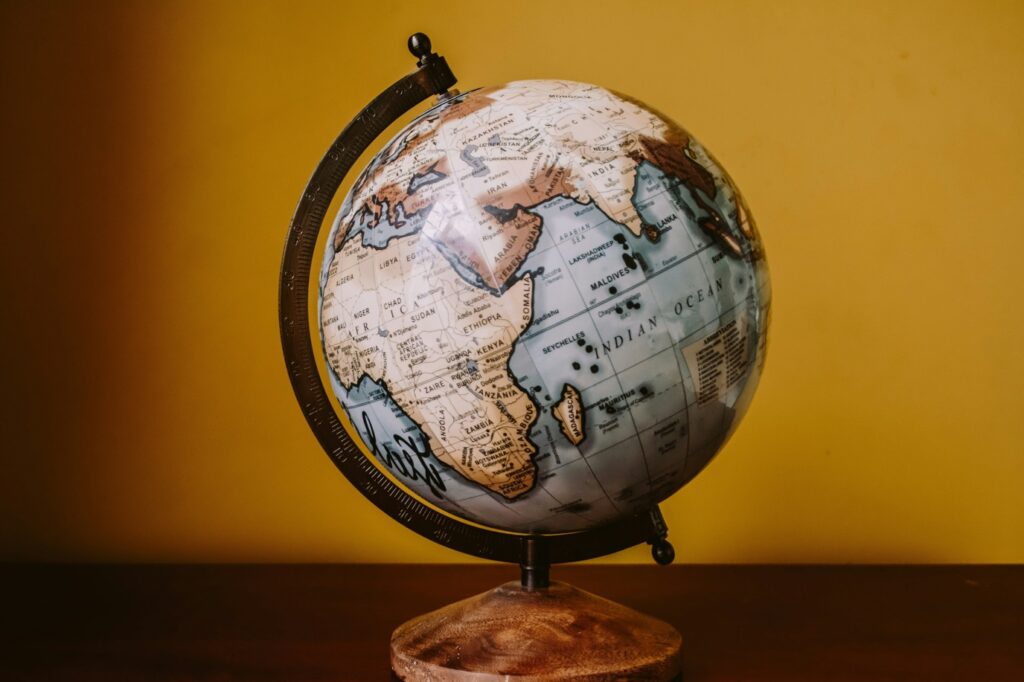
 Arpit Rastogi, Unsplash
 For over 75 years, geography departments have been nearly nonexistent at so-called elite colleges in the United States. Most Ivy League schools, as well as Stanford and the University of Chicago, once had geography departments. Now, the only one with a geography department is Dartmouth. Having taught college geography for over eight years, I can attest that most American college students never take a geography course. They graduate without ever having to demonstrate that they know anything about the physical or cultural landscapes of other countries, let alone their own.
American geographic education took a massive step backward in the wake of World War II, when Harvard shut down its geography department in 1948 and most other U.S. colleges with geography departments followed suit. But while geography went out of style among the elites, since the 1980s it has made a major resurgence, especially in the land-grant universities, where greater emphases on energy, agriculture, and natural-resource management provide a demand for geographic knowledge.
The region is the fundamental unit for packaging places in geography. However, with this ongoing expansion of geography in American higher education has come a shift away from the field’s proper foundation: the study of the regions of the earth. Geography is the yin to history’s yang. As Kant pointed out, these two fields are the broad, synthesizing fields that perceive empirical reality through complementary lenses, space and time. Geography explores places in space, history events in time. Each contains a substantial bit of the other: History textbooks are full of maps, and geography textbooks are full of histories of places. Just as the period is the fundamental organizing unit for packaging events in history, so the region is the fundamental unit for packaging places in geography. Thus, as Carl Sauer, the father of modern cultural geography, articulated in his 1925 essay “The Morphology of Landscape,” if regions are not the focus, the study is no longer geography.
Offering courses in world regional geography and specific regions is, today, often treated as an afterthought by geography departments. But the discipline’s contemporary focus on GIS technologies, climate fanaticism, and woke agendas—and, perhaps most of all, its overspecialization and lack of common sense about what students need—have left regional geography by the wayside. Offering courses in world regional geography and specific regions is, today, often treated as an afterthought by geography departments. That study should be the top priority. An orientation to the world is as essential as orientation on campus. In teaching the college courses “World Regional Geography,” “Geography of Europe,” and “Geography of Latin America,” I have seen students often express that the relevance of such courses is obvious to them. At a minimum, world regional geography should be required for all college students. Assuming the instructors are competent, just adding this requirement would yield exponential improvement in students’ mental maps of the world. Such a course can establish a concrete geographic framework from which students can engage in a continued conversation about global issues throughout the rest of their studies and for a lifetime.
But a look through the faculty webpage of most geography departments reveals that extremely few tenured geography professors identify themselves as regionalists (i.e., experts in some region of the world). The paucity of true regionalists, self-declared or otherwise, in geography departments has caused repercussions, not only in academia but in public life. Back in 1987, Ronald F. Abler, the president of the American Association of Geographers, warned that the demise of the study of regions within geography had left a “large vacuum, which is rapidly being filled by centers that are staffed from language departments and area studies programs.” Today, even the area studies departments are in decline. Writes Georgetown’s Joshua Mitchell, “Gone are the universities that once trained the area specialists who could inform the Pentagon, the State Department, and the CIA that a plan it had devised was ill-advised because of the facts on the ground, which they, the area specialists, knew from a lifetime of study.”
Perhaps the greatest educator in regional geography of the last half-century was the late Dutch-American professor Harm de Blij. “War teaches geography,” de Blij often said. He knew this from experience. De Blij spent five years of his childhood in the Netherlands, living under Nazi occupation. As he recounted in his autobiography, Wartime Encounter, geography was his favorite subject in school. He came home and used maps to follow the battles he heard described on the radio. De Blij later emigrated to the U.S. and popularized geography as an editor with National Geographic and as the geography editor of ABC’s Good Morning America, and he later became a professor of geography at Michigan State and other schools. He authored some 30 geography books, and a used copy of his popular world regional geography textbook, Geography: Realms, Regions, and Concepts (look for an edition from the late 2010s, before the authors changed after his death), contains more about world regions than even many geography professors know. “We, unfortunately, in America … are pretty illiterate geographically,” de Blij said in a 2009 interview. “And it behooves us, being the sole superpower today—whether the world likes it or not—for us to know the world we can affect so strongly better than we do.”
But the number of geography textbooks focusing on specific regions of the world is scant. Among the few on the market are Robert Ostergren’s The Europeans: A Geography of People, Culture, and Environment, Robert B. Kent’s Latin America: Regions and People, Benjamin Ofori-Amoah’s Africa’s Geography: Dynamics of Place, Cultures, and Economies, and Gregory Veeck’s China’s Geography. Globalization is a common buzzword in education. So how is it that there are not scores of textbooks competing to teach rising generations about the regions of the globe? The answer is largely that colleges simply are not offering enough courses in regional geography to provide demand for such books.
The resulting ignorance of regional geography is a primary reason that so many students today are so easily brainwashed about world affairs. The resulting ignorance of regional geography is a primary reason that so many students today are so easily brainwashed about world affairs. For example, only a profound misunderstanding of the historical geography of the Middle East could allow one to believe that the Jewish people have no right to exist there and should be extinguished “from the river to the sea.” Yet student protesters at Columbia and many other schools in the past few years have chanted this very phrase, meaning Jews should be exterminated from the area between the Jordan River and the Mediterranean Sea. Newsweek reported that a poll by a UC Berkeley professor revealed that, while 86 percent of students interviewed said they supported the catchphrase “from the river to the sea,” only 47 percent knew which river and sea it refers to. “Once students learned more about the region, 67.8 percent of those surveyed no longer agreed with the sentiment.” Mark Twain said, “Travel is fatal to prejudice, bigotry, and narrow-mindedness,” and so is knowledge of regional geography. It is uniquely suited to situating world developments in a larger holistic and spatial context.
While 86 percent said they supported the phrase “from the river to the sea,” only 47 percent knew which river and sea it refers to. To be sure, one sometimes bumps into astute “unofficial,” often self-trained, regional geographers scattered in other departments, such as history, political science, international relations, geology, biology, and ecology. And there are many regionalists outside academia, for example in tourism and the military. Talking heads such as Peter Zeihan, Robert Kaplan, Ian Bremmer, and General Jack Keane are among the figures who frequently impart wisdom about regional geography in the public arena. But, in general, regional geographers are underrepresented in comparison to other researchers such as economists and historians.
Geography is a field of explorers and visionaries. It helps reveal the bigger picture and teaches people to think big. Michael Jordan majored in geography, as did Prince William, the future king of England. Mother Teresa left her native Macedonia and taught high-school geography for two decades in Calcutta, India. A lack of understanding of world regional geography leaves students without a larger context in which to understand global events. This limits their ability to exercise agency wisely to effect change. When centered on the study of regions, geography has the singular ability to corral, explore, and make visible all the myriad spatial knowledge of each part of Earth’s landscape and show how it is all interconnected. The world needs much more of this, and making regions the central focus of geography departments again, while making a world regional geography course a standard college requirement, would go a long way toward developing citizens capable of following Gandhi’s maxim: “Be the change that you wish to see in the world.”
Robert C. Thornett has taught in seven countries and has written in Quillette, Education Next, Law & Liberty, Front Porch Republic, Solutions Journal, American Affairs, Commentary, Modern Diplomacy, Earth Island Journal, and Yale e360.
Author
Robert C. Thornett
