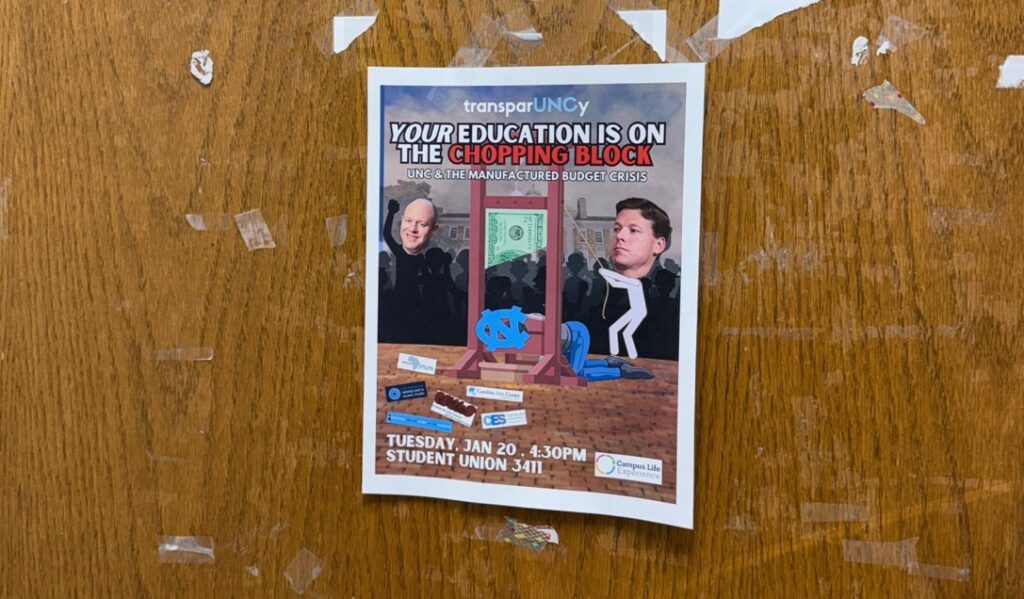
 Photo Credit: Ashley Dowdney
 Earlier this year, Inside Higher Ed ran a puff profile of “TransparUNCy,” the unpronounceable left-leaning organization that has lately become one of the University of North Carolina’s “most effective watchdogs.” While IHE’s ideological sympathies are clear enough, the rest of us may need more information. What is the activist outfit up to, and what do the students who run it appear to believe?
According to the organization’s Instagram, TransparUNCy intends to educate readers about “who controls your education, how they do it, and what they don’t want you to know.” TransparUNCy describes itself as a “political education project” for UNC undergraduates. The group is an outgrowth of UNC’s Affirmative Action Coalition but one with a new mission: fomenting a partisan perception of UNC’s administration. For four years now, the organization has brought its undergraduate wisdom to bear on issues ranging from UNC’s new School of Civic Life and Leadership (opposed) to UNC’s Green New Deal (supported) to ICE on campus (protested). The group has been undeniably successful. Between its guillotine-bearing fliers and its overflowing townhalls attended by university officials, TransparUNCy has become a force in campus politics.
From its first post, TransparUNCy has displayed a clear founding principle: dispelling an allegedly vast right-wing conspiracy. But the group’s narrative is a false one. Through selectively presenting facts and spreading disinformation about the motivations behind administrative initiatives, TransparUNCy erodes trust between the Carolina community and UNC administration.
TransparUNCy exposes a weak spot in the university: The administration is losing a PR battle. In response to the activist organization’s agitations, UNC has sent administrators to townhalls and issued formal statements, a business-as-usual approach. It is time for the administration to adopt the youthful, energetic tactics of its progressive adversaries.
TransparUNCy exposes a weak spot in the university: The administration is losing a PR battle. From its first Instagram post, TransparUNCy has displayed a clear founding principle: dispelling an allegedly vast right-wing conspiracy. To TransparUNCy, Republicans are fundamentally opposed to the well-being of North Carolinians, having “shredded social welfare and public spending over the last decade.” In a series of Instagram reels, TransparUNCy co-founder and president Tobey Posel outlines the North Carolina GOP’s “attacks” against working-class families and its “defunding [of] our crucial public institutions like UNC-Chapel Hill.”
UNC chancellor Lee Roberts and the Board of Trustees are at the center of this supposed right-wing conspiracy. Posel claims, in the aforementioned Instagram reel, that “Roberts’s appointment is merely the latest in a decades-long history of political attacks on our campus.” In another post, a group member calls Roberts’s links to conservative donor Art Pope “dangerous.”
The group even goes so far as to characterize UNC Board of Trustees member Marty Kotis’s opposition to diversity, equity, and inclusion as a “loud validation of white power.”
Although TransparUNCy claims, in a 2024 open letter, that the “constituency” these university officials represent is the “university community,” administrators’ real constituency group is much larger: the people of North Carolina. As a public university, UNC must represent the democratic interests of North Carolinians.
And UNC’s new administration has been anything but partisan. Chancellor Roberts has overseen a transition away from ideological initiatives and the politicization of the university, such as in his implementation of the “Equality Within the University of North Carolina” policy. Indeed, the vitriol towards Republicans expressed by TransparUNCy reflects how partisan the UNC student body has become, not the politics of the administration. Perhaps activist students should grow more comfortable with an ideologically diverse North Carolina.
Spreading hyperbolic accusations harms the Carolina community. Students and faculty begin to view the administration not as a group to work with but as a group to fight.
The administration ought to take a page from TransparUNCy’s book. Transparency does matter. In an age of digital media, it’s time the university launched a PR campaign aimed at young people. More podcasts, more events, and more real transparency are necessary to maintain trust among the Carolina community.
Staid formal statements aren’t what the administration needs. It needs dynamism.
Ashley Dowdney is a senior at the University of North Carolina-Chapel Hill and a campus transparency initiative fellow with the Fund for American Studies.
Martin Center content may be reproduced with permission. Please write to republish@jamesgmartin.center. All republished articles should include our reporter’s byline and must prominently name the Martin Center as the original publisher.
Author
Ashley Dowdney