
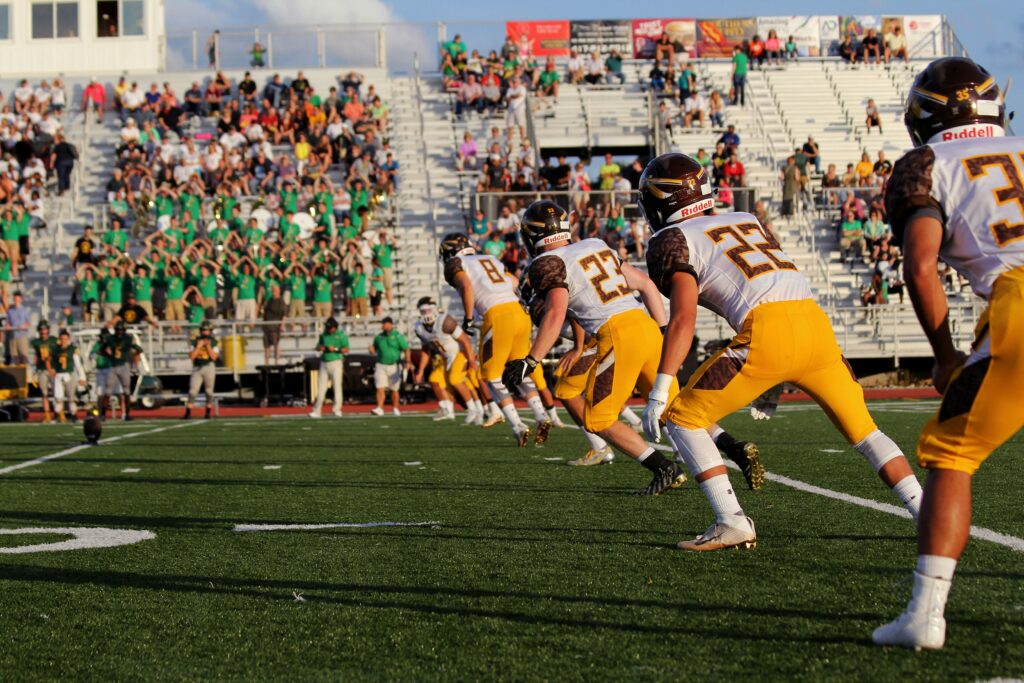
 Riley McCullough, Unsplash
 College athletics are big business. And states are increasingly competing to give their universities an edge in recruiting talented student-athletes. What began as an effort to allow athletes to profit from their own name, image, and likeness (NIL) is quickly evolving into something else: a state-level subsidy race.
Last year, North Carolina legislators introduced a new bill intended to “enhance the competitiveness of student-athletes in North Carolina.” The “Michael Jordans of Tomorrow Act,” named for North Carolina’s most famous college athlete, illustrates just how far this trend could go. It would not only expand NIL opportunities but also commit taxpayer dollars to support them.
Although a competing NC bill to “Authorize NIL Agency Contracts” is more likely to be passed than the “Michael Jordans of Tomorrow Act,” the latter is worth watching because it is distinct among state NIL policies. It suggests that the next phase of NIL policy may be defined less by markets than by government-backed competition among states. Some sports analysts are calling this competition a “race to the bottom.”
Even if North Carolina’s proposal does not advance, similar policies are already emerging across the country. Since 2019, at least 25 states have passed NIL laws allowing athletes to earn compensation. These laws enable private markets by removing NCAA restrictions, establishing disclosure and compliance requirements, and allowing students to have representation. All of that is to be expected, given recent court decisions limiting the NCAA’s ability to restrict athlete compensation and a broader recognition that athletes should be free to participate in ordinary market transactions. Some sports analysts are calling this competition a “race to the bottom.”
But many states are now taking it a step further. Instead of simply allowing markets to function, some policymakers are beginning to intervene in them, using tax policy and public resources to tilt the playing field. In 2025, Arkansas became the first state to exempt NIL earnings from state income tax. Mississippi followed Arkansas’s lead in 2026 with similar tax exemption legislation. Georgia, Illinois, Louisiana, New Jersey, and South Carolina are considering comparable policies.
These measures may appear modest, but they reflect an important shift. These measures may appear modest, but they reflect an important shift. Rather than removing barriers to private exchange, states are beginning to subsidize it. That shift changes the incentives for universities, athletes, and sponsors alike. It encourages escalation, rewards political influence, and risks crowding out private investment that would otherwise flow through voluntary arrangements. In doing so, it would move into explicit public financing of college athletics.
North Carolina’s proposed law would go further still, giving students and athletics programs more than just tax exemptions. It would give direct taxpayer-funded grants to student-athletes, offer tax credits to businesses that support or facilitate NIL compensation, and establish a new administrative infrastructure to oversee and distribute these payments.
Although the bill would ostensibly improve athletics recruitment at North Carolina universities, the costs would outweigh the benefits. In addition to directly decreasing the amount of general fund dollars for core government functions, the bill would expand the administrative government footprint in athletics and distort both higher education and NIL markets.
To be sure, NIL and transfer portal rules have upended college sports. Texas quarterback Arch Manning has reportedly made more than $6.8 million in NIL deals. Across the NCAA, television contracts are worth more than $1 billion annually. Predictably, universities are seeking ways to stay competitive in this new environment.
But state governments shouldn’t attempt to manipulate the market. The original logic of NIL reform was straightforward: allow athletes to participate in a market that already existed. That logic did not require taxpayers to finance the outcome.
We’ve seen this story play out before with incentives given to private companies, handouts for sports stadiums, and targeted film tax credits. The pattern is familiar: competition between states leads to subsidies, subsidies distort the market, and taxpayers are left with the bill. Legislators should resist the urge to add college athletics to the list.
Jenna A. Robinson is president of the James G. Martin Center for Academic Renewal.
Author
Jenna A. Robinson
