
 DMegias, Adobe Stock
 Two years ago, UNC-Chapel Hill introduced a new resource allocation model that ties funding more closely with student demand. This approach makes sense, aligning incentives across academic units and rewarding increased productivity. However, it means that some departments that have lost enrollment will have to make significant changes going forward.
UNC-Chapel Hill began to implement the new model in FY 2025, making changes incrementally. The previous fiscal year was treated as a “base budget” with subsequent funding being distributed primarily based on changes in enrollment by major. A Finance & Operations presentation explains that the new model addresses significant problems with the previous model, namely that “revenue generation does not tie to revenue distribution.” According to a memo outlining the changes, the new model will mean that “some adjustment in how funding is managed and budgeted” will be required. In practice, the model forces departments to respond more directly to student demand.
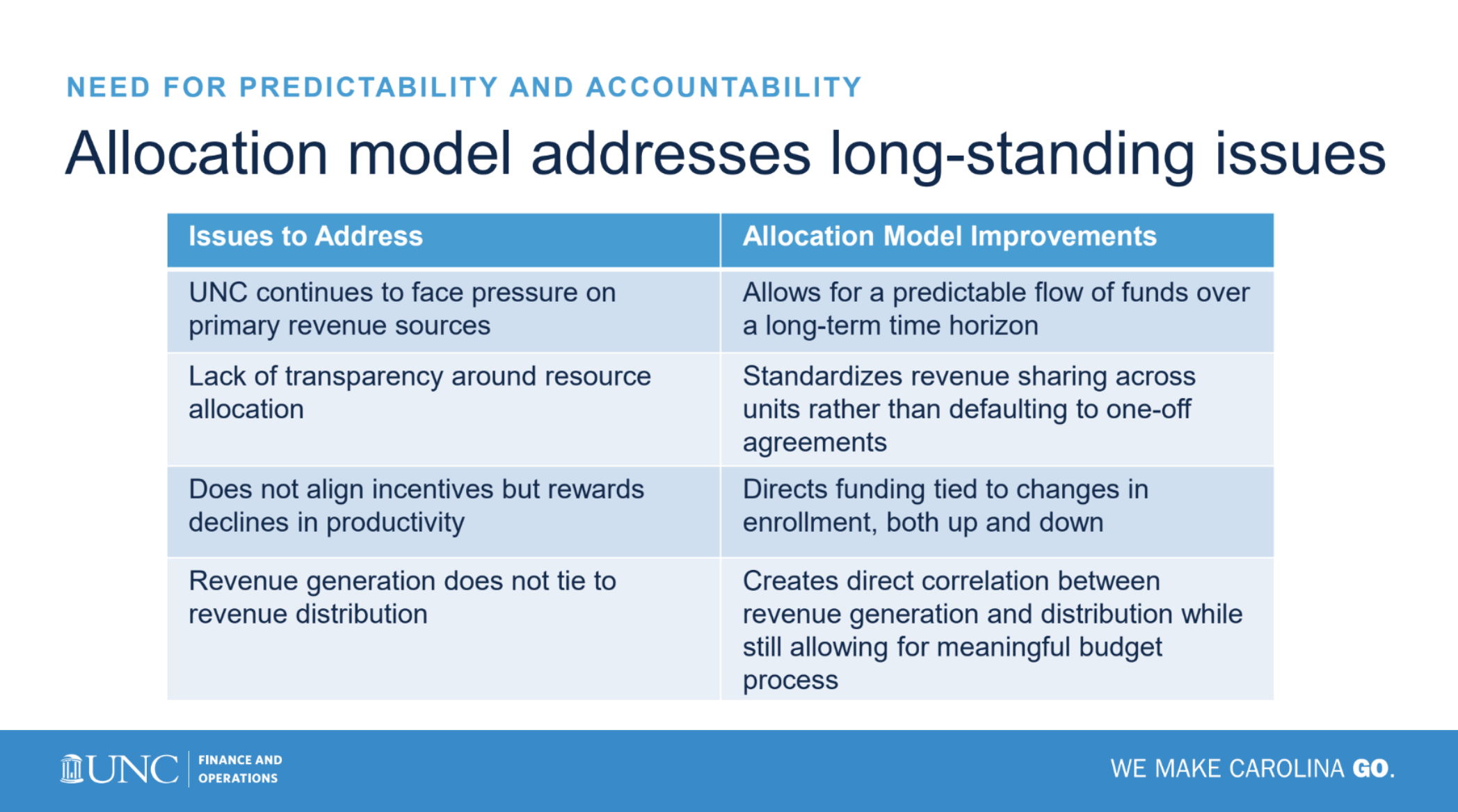
The model will greatly improve fiscal predictability and accountability across the university. It also addresses a fundamental problem in higher education: adaptability to changing student demands. By allowing funding to follow students, future decisions will necessarily be responsive to students’ needs. Too often, that hasn’t been the case in universities.
Changes will be felt most in departments that are either rapidly growing or rapidly shrinking. Those that are attracting more majors each year will see large increases in funding, enabling them to hire new faculty and staff to meet student needs. Those where the number of majors is shrinking will see concomitant declines in funding, and will have to cut costs.
One recent Board of Trustees decision demonstrates how the new fiscal realities are beginning to shape hiring decisions. On May 13, trustees voted against hiring with tenure a new women’s studies professor. The decision reflects longstanding UNC policy requiring tenure decisions to include consideration of “institutional needs and resources.” In previous discussions on tenure, UNC trustees voiced significant concerns about the long-term costs of tenure.
“Tenure is effectively a permanent commitment of taxpayer and tuition resources.”When reached for comment, Trustee Marty Kotis, chair of the committee on budget, finance, and infrastructure, told the Martin Center, “While I cannot comment on any specific candidate or personnel action, I believe public universities must begin treating tenure decisions with the same level of financial scrutiny applied to any other long-term institutional obligation.” He continued, “Tenure is effectively a permanent commitment of taxpayer and tuition resources, and those commitments should be evaluated alongside enrollment trends, student demand, research funding patterns, and broader institutional priorities.”
The department’s recent enrollment trajectory provides important context for the vote. Current enrollment in the women’s and gender studies department doesn’t justify the long-term commitment of the resources required to hire an additional faculty member. Information from the UNC System’s data dashboard on enrollment confirms those facts; the number of Women’s Studies majors fell from 70 in fall 2016 to just 33 in fall 2025, a decrease of more than 50 percent. According to the Historical Course Record, total enrollment in all Women’s Studies courses fell from 635 in fall 2021 to just 366 in fall 2025, a decline of 42 percent in just four years. In this environment, growing the department (or even replacing a departing faculty member) doesn’t make financial sense.
“In an era of constrained resources, universities cannot operate as though every program exists in a vacuum insulated from market demand or fiscal realities,” Kotis stated.
The broader issue is whether universities align long-term commitments with demonstrated student demand.The broader issue is whether universities align long-term commitments with demonstrated student demand. Trustees’ insistence on aligning both funding allocation and tenure decisions with student demand and university resources should be applauded. It demonstrates a commitment to accountability and fiscal responsibility.
Still, universities should make these decisions earlier and more systematically. For example, the process should be streamlined so that institutional needs and resources are considered well before new hires come before the board for final approval. Departments should carefully consider their available resources before posting faculty positions. The university should also insist on balanced departmental budgets to ensure that such considerations are given appropriate weight.
Kotis told the Martin Center, “Trustees are ultimately accountable for the long-term financial health of the institution, yet our formal involvement largely occurs at the end of the process. I believe governance would improve if trustees had earlier visibility into program performance, budget impacts, and strategic alignment before tenure recommendations reach the board.”
Ultimately, UNC-Chapel Hill’s new funding allocation system should be a model for other universities in the UNC System. It improves accountability, predictability, and fiscal responsibility, especially as demographics and enrollment change. With careful implementation, these benefits could spread across the state.
Jenna Robinson is president of the James G. Martin Center for Academic Renewal.
Author
Jenna A. Robinson
