
 Freedomz, Adobe Stock
 North Carolina enjoys a healthy, growing economy. Unemployment rates are low. Job growth is robust. And people continue to move to North Carolina at staggering rates. But new data from the UNC System and the North Carolina Department of Commerce reveal that North Carolina’s education outcomes don’t always match the state’s workforce needs.
Demographic and economic trends also contribute to workforce shortages in key fields. According to the NCDHHS Division of Aging and Adult Services, roughly 20 percent of North Carolina residents are now older than 65. Many are retired. At the same time, declining birth rates mean there are fewer young people entering college and the workforce in general.
Together, these trends—the demographic cliff, an aging population, and misalignment between degrees and jobs—create significant mismatches between available jobs and employee skills.
The shortage is already visible to North Carolina employers.The shortage is already visible to North Carolina employers, who want to hire but often report difficulty finding workers with job-ready skills. According to the North Carolina Department of Commerce’s 2024 Employer Needs Survey, 62 percent of employers report having difficulties in hiring. The UNC System Workforce Alignment Report underscores this difficulty, noting that North Carolina is “undersupplied for meeting future demand” in many academic disciplines, including business, computer science, education, engineering, and health professions.
The report defines an “undersupplied” degree as one where program completions would need to increase significantly and where either earnings are high, or there is an important public purpose (e.g., teaching). It identified “critical workforce gaps” in nursing, engineering, social work, and teaching. Currently, the UNC System educates a large number of graduates with degrees in these sectors, but not enough to meet demand.
The NC Community College System has also identified workforce gaps in several essential sectors, including: healthcare, engineering and advanced manufacturing, trades and transportation, information technology, and public safety and first responders.
Traditional degree pathways are often slow to adapt.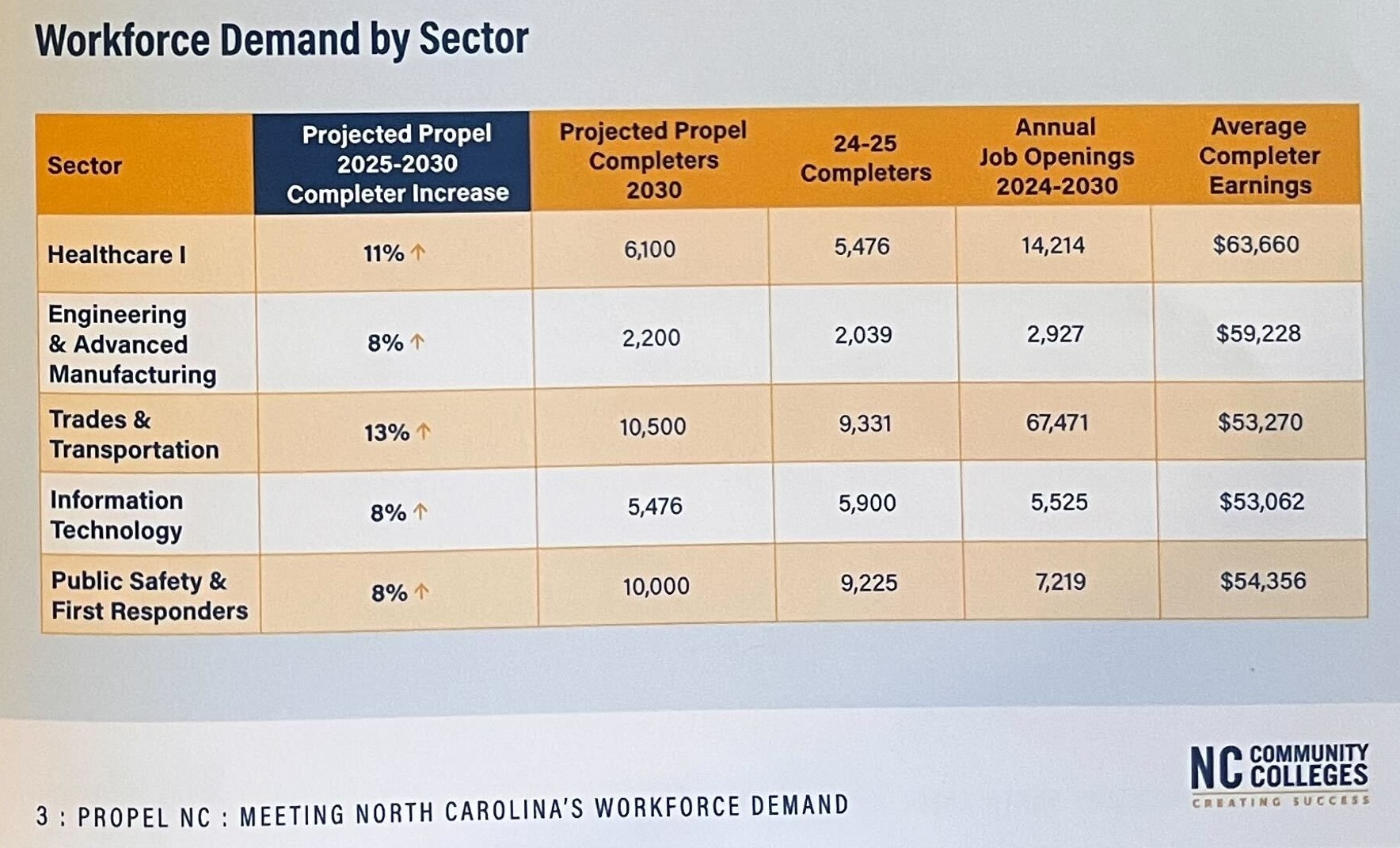
There are myriad causes for this unmet employer demand. Rapid technological change exacerbates the misalignment between available jobs and current skills by accelerating demand for new competencies. Traditional degree pathways are often slow to adapt, leading to an overproduction of degrees in fields with weak labor-market demand. And labor market signaling often lags employer needs, making it difficult for institutions of higher education to anticipate which programs should grow. Alternative pathways such as apprenticeships, short-term credentials, and employer partnerships can often adapt more quickly to changing workforce needs.
Workforce mismatch also means that graduates who chose majors with little employer demand are often underemployed. In 2024, 45 percent of recent North Carolina college graduates were underemployed: they earned a college degree but did not work in college-level jobs. For example, many recent graduates of four-year institutions in North Carolina work in retail or hospitality roles that do not require a bachelor’s degree within their first five years after graduation.
Business as usual won’t close these gaps.Underemployment affects students graduating from all types of postsecondary institutions. For example, at inclusive public colleges and universities, 60 percent of graduates with a terminal bachelor’s degree in communications are underemployed. As are 59 percent with degrees in psychology, 58 percent with degrees in visual and performing arts, and 56 percent with degrees in biological and biomedical sciences. At selective public universities, 52 percent of psychology majors end up underemployed, as do 52 percent of communication and journalism majors, and 52 percent of visual and performing arts majors.
Business as usual won’t close these gaps. Innovative thinking and multiple pathways are necessary. Apprenticeships, 90-hour bachelor’s degrees, high-quality workforce credentials, and employer partnerships should all be part of the solution. Legislators should help by ensuring that incentives are aligned so that businesses and postsecondary education institutions can work together to provide the workforce that’s needed. They can also ensure that there are no regulatory barriers to such public-private partnerships. North Carolina’s vibrant economy demands that students have access to multiple flexible, adaptable pathways to success.
Jenna Robinson is president of the James G. Martin Center for Academic Renewal.
Author
Jenna A. Robinson
