
 Gancheva, Pixabay
 Education experts have written many excellent books and articles in recent years and made insightful presentations covering a range of important topics – admissions, curriculum, pedagogy, administration, and accreditation. The Martin Center itself has co-authored model legislation for general education. From different perspectives, many of these present well-reasoned arguments for the restoration of the Western tradition in general education. While there has been some recent progress, it has been gradual and halting. To move forward, I suggest we review three lessons from ancient Sparta.
Defining the Scope
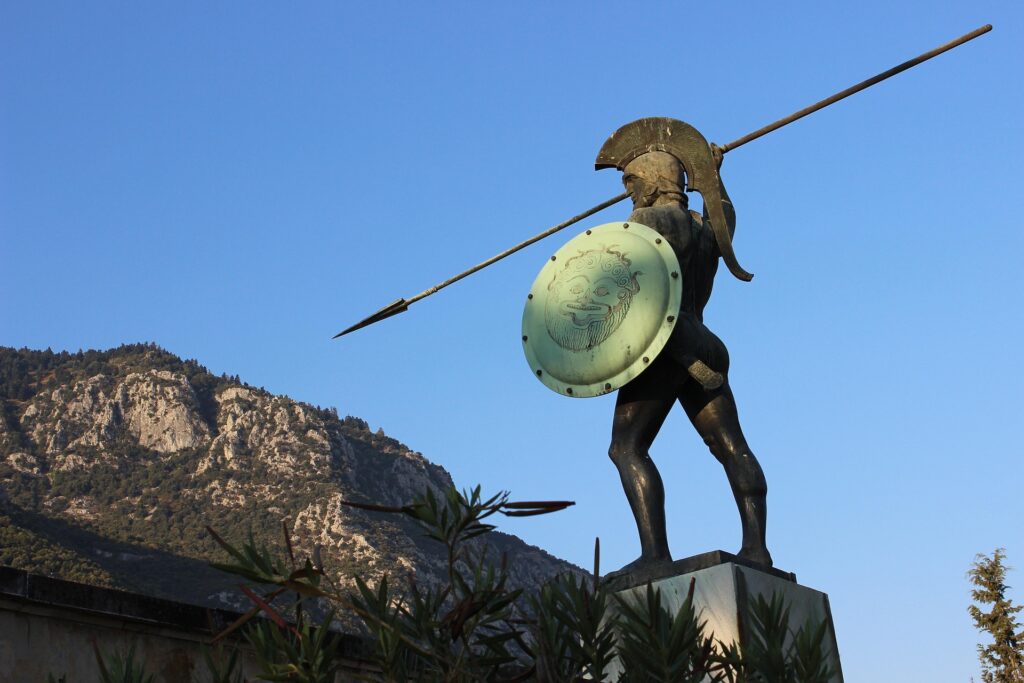
Their goals were much more limited: to unify and defend the Greek city-states.In 480 BC, Sparta and its allies were vastly outnumbered and overmatched by the invading Persian army. In response, the Greeks did not set out to conquer the world, or even Persia. Their goals were much more limited: to unify and defend the Greek city-states, a relatively small geographic area.
Likewise, current education reformers should perhaps not try to “save the world,” i.e., U.S. higher education. Why spend time, resources, and energy on an institution that does not wish nor deserve to be saved? Instead, like good Spartans, reformers ought to focus on the preservation of a smaller, strategically defensible area. Taking our cue from the Encyclopedists of Isaac Asimov’s Foundation, let’s get out of the way and let the corrupt Empire crumble.
Narrowing the Battlefield
Meanwhile, back to the defense of Greece. The current structure of general education — departments for STEM, social sciences, humanities, etc.— leaves every subject matter area open to attack, often keeping reform-minded experts occupied with unproductive disputes (e.g., is mathematics patriarchal or Eurocentric?), when that time and effort could be better spent on the issues that truly matter.
In addition, reformers are heavily outnumbered and overmatched in terms of money, media support, and other key resources. As mentioned, the outnumbered and overmatched Greeks responded by funneling the Persian army into the narrow, more defensible pass at Thermopylae.
In academia, the battlefield is intellectual. How do we apply the wisdom of Spartan leadership to the current situation in general education, i.e., how do we narrow the battlefield? I suggest we begin by redefining the terrain, using as our point of departure a concept that virtually everyone agrees is worthy — the teaching of critical thinking skills. Such skills arguably include the ability to distinguish between analytic and synthetic statements (Kant), falsifiable and non-falsifiable hypotheses (Popper), and facts and values (Hume). Here is my redefined terrain:
I suggest we begin by redefining the terrain, using as our point of departure a concept that virtually everyone agrees is worthy — the teaching of critical thinking skills.- A department of analytic knowledge. This would include most of mathematics and linguistics. In general, these subjects are either true by definition or logically derived from axioms. No serious academic reformer should waste time disputing definitional or logical subject matter. By establishing such a department, we remove these subjects and topics from the fight, conserving our scarce resources. To the extent that it is impractical to have “pure” analytic courses, this can be mitigated by descriptive syllabi that clarify which course sections are analytic vs. those that fall elsewhere.
- A department of falsifiable knowledge. This would include the “hard” sciences of physics, chemistry, biology, and others that meet Karl Popper’s test of falsifiability. Once again, faculty would face the prospect of “impure” subjects that comprise both falsifiable and non-falsifiable concepts, such as psychology. This framework would not completely remove these subjects from the battlefield, but it should significantly narrow the range and type of disputes.
- A department of non-falsifiable knowledge. Here is the true battlefield. This would be largely populated with the social sciences, which are loaded with important issues. Here is where we grapple with freedom vs. equality, capitalism vs. socialism, the sacred vs. the secular, etc. All of these and more deserve a well-furnished home in the university, but they must be placed in the proper non-falsifiable context. They must not be presented as analytic or falsifiable concepts. This is our narrow pass at Thermopylae.
- A department of fine arts and humanities. What belongs here? Subjects that do not purport to be intrinsically factual. This important area has also suffered, for example, from the teaching of “facts” that are often subjective assertions of opinions and values.
Importantly, I’m not suggesting a costly and time-consuming physical change in departmental structure, but rather a definitional change to be applied to each specific course. The above structure would certainly come with its own set of problems. There would undoubtedly be disputes about the appropriateness of using Popper’s scientific principles or Kant’s epistemology.
But I propose them as ideas for a more efficient general framework, not as an invitation to a philosophical debate. More importantly, do I think the academic world will flock to this new structure? Of course not, but as mentioned, conquering the world should not be the objective. But if our goal is to effect real change, what is the next step?
Inspiring the Uncommitted
Marx and Engels famously wrote “Workers of the world, unite!” in The Communist Manifesto. Setting aside whether one agrees with the Manifesto, this was clearly a call to action that reached the heart of the disaffected. Unlike most arguments for capitalism or constitutional republicanism, it was visceral. Things are not going the right way, and I can do something! Those of us who desire a return to the Western tradition in general education have plenty of excellent logical, factual arguments, but no call to action, certainly not in a Marxian sense. Here’s an analytic proposition: to win hearts and minds, one must win hearts!
Here’s an analytic proposition: to win hearts and minds, one must win hearts!To expand the mission to restore Western Civilization to currently uncommitted donors, parents, students, and future members of the faculty and administration, can we find inspiration in our own Western tradition? I hope so. Let’s recall one final lesson from Thermopylae. As discussed, the Spartans employed a very effective, although ultimately unsuccessful, military strategy.
But this battle provided another, perhaps more important benefit — a symbol of courage and valor against a superior foe, which contributed to the subsequent success at Salamis.
As we move forward to the hoped-for reform and recovery of our Western academic tradition, we need to look to our own intellectual reserves for such symbols. It falls to us 21st-century Spartans to find and apply these symbols to accelerate needed change.
Author
David C. Dufendach
