
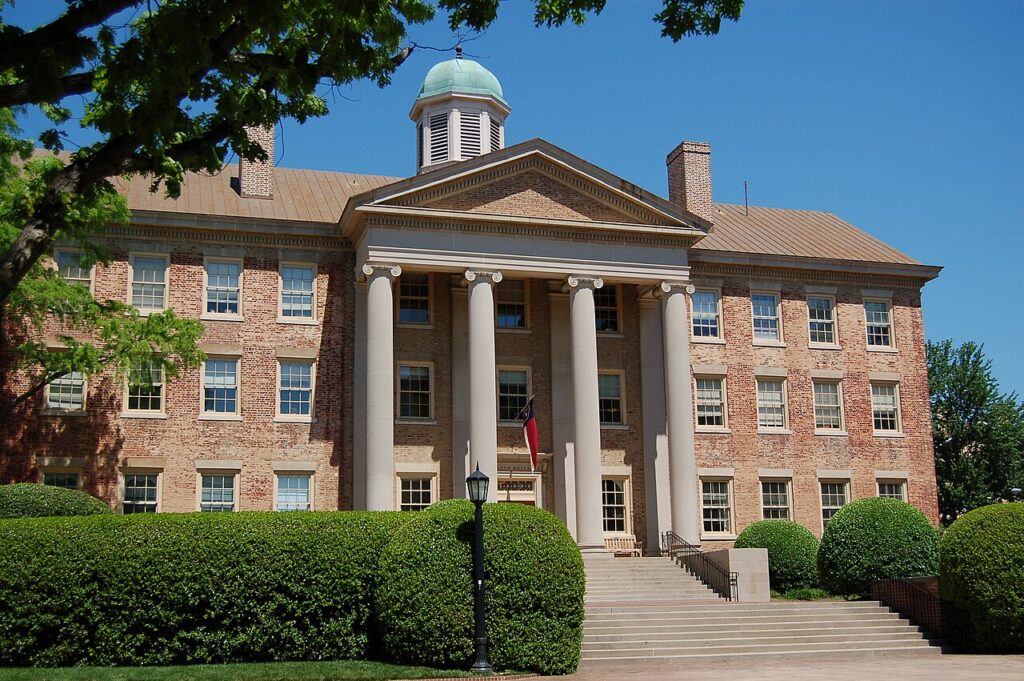
 Wgreaves, Wikimedia Commons
 I have always found it inspiring that the University of North Carolina was chartered in 1789—during the same legislative session that ratified the American Constitution. The demands of citizenship were very much on the minds of state lawmakers as they laid the groundwork for the nation’s first public university. UNC’s earliest charge was to prepare a rising generation “for an honourable discharge of the social duties of life.”
As America has just celebrated its 250th birthday, those social duties have become more fraught. An alarming percentage of young people feel distrustful and disconnected from public life, pessimistic about democracy, and reluctant to share their earnest opinions about important issues. The intensifying partisanship and social-media surveillance of the last couple decades has made it much harder for universities to meet their mission of readying students for citizenship in our constitutional democracy.
The intensifying partisanship and social-media surveillance of the last couple decades has made it much harder for universities to meet their mission of readying students for citizenship in our constitutional democracy.But the UNC System is up for the challenge. This summer, scores of faculty members from across the state gathered for the Common Ground Collaborative, a new effort to promote civic discourse and constructive dialogue at North Carolina’s public universities. There is already excellent work happening across the state, with BridgeUSA chapters growing on many campuses and faculty members working with the College Debates and Discourse Alliance, an initiative of the American Council of Trustees and Alumni (ACTA), at nearly all public universities.
The UNC System Office is investing real money to broaden the effort, thus far awarding more than $500,000 in grants that will allow dozens of faculty across 16 UNC campuses to build or redesign courses to emphasize open debate and civil dialogue. We’re restarting the highly-regarded 2022 survey on Free Expression and Constructive Dialogue, which offered a detailed look at student attitudes about free speech and political engagement. And we’re partnering with the Constructive Dialogue Institute to deliver training to hundreds of students this fall in how to listen and work through disagreement.
“If we want our universities to survive as freethinking, truth-seeking institutions, we need to toughen up our commitment to free inquiry and civic discourse,” UNC System President Peter Hans said earlier this spring, announcing the new civic initiatives alongside a stronger definition of academic freedom. “It took many years of disruption and distraction to reach the challenging state we’re in now, and it will take many years of patient recommitment to sustain the culture of inquiry and truth-seeking we need.”
At the Common Ground gathering in May, professors in fields from political science to physics showcased the teaching techniques they use to get students discussing and debating. They talked about encouraging students to share honest views about fraught topics. And they emphasized the need for everyone to put down their phones and let the college classroom be a forgiving place for open-minded discussion.
And they emphasized the need for everyone to put down their phones and let the college classroom be a forgiving place for open-minded discussion.Rob Taber, an historian at Fayetteville State who is leading a statewide faculty effort to support more dialogue in the classroom, stressed that “civil discourse” isn’t just about being nice to one another. It means figuring out how to work together to solve real problems, which is the fundamental goal of civic life.
“Problem-solving requires recognizing and diagnosing challenges, establishing dialogue across common ground, testing opposed hypotheses, and engaging in reasoned debate and constructive dialogue across disciplines,” Taber told more than 100 faculty members gathered in Charlotte. “To me, one of the best features of civil discourse is that in an era where so many people—and AI-powered social media bots—are shouting their answers, civil discourse requires us to hear and raise questions.”
As any good professor knows, that can only happen when students trust one another, and when faculty have the freedom and support to tackle difficult topics. One of the biggest obstacles to effective civic education right now, one that shows up clearly in the 2022 survey results and in every honest conversation with college students, is the fear that one misunderstanding or contentious comment can be taken out of context and blasted across the internet. Like Americans of all ages, young people aren’t going to speak honestly if they worry that any stray remark can become a reputation-wrecking firestorm.
One of the biggest obstacles to effective civic education right now…is the fear that one misunderstanding or contentious comment can be taken out of context and blasted across the internet.“Trust has to be intentionally built,” explained Jake Fay, who leads education efforts for the Constructive Dialogue Institute. “You have to design your classroom for it.”
And universities have to design their policies for it. That’s why the UNC System has some of the strongest free speech and academic freedom protections in the nation, including a provision that explicitly protects the teaching of controversial ideas. If we want our students to be ready for the rough-and-tumble of American public life, we need classrooms where students and professors alike are comfortable tackling tough issues.
“Our public universities, especially, are purpose-built to be in conversation with the broader public life of our nation,” President Hans said. In North Carolina, we’re working hard to make sure that stays true for another two and a half centuries.
Eric Johnson is a senior advisor at the UNC System.
Author
Eric Johnson
