
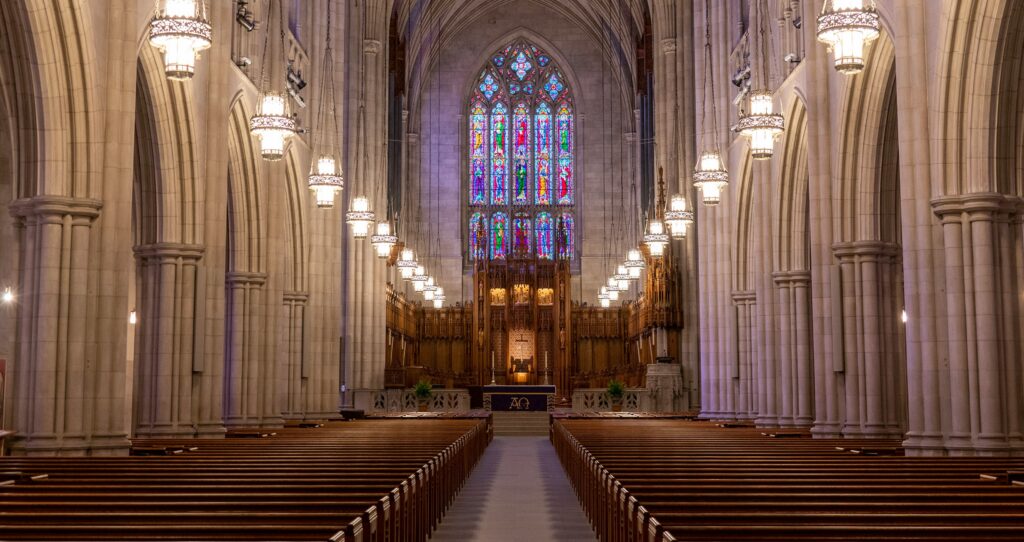
 Yiyang, Unsplash
 To Christian eyes, our nation’s most prestigious university chapels are in a state of utter decay. This is, of course, not a new claim. Entire scholarly careers have already come and gone documenting the decline of institutional Christianity at America’s elite colleges. Most Americans know that the gospel of the modern university chapel is, at best, that of the yard sign exclaiming “God is Love,” and, at worst, professedly anti-Christian. But what if I told you that there is still a Christian, Nicene Creed-affirming university chapel out there lurking in the spiritual wilderness?
Enter Duke Chapel, which still boasts a full Christian liturgical calendar. This is quite distinct from Duke’s two most comparable chapels, with Harvard’s Memorial Church only holding services during the academic year and Yale’s University Church taking a “hiatus” during the month of July.
In addition to being more regular, Duke Chapel’s services are also far better attended, boasting a weekly attendance in the hundreds and a full, traditional choir—even during the summer months.In addition to being more regular, Duke Chapel’s services are also far better attended, boasting a weekly attendance in the hundreds and a full, traditional choir—even during the summer months. By contrast, Harvard and Yale’s congregations maintain weekly attendance in the dozens, despite Harvard itself maintaining a significantly larger total student population than Duke. One only has to look at recordings of the most recent services at each university church to understand the extent of Duke’s congregational advantage (See: Duke Chapel service on 6/28 vs Yale).
But, one might object, these differences have little bearing on whether Duke Chapel is actually Christian. Perhaps Duke’s fuller liturgical calendar, larger congregation, and broader programming are simply products of greater resources and a larger university. Certainly, Duke Chapel enjoys considerable advantages: generous financial support, a dedicated staff, and one of the nation’s finest examples of Collegiate Gothic architecture.
Yet money and magnificent buildings do not create living congregations. If anything, recent American church history suggests the opposite. Some of the country’s wealthiest and most architecturally impressive mainline Protestant churches have struggled for decades with dwindling attendance and declining religious commitment. Endowments may preserve buildings, but they cannot fill pews. The fact that hundreds continue to gather each Sunday at Duke Chapel therefore suggests an explanation beyond its budget or its stone walls.
A potential answer to this question can be found in the kinds of people who preach at Duke Chapel. Since 1932, Duke Chapel has maintained an unbroken line of ordained, Christian deans, all of them heterosexual men. There have, of course, been female pastors on the Chapel staff for decades, many of whom regularly preach and preside over services. Yet the office of Dean has remained occupied by ordained Christian clergy whose preaching has remained recognizably within the broad stream of Nicene, ecumenical Protestant Christianity.
In an era when questions surrounding women’s ordination, sexuality, and the authority of Scripture have become defining fault lines within Protestantism, the identity of those entrusted with the Chapel’s principal preaching ministry says much about the institution’s theological heart.In an era when questions surrounding women’s ordination, sexuality, and the authority of Scripture have become defining fault lines within Protestantism, the identity of those entrusted with the Chapel’s principal preaching ministry says much about the institution’s theological heart. Duke’s current dean, Rev. Dr. Luke A. Powery, was ordained in a liberal denomination and often emphasizes themes of social justice, reconciliation, and acceptance. Nevertheless, his preaching remains unmistakably Christian, centered on Scripture, Jesus Christ, and the historic liturgy of the Church rather than mere spiritualism.
The same cannot be said of Duke’s peers. Harvard’s Memorial Church has welcomed imams and rabbis into its Sunday pulpit and, more broadly, Harvard drew national attention in 2021 when it selected an atheist to serve as the university’s chief chaplain. No comparable display of religious pluralism has occurred during Duke Chapel’s official Sunday worship. For its part, Yale University’s equivalent of the Chapel Dean—the Pastor of the University Church—has, in recent years, been occupied by women such as Martha Highsmith.
Whether these differences are merely differences of degree or represent total breaks from historic Christianity is ultimately for theologians to debate. What is clear, however, is that Duke Chapel has been markedly more cautious than its peer institutions in altering the character of its principal preaching office or inviting non-Christian religious leaders into its regular Sunday services.
That said, there are still many aspects of Duke Chapel that fall far outside the mainstream of historic Christianity.
Though the Chapel officially sanctioned same-sex marriages in 2000, it has, in recent years, become bolder in its support of progressive sexual causes. This was made exceedingly clear to me when, at the Chapel’s marquee event, the 2024 Few Lecture, which I staffed as a Chapel Ambassador, Irish poet Pádraig Ó Tuama intimately described his boyhood homosexual passions from the lectern. He read the following excerpt:
“I wish you [the priest] didn’t see intrinsic evil in me… all my homosexualities… the nest of demons in me… I wondered where they lived: in my semen? In the dreams I had of being kissed? Why did they breed in me? My God. My exorcist.”
As Ó Tuama read from the lectern, mere feet away from James B. Duke’s sarcophagus, one wonders whether this was the sort of spiritual influence Mr. Duke envisioned for his “great towering church.”
In truth, Duke Chapel has not gone as far as its peers in fully endorsing this LGBTQ+ anthropology. But it has, as this Ó Tuama episode shows, demonstrated a striking willingness to platform the voices of that movement.
Perhaps even more damning is that the Chapel has a very recent history of employing outspoken homosexual pastors. During my time at Duke, one of the most highly-advertised educational programs for undergraduates—apart from the more orthodox Chapel Scholars program—was a series of seminars called “Theology Underground.” This program was led by lesbian pastor Racquel Gill—now the community relations supervisor for the City of Raleigh’s DEI Office—and introduced students to topics such as queer theology, womanist ethics, and the theology of Malcolm X.
Apart from its approval of radical theories regarding sexuality and aforementioned willingness to employ female pastors, Duke Chapel also has some difficulty, like its peers who occupy similar positions on their campuses, decoupling its competing roles of Christian church and the university’s hub for all religious life. One need only look at the Chapel’s “About the Chapel” page on its website to see how it first characterizes itself as “open to all people” and a “suitable institution to act as the moderator for Religious Life at Duke” before saying anything about its Christian congregation. One may even get the impression from these official writings that the Chapel understands itself primarily as a “symbol of faith” that just so happens to have overtly-Christian architecture and ordained, creed-affirming clergy.
This struggle to clearly articulate its Christian commitments in the face of its secular, institutional obligations was made painfully clear in 2015, when Duke administrators briefly permitted, then walked back, broadcasting the Islamic call to prayer from the Chapel’s bell tower.
Yet even in light of these concerns, Duke Chapel remains…more consistently tethered to the creedal core of historic Christianity…Yet even in light of these concerns, Duke Chapel remains, by the standards of its peer institutions, more consistently tethered to the creedal core of historic Christianity, at least as measured by worship, clerical identity, and liturgical continuity. But why?
To explore this question I spoke with Duke Chapel’s Assistant Dean, Bruce Puckett, an ordained minister and Chapel staff member since 2012. Rev. Puckett attributes Duke Chapel’s perseverance to three basic factors unique to Duke: its location, historical inheritance, and leadership.
Puckett argues that Duke Chapel should be understood both as a Southern church and as the “emblem of the university”—built at the literal center of West Campus by design. As he put it, “the Dukes building the chapel right at the center of campus made a difference, a continued difference.” Puckett likewise argued that the Chapel’s endurance should be seen just as much a consequence of the broader religious appetite of the South as it is a product of its physical prominence on campus. Because “faith matters more to people” here, Puckett contends, the Chapel has an easier time soliciting funds and attracting large gatherings for its regular services. Pew’s recent Religious Landscape Study says as much, showing that North Carolinians are markedly more religious than their counterparts in the Northeast.
But, for whatever credit one can attribute to the general culture surrounding Duke Chapel, it is really its history and leadership which explain its continued adherence to the Christian faith.
Throughout its recent past, the leadership of Duke Chapel has consistently refused to frame Christianity as opposed to the modern university, instead presenting it as the tradition best suited to serve a religiously diverse campus. Former dean, Rev. Dr. Sam Wells (2005-2012), insisted, in a 2007 report provided by Puckett, the Chapel remain an example of “generous Christian orthodoxy” while stressing its role as the university’s convenor of religious life, creating space for Catholics, Muslims, Jews, Buddhists, and Hindus rather than asking them to operate on Christianity’s margins. To this end, Wells explicitly argued for the creation of an official Muslim chaplaincy position, an office that would be formally established in the summer of 2008.
During his term, Dean Powery (2012-Present) has pursued a similar path to his predecessor, preserving traditional worship while emphasizing dialogue and pluralism through new programs like the Pluralism Lecture. Whether this vision constitutes a theological success is another matter. A Christianity defined principally by hospitality will often hesitate to insist upon the exclusivity of its own truth claims—and the Chapel’s official embrace of same-sex marriage and willingness to platform speakers outside historic Christian teaching testify to that cost.
Yet those tensions may also help explain its institutional durability.Yet those tensions may also help explain its institutional durability. Unlike peer institutions that have softened their Christian identity and relocated to the fringe of campus life, Duke Chapel has preserved a recognizable Christian identity while expanding its role as an arbiter of the campus’ religious future. It has, in effect, retained the forms of historic Christian worship while embedding them within a broader framework of religious pluralism.
Ultimately, the question of whether the Chapel has struck the right balance is for the theologians to decide. But as an institutional matter, it is difficult to avoid the conclusion that— in an era when most elite university chapels have receded to the periphery of the higher education landscape—Duke Chapel remains remarkably central. It has done so not simply by resisting pluralism and progressive critiques of traditional Christianity but by recasting the faith itself as the language through which the university speaks about religion.
Sherman Criner is a Duke University alumnus interested in public policy, history, and political science. He is an incoming Ph.D. student in history at Stanford University.
Author
Sherman Criner
