

Last week, UNC-Chapel Hill became the most recent university in the country to settle with the U.S. Department of Justice (DOJ) over allegations of antisemitism and racial preferences. It also became the second, after the University of Virginia, to reach a settlement without a monetary penalty. Other universities, including Columbia, Brown, Cornell, and Northwestern, agreed to pay heavy monetary penalties to settle more comprehensive DOJ complaints.
Observers from both within the university community and beyond have criticized the agreement, some for its overreach and others for its laxity. UNC insiders criticized the agreement’s antisemitism provisions. Political provocateur Laura Loomer complained on X that “The DOJ caught Chapel Hill *continuing* to discriminate on the basis of race in admissions,” but offered a “sweetheart deal,” letting them “completely off the hook.” (She cited no evidence for her claim.)
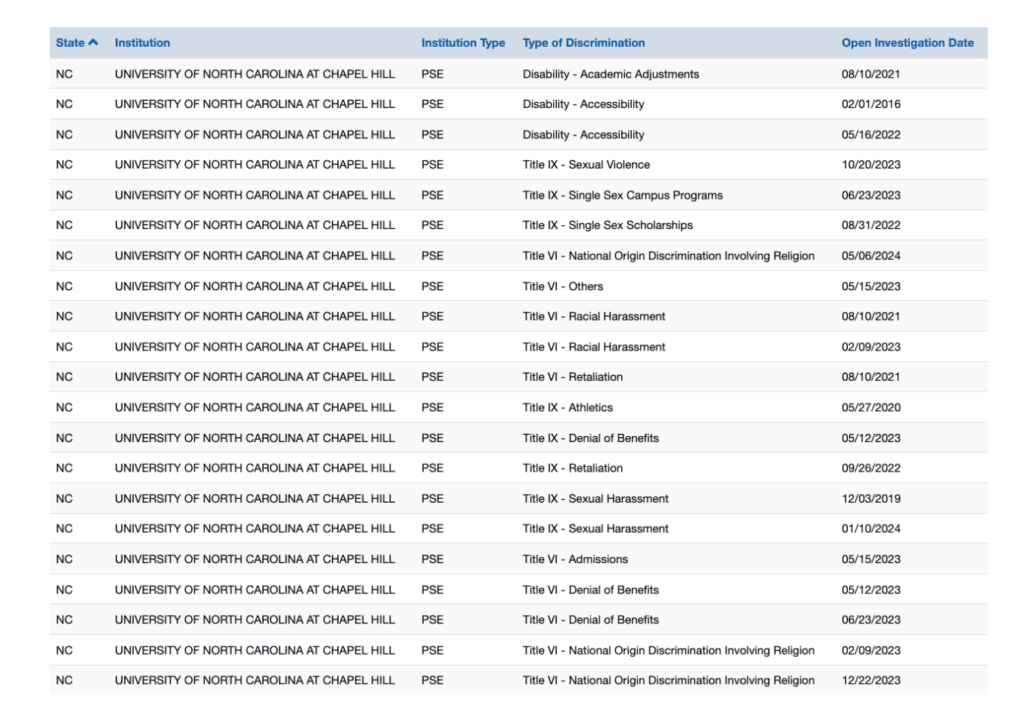
However…UNC’s settlement appears fair to both the university and the Justice Department.Publicly available information about specific allegations against UNC is sparse. However, based on the limited information available, UNC’s settlement appears fair to both the university and the Justice Department. The agreement closed 18 federal investigations, some going back to 2019, as well as a separate DOJ compliance review. UNC describes the investigations as “addressing allegations of discrimination based on race, sex, ethnicity, and other protected characteristics, including antisemitic harassment and other harassment based on shared ancestry.”
The Martin Center attempted to identify as many of the listed complaints as possible.
A few have explicitly appeared online:
- Title VI Antisemitism Complaint: On December 22, 2023, the Department of Education’s Office for Civil Rights announced that it would investigate whether UNC responded appropriately to “alleged harassment of students based on shared Jewish ancestry in a manner consistent with the requirements of Title VI.” The two incidents in question were an offensive statement made in class by a UNC faculty member and comments during a roundtable discussion co-sponsored by the UNC Department of Geography and Environment and the UNC Center for Middle East and Islamic Studies. (Read the full account in the Daily Tar Heel.)
- Discriminatory Scholarships: Three scholarships “exclusive to Black students” were named in a June 23, 2023, letter from the Office for Civil Rights to Mark J. Perry, who filed the complaint. The letter also listed a “Well-Being Initiative for Women Faculty of Color,” a program limited to “BIPOC female Assistant and Associate Professors.” (Read the OCR letter here.)
- Unequal treatment of pro-Israel and pro-Palestine students and student groups: In 2024, Palestine Legal filed a complaint on behalf of UNC-Chapel Hill’s chapter of Students for Justice in Palestine, alleging that the university gives “preferential treatment [to] Israeli students and their allies” and “target[s]…pro-Palestine students and groups.” (NC Newsline covered the complaint here.)
Using ProPublica’s Civil Rights Investigations database, the Martin Center found information regarding two additional OCR cases listed in the settlement:
- Case 11-25-2330: Grievance Procedures (6/17/2025)
- Case 11-26-2233: Different Treatment/Exclusion/Denial of Benefits (other) (2/10/2026)
And the Department of Education’s OCR database (last updated January 14, 2025) lists the following investigations as “pending.” Since case numbers are not listed here, it’s impossible to identify which of these cases are included in the settlement. One of the open cases lists “Title VI – Admissions” as the type of discrimination.
The Martin Center’s own experience with administrators at UNC-Chapel Hill has shown that they are usually quick to resolve complaints of illegal discrimination. The Martin Center previously called out several discriminatory scholarship programs across the university. These programs—including the Carolina Millennial Scholars Program, the Chancellor’s Science Scholarship, and the Gates Millennium Scholars—all appear to have been discontinued.
UNC is already obligated, under state law, UNC System policy, and campus policy, to carry out many of the demands made by the Department of Justice.The Martin Center also wrote about several programs at UNC-Chapel Hill and across the UNC System that discriminated against men. In 2021, the Martin Center criticized the women-only BRIDGES program, which has since been opened to “all higher education professionals seeking to gain or strengthen their academic leadership capabilities.” And in 2020, the Martin Center identified “at least a dozen UNC programs [that] discriminate on the basis of sex.” The related OCR complaints that were filed at the time were all successfully resolved.
Moreover, as others have already pointed out, UNC is already obligated, under state law, UNC System policy, and campus policy, to carry out many of the demands made by the Department of Justice. (AI was used to compile the data in the following table.)
| Item in the agreement | Agreement provision | Existing state, BOG, or campus requirement |
|---|---|---|
| Both parties must respect academic freedom and free expression. | §7 | BOG Policy 300.8.5, §§IV–V already protects free expression and academic freedom; its implementation guidance preserves faculty control of academic content. |
| UNC must prohibit antisemitic discrimination and protect Jewish and Israeli students. | §9(b)–(c) | UNC’s Policy on Prohibited Discrimination, Harassment and Related Misconduct expressly identifies antisemitic harassment and discrimination against people perceived to be Jewish or from Israel. |
| UNC must respond promptly to discrimination and harassment complaints. | §9(b)–(c) | Campus policy requires prompt, impartial, effective resolution and assigns coordinated response responsibilities to the University Compliance Office. |
| UNC must maintain complaint and disciplinary records. | §9(e)–(f) | The campus policy’s records section requires retention of reports, outcomes, and disciplinary records. |
| UNC must restrict the use of masks used to conceal identity during protests. | §9(h) | G.S. 14-12.7 and 14-12.8 already prohibit identity-concealing masks on public ways and public property, subject to G.S. 14-12.11 exceptions. |
| UNC must require student organizations to admit members without racial discrimination and hold organizations accountable for misconduct. | §9(i), §11(f), §12(b) | The 2025–26 Student Organization Handbook requires nondiscriminatory membership. The campus discrimination policy permits charging organizations collectively for prohibited conduct. |
| UNC must not discriminate or grant racial preferences in admissions. | §10(a) | UNC’s July 27, 2023, trustees’ civil-rights resolution prohibits unlawful discrimination and preferential treatment in admissions. The university’s admissions policy also requires nondiscriminatory access. |
| UNC may not use essays or other racial proxies to award admissions preferences. | §10(b)–(c) | The 2023 trustees’ resolution expressly prohibits race-based heuristics or proxies, including through application essays, and requires evaluating applicants’ experiences individually. |
| UNC must select admissions personnel without racial discrimination. | First part of §10(i) | The 2023 trustees’ resolution covers hiring; BOG Policy 300.8.5, §II requires nondiscrimination in employment. |
| UNC must consider standardized test scores when applicants submit them. | §10(g) | UNC’s 2026 undergraduate admissions catalog already identifies submitted standardized test scores as an important element of the admissions decision. |
| UNC must not use outside organizations to carry out prohibited discrimination. | Relevant parts of §10(h) | The UNC System’s June 28, 2024 guidance, §10 prohibits contracting for practices the university itself cannot undertake, including outsourcing prohibited practices to associated nonprofits. |
| UNC must provide student benefits, financial aid, scholarships, and programs without unlawful racial discrimination. | §11(a)–(b), (e) | UNC’s Non-Discrimination Policy Statement prohibits exclusion or denial of benefits based on protected status in any university program. BOG Policy 300.8.5, §II also covers educational programs and activities. |
| UNC must keep university-run centers and student-support programs open without racial exclusion. | §11(c), relevant parts of §11(f) | The System’s 2024 implementation guidance says tailored student-success initiatives must remain open to all students. It permits identity-related programming only within nondiscrimination requirements. |
| UNC must apply disciplinary standards consistently without racial discrimination. | §12(a), (c) | UNC’s Non-Discrimination Policy Statement expressly requires relevant individual factors and consistent standards in disciplinary decisions. |
Without knowing the details of each OCR investigation, it is impossible to say with absolute certainty that the agreement between UNC-Chapel Hill and the DOJ holds the university appropriately accountable. However, observers should have a significant amount of confidence that the policies in place hold UNC to a high standard going forward.
Jenna Robinson is president of the James G. Martin Center for Academic Renewal.
Author
Jenna A. Robinson
