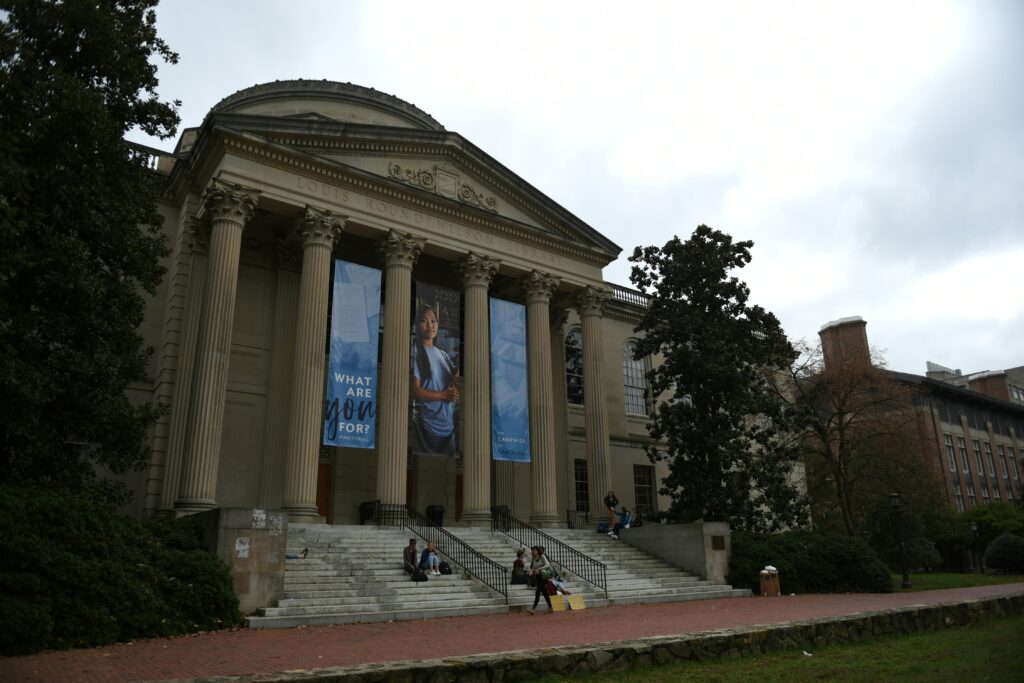
 Colin Rowley, Unsplash
This semester, as WUNC News’ Brianna Atkinson would have you know, UNC-Chapel Hill professor Seth Kotch replaced a once-detailed, color-coded, seven-page, Trivial Pursuit-themed course syllabus with something “more closely representing a business one-pager.”
The reason?
The UNC System recently “mandated that all university faculty publicly post course syllabi in searchable databases” that, as UNC’s Office of Faculty Governance notes, “will be considered public records and will be publicly visible through a central platform.” This mandate, Atkinson ominously declares, is a “response to…a syllabus fishing expedition” launched by an unnamed “conservative watchdog group…to see how professors [of whom Kotch is one] were, in their words, teaching ‘DEI’ in classrooms.” Conservative activists, Atkinson implies, are why we can’t have nice things.
Of course, “fishing expedition” is an uncharitable term for what might be characterized as a legitimate effort at democratic oversight and accountability. But this particular effort was made by the Heritage Foundation-affiliated Oversight Project—one of the groups that, Atkinson writes, “ha[s] made it clear their goal is to prevent instruction associated with diversity, equity, and inclusion or related topics.”
Rather than paraphrase, she might have quoted the organization’s own equally concise statement of its purpose: “to determine whether the university continues to teach DEI in violation of President Trump’s Executive Order, ‘Ending Illegal Discrimination and Restoring Merit-Based Opportunity.’” The omission of this detail is in keeping with the article’s fallacious appeal to pathos: fear of nefarious right-wing bullies and pity for the victimized faculty. (See also here, here, and here.) The attitude of entitlement presented here should be concerning not only to UNC students, their parents, and alumni, but also to all state citizens. Public education is, after all, a matter of public interest.
Yet something else seems to be guiding public education.
In an article published last fall about the then-ongoing debate over public syllabi, Atkinson quoted the then-president of the UNC-Greensboro American Association of University Professors chapter, Jeff Jones, who expressed concern about the threat of outside academic oversight: “We’ve been hired to do our jobs through a very complex vetting and hiring process and we do not need outside groups coming in to interfere with what we do.”
There’s much to be said for professional expertise and self-regulation, but this quote betrays an elitist technocratic attitude that is at odds with the principles of American liberal democracy. It suggests that only “educators” have a right to concern themselves with education. But education—especially public education with the stated mission “to discover, create, transmit, and apply knowledge to address the needs of individuals and society”—is a concern for those who receive it, those who fund it, and those who are impacted by it, as well as those who provide it.
Whatever else they might be, public university professors are, in effect, public servants.Whatever else they might be, public university professors are, in effect, public servants. The education that they provide, therefore, should and must be for the public good.
The decision by UNC System President Peter Hans that “public university syllabi should be public records” is well within the boundaries of responsible educational administration in a nation founded on self-governance and the rule of law. The fact that the decision was arrived at only after pressure was brought to bear by a “conservative watchdog group” does not in any way diminish its rightness.
If anything, it seems that more could and should be made public than seems to be currently available. Citing a “condensed time frame… to comply with the System Office policy,” the Office of the Provost notes that UNC is currently “only able to offer the five System Office required fields in Simple Syllabus.” A bare-bones syllabus that simply meets the basic requirements in each of these fields would provide little more insight into the course than an entry in a course catalog. None requires information about specific course content (let alone how that content will be framed), or course materials that students are not required to purchase. And the guidelines explicitly invite faculty to provide enrolled students with “additional items” that they have included in past syllabi “via historic or alternative means” that fall outside the “public syllabi” purview. In other words, faculty have ample opportunity to violate the spirit of the law while complying with its letter.
This may be more than the university can afford. While education oversight, accountability, and reform initiatives are still largely being spearheaded by conservatives, greater and greater numbers of citizens across the political spectrum are taking a closer look at American higher education and expressing real concerns about what they’re seeing.
For more than a decade now, many on the ideological left have insisted that “when you’re accustomed to privilege, equality feels like oppression.” It is ironic, then, that the new policy has provoked such a strongly negative knee-jerk reaction in so many. But the bien-pensants of the American academy are nothing if not privileged.
It’s telling that Kotch (who actually comes off fairly well in Atkinson’s article) says that the worry felt by many in the university is “less about whether or not students feel comfortable expressing themselves in class, and it’s more about how much an instructor needs to worry that a slip of the tongue will cost them a career they’ve been building for years.”
This is a legitimate concern, as those on the ideological right know all too well. This is to be lamented and fought against. But so, too, is the fact that, as a recent survey from the Foundation for Individual Rights and Expression shows, the majority of UNC students don’t “feel comfortable expressing themselves” on campus. It’s extremely likely that if more faculty were worried about these students—and how much they might fear what “a slip of the tongue” might cost them—we wouldn’t be here.
It is in UNC’s own interest to embrace more transparency, welcome more public discussion of education, and invite more accountability to the public.It wouldn’t be unfair or unreasonable to put new, larger, and clearer windows into the ivory tower even if all was well within. But not all is well within, and the effects include a tremendous loss of trust in our institutions of higher education, with significant negative consequences. It is in UNC’s own interest to embrace more transparency, welcome more public discussion of education, and invite more accountability to the public.
In this case, that means allowing the public to view its syllabi—the full syllabi.
David C. Phillips is an English teacher who lives in Greensboro, North Carolina.
Author
David C. Phillips