Articles

Articles


Why college graduates don’t write well

We keep hearing that America’s colleges and universities are the envy of the world, which seems to imply that they impart to students an extremely high level of knowledge and deep, refined skills necessary for success in today’s world. The trouble with that idea is the fact that many students manage to obtain college degrees despite the fact that they don’t even have the basic language and math skills that would have been taken for granted among high school students fifty years ago. Last year’s National Assessment of Adult Literacy report showed that basic literacy of college graduates is low and falling and a new paper released this week by the Pope Center shows that college graduates also have weak writing skills and explains why that is the case.

In “English 101: Prologue to Literacy or Postmodern Moonshine?” retired English professor Nan Miller, who taught writing for twenty-six years, examines the changes in the typical freshman composition course. She laments that those crucial courses are now dominated by “composition theorists.” Miller writes that “Composition is now taught according to their vision, in spite of evidence that shows a sharp decline in literacy among college graduates.” The ideas of the theorists, she contends, “hold students hostage to a bad idea.”


Miller Discusses Problems with College Writing

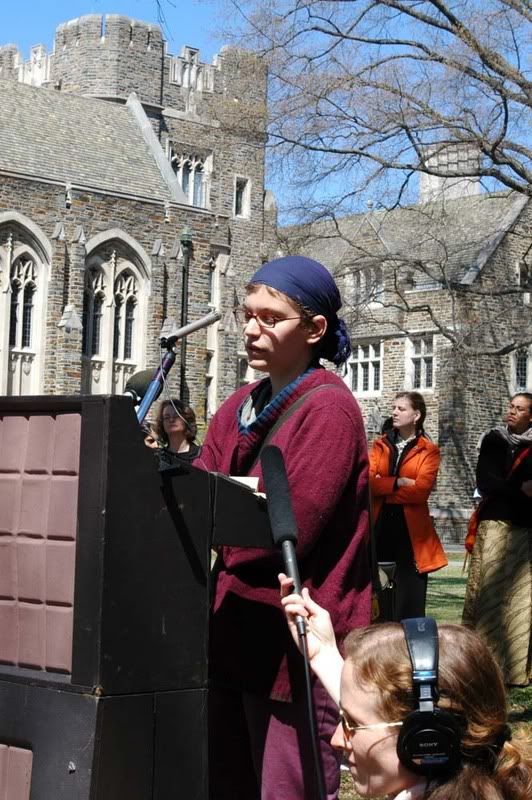
This is a portion of Nan Miller’s speech to the John Locke Foundation Monday. Miller discussed a recent study examining college writing courses to a crowd of 40 people. This excerpt shows typical conversations one may have about college writing programs.

Imagine for a minute that you have a daughter who is a freshman at Carolina. That�s the question I put to you. What if� (when the ink is barely dry on the tuition check) you had this conversation with your daughter. I�ll call her Page, and let�s say that she has been at Carolina for about a month and has left Chapel Hill for her very first weekend at home. She might be bursting with the details about her social life, but you are impatient to hear about the courses you just wrote the big check for. So you interrupt�


Inquiry Paper No. 24: English 101: Prologue to Literacy or Postmodern Moonshine?

Since freshman composition became a required course at Harvard in 1872, it has seen many changes, but none so radical as the changes brought about in the 1970s, when composition theory became a specialty. Postmodern theories about teaching composition have transformed writing programs nationwide, and this paper examines what has become of freshman writing courses at the two flagship branches of the University of North Carolina, N.C. State and UNC-Chapel Hill.

Download PDF file


Study Examines College Writing Courses

RALEIGH � Postmodern theorists have changed the way composition courses in college are taught, eliminating literature and grammar instruction by imposing group discussions with little involvement from the teachers, according to a new study released Monday by the John William Pope Center for Higher Education Policy.

The study, written by Nan Miller, a former English professor at North Carolina State University and Meredith College, discusses several fallacies that she believes have severely lowered the quality of writing among college students.


College Board misguided on student debt proposals

Every year as students graduate and enter the workforce, the media is prone to write stories that chronicle the lives of selected students as they struggle with student loan repayments. They usually write sad pieces on how loan payments make it difficult for students to live as they’d wish.

A recent study by the College Board entitled “How Much Debt Is Too Much? Defining Benchmarks for Manageable Student Debt,” by Sandy Baum of Skidmore College and Saul Schwartz of Carleton University, jumps into that issue. The authors, while finding that only a small minority of students have trouble managing their student debts, suggests several “policy” changes that they believe should be made.

The body of the paper consists of the authors’ analysis of an appropriate “benchmark” for how much debt it’s prudent for students to have. Their concern is that with too much debt, former students will have to sacrifice or delay other major things in life, such as home ownership. After much analysis and discussion, they say that “repayment will rarely be a problem if payments are below 7 percent of income and that few students would be well advised to exceed 17 percent.”


Jim Hunt believes colleges are not measuring up

In a report recently issued by the National Center for Public Policy and Higher Education, former North Carolina governor Jim Hunt and businessman Thomas Tierney address the question “How does American higher education measure up for the 21st century?” Not very well, they conclude.
I happen to think their conclusion is correct, but not for the reasons they give. The difficulty is that Hunt and Tierney are obsessed with the notion that we have a quantity problem. We don’t. We have a quality problem.
The tone for the report is set by former New Mexico governor Garrey Carruthers in his foreword. He states that, due to the demands of the “knowledge-based global economy,” it is imperative that “more Americans must prepare for, enroll in, and successfully complete degree and certificate programs.” Carruthers provides not the tiniest bit of evidence to support his assertion, but this is only the foreword. He calls for government, schools and colleges, and public leaders to “ratchet up the educational level” of the populace.


Is Ward Churchill an Aberration?

While University of Colorado professor Ward Churchill is infamous and controversial for his assertion that the people killed in the World Trade Center attacks shouldn’t be mourned because they were just “little Eichmanns,” that moronic statement is not at issue in the university’s investigation of him. A professor is just as entitled to say stupid things out of class as a retail clerk is entitled to say stupid things on her free time.

The University of Colorado appointed a team of scholars to investigate allegations that Churchill was guilty of plagiarism and academic fraud. Their findings were very clear: Churchill had indeed committed numerous, flagrant violations of the canons of scholarship. Later this year, the university will decide what penalty to impose.


Cleveland introduces bill to overturn scholarship provision

RALEIGH – A state legislator is calling for a controversial budget provision seen by many as a gift to athletic booster organizations to be overturned before the costs get out of hand.

Rep. George Cleveland, R-Onslow, said that a budget provision in last year’s budget that allowed UNC institutions to consider out-of-state residents as in-state residents for purposes of awarding scholarships was bad fiscal policy for taxpayers. Cleveland has since introduced legislation to overturn the provision. The bill is House Bill 2423.

Taxpayers, Cleveland said, should not front the costs of a program that helps out-of-state students.

“I don’t see why taxpayers should worry about it,” Cleveland said about scholarship funding. “That is a school problem, not a taxpayer problem.”


Does UNC need to expand?

When I first saw the email heading – “Could NC Wesleyan become a UNC school?” – I thought it was going to be a joke.

But as I read through the news item, I found out that several members of the General Assembly are quite serious about wanting to have North Carolina Wesleyan College be taken over by the University of North Carolina system. The idea is laughable, but they’re serious.

A provision was included in the Senate budget bill to study (at a cost to the taxpayers of $50,000) the feasibility of bringing this liberal arts college that is affiliated with the United Methodist Church into the big UNC congregation. Why on earth would we want to start ladling public money into a school that has managed quite well for half a century on funds raised from willing donors and students?