V-Day: Stripping Away Modesty and Dignity

Ask a random stranger what “V-Day” is. You might get some interesting answers. Some will probably confuse it with VE-Day or VJ-Day, the days marking the end of World War II in Europe and Japan. Perhaps some will think it’s simply an abbreviation of Valentine’s Day. However, no incorrect guesses could possibly be as interesting, or as shocking, as the truth. V-Day stands for “Vagina Day” and takes place the same day as the more traditional Valentine’s Day.
The University of North Carolina at Chapel Hill is one of 17 universities in North Carolina hosting “The Vagina Monologues” on or around Valentine’s Day this year. Nationally, “Vagina Warriors” at over 1000 universities will participate in the unusual festivities.


Big Education Conference Misses the Boat

Every year since 1986, the Institute for Emerging Issues has held a highly publicized conference devoted to some current policy issue. For 2007, the theme was “Transforming Higher Education: A Competitive Advantage for North Carolina.” Sadly, there was very little said about actually transforming higher education in the state over the two days of the event – that is, how it might be made a better and more valuable experience for students. Instead, the speakers were mostly fixated on the supposed need for North Carolina (and the United States as a whole) to put more students into and through college.

In other words, it was about quantity rather than quality. What needs to change, according to most of the speakers, is the number of young Americans entering and graduating from college, not the educational worth of the courses they take. This made for a rather monochromatic conference, rather like attending a concert where every piece was just a variation on the same theme.

The main theme was that America’s higher education system is “underperforming.” Whereas in the past the United States had the highest percentage of its workforce holding college degrees of any nation, today a number of countries now surpass the U.S. and more are catching up. Several speakers, including Governor Mike Easley, asserted that this situation poses a threat to our standard of living. Businessman Thomas Tierney stated that there is a “direct relationship between completion of higher education and economic growth,” and since the U.S. is losing its “lead” over other nations, our standard of living is in jeopardy.

Boseman, Swindell named to leadership posts

RALEIGH – State Senators A.B. Swindell and Julia Boseman will be among the key legislators that will push higher education policy and funding through the North Carolina Senate during the 2007-08 legislative session.

Both were named to key leadership posts on committees that have oversight of higher education spending and policy in the state Senate. Committee assignments for state senators were announced Thursday. The state House has not made committee assignments.

Swindell and Boseman, both Democrats, will chair the Senate Appropriations Subcommittee on Education and Higher Education as well as the Senate Education/Higher Education Committee. Swindell is the senior chairman.

Republican Richard Stevens, of Wake County, will serve as the ranking Republican co-chairman on both committees.


Bowles leads accountability charge in first year

CHAPEL HILL – When Erskine Bowles took over as president of the University of North Carolina system in 2006, his top priorities were to make the system more accountable to taxpayers and to make the system more efficient. His interest in those goals was among the reasons that Bowles, a former business executive and Clinton administration chief of staff, was the top choice as a replacement for then-president Molly Broad.

In his first year, Bowles lived up to his promises in these areas. Throughout the year, Bowles and the Board of Governors initiated policies that focused on ways to “manage this organization in the most efficient, effective manner we possibly can,” as he told the Board of Governors in his first address. “We are going to do everything we can to make sure we operate this place in a manner that you can be proud of, that any organization could be proud of,” Bowles said in January 2006.


Bush FY 2008 budget includes more financial aid

Increases in federal higher education spending were among the proposals included in President Bush’s $2.9 trillion budget for fiscal year 2008, which he presented to the Democratic-controlled Congress Monday.

Secretary of Education Margaret Spellings’ Commission on the Future of Higher Education, which issued a report in September, had foreshadowed many of the budget proposals, including increases in Pell Grant funding and reforms of the federal financial aid system.

According to White House budget information, Bush is proposing a five-year increase in the Pell Grant funding. The increase would take the maximum Pell Grant award from $4,050 to $5,400.


Is Law School a Waste of Time?

Strange as it may seem, it is quite possible for someone who has never gone to law school to be a good attorney.

An article that appeared recently in The Wall Street Journal makes that exact point. In “Meet the Clients,” (available here) New York attorney Cameron Stracher writes, “One of the biggest problems with the current state of legal education is its emphasis on books rather than people. By reading about the law rather than engaging in it, students end up with the misperception that lawyers spend most of their time debating the niceties of the Rule Against Perpetuities rather than sorting out the messy, somewhat anarchic version of the truth that judges and courts care about.”


Is Leftist Bias on College Campuses a Myth?

Conventional wisdom has long claimed that campuses are hotbeds of leftist thought with professors far more likely to be Marxists than Republicans. Recent research has taken steps to substantiate these claims. Eight separate studies of faculty politics and campus climate have demonstrated that professors with a leftist philosophy vastly outnumber those with a conservative or libertarian philosophy at four-year universities across the nation. The various studies address two major themes: that faculty members are liberal and that their liberal inclinations can affect classroom performance.

Now, a new study conducted by John B. Lee for the American Federation of Teachers concludes that those studies documenting liberal bias on campus might be incorrect, or at least inconclusive. “The ‘Faculty Bias’ Studies: Science or Propaganda,” takes eight of the recent studies on faculty politics and judges them by five general tests of social science research. According to Lee, “basic methodological flaws keep a critical reader from accepting the conclusions suggested by the authors.”

Unfortunately, Lee misses the point. Instead of refuting the results, Lee devotes his time to dissecting the methods employed by the researchers who have found evidence of leftist domination. Quibbling over details shouldn’t detract from the seriousness of the problem. Whether the number of professors who use their classrooms to peddle their own socio-political views is in the millions or in single digits, it shouldn’t be tolerated at all.


Legislative agenda centered on PACE study

RALEIGH – Legislators return to Raleigh today for the start of the 2007 regular session, with Democrats holding stronger majorities in both the state House (68 Democrats to 52 Republicans) and Senate (31 Democrats to 19 Republicans). Within a week, legislators will begin to wade through wish-list items from the University of North Carolina system. The list includes policy changes and a large spending request to give more money for faculty salaries.

The first General Assembly session of the new year will be held at noon. Today’s sessions are primarily ceremonial, with swearing-in ceremonies and the official transfer of the Speaker of the House chair to Orange County Democrat Rep. Joe Hackney. Democrats elected Hackney to replace the embattled Rep. Jim Black. Senate Democrats elected Sen. Marc Basnight to serve an unprecedented eighth term as Senate President Pro Tem.


Duke’s Curtis Crisis

Last spring, 88 Duke faculty members signed a public statement stating unequivocally that something “happened” to the accuser in the Duke lacrosse case. They promised to “turn up the volume” regarding the “social disaster” the lacrosse players had unleashed. And the professors said “thank you” to widely publicized protesters who had put up “wanted” posters with the lacrosse players’ photos while carrying signs reading “Time to confess” and “Castrate” outside the lacrosse players’ house.

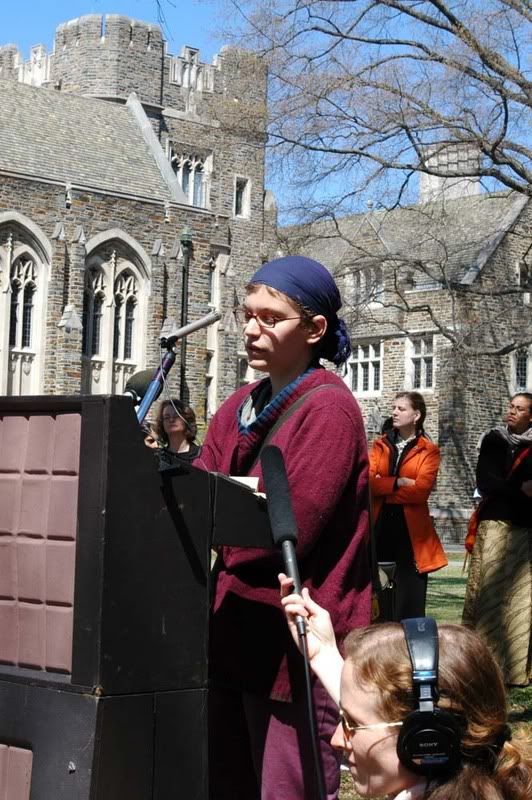
The “Group of 88” included Kim Curtis, who before late March had compiled a lengthy if unspectacular tenure as a longtime visiting political science professor. Then came the lacrosse incident. For faculty members predisposed to an extreme version of the race/class/gender trinity, the case was too tempting not to exploit. Before signing onto the Group of 88’s statement, Curtis attended rallies denouncing the players (background, in this photo). On March 29, she emailed fellow Durham activists expressing outrage that defense attorneys had (correctly) stated that no DNA match would occur to any lacrosse player. “The self assurance,” wrote Curtis,

in the statement issued yesterday by the team that they will be exonerated by the results of the DNA testing makes me wonder if we’ve gotten the full story about who was at the house that night. Were there others present who in fact carried out the rape and who are being protected by everyone else who was there? How do we know who was there?


Private colleges, universities want part-time students to receive grants

RALEIGH – The state’s association of private, non-profit colleges is pushing to extend the state’s Legislative Tuition Grant program to part-time students. Hope Williams, president of the North Carolina Independent Colleges and Universities, made the appeal at a meeting of the Joint Legislative Education Oversight Committee in December.

The legislative tuition grant (called NCLTG) is a popular state program that has been in effect since 1975. In 2006, the General Assembly raised the maximum grant per student from $1,800 to $1,900 per year.

The program originated in efforts to “strengthen the academic, management, and financial quality and viability of the private higher education sector,” says education researcher Nat Fullwood, In the 1970s, the University of North Carolina system was expanding rapidly and it was evident that private colleges and universities would lose students to the state system.