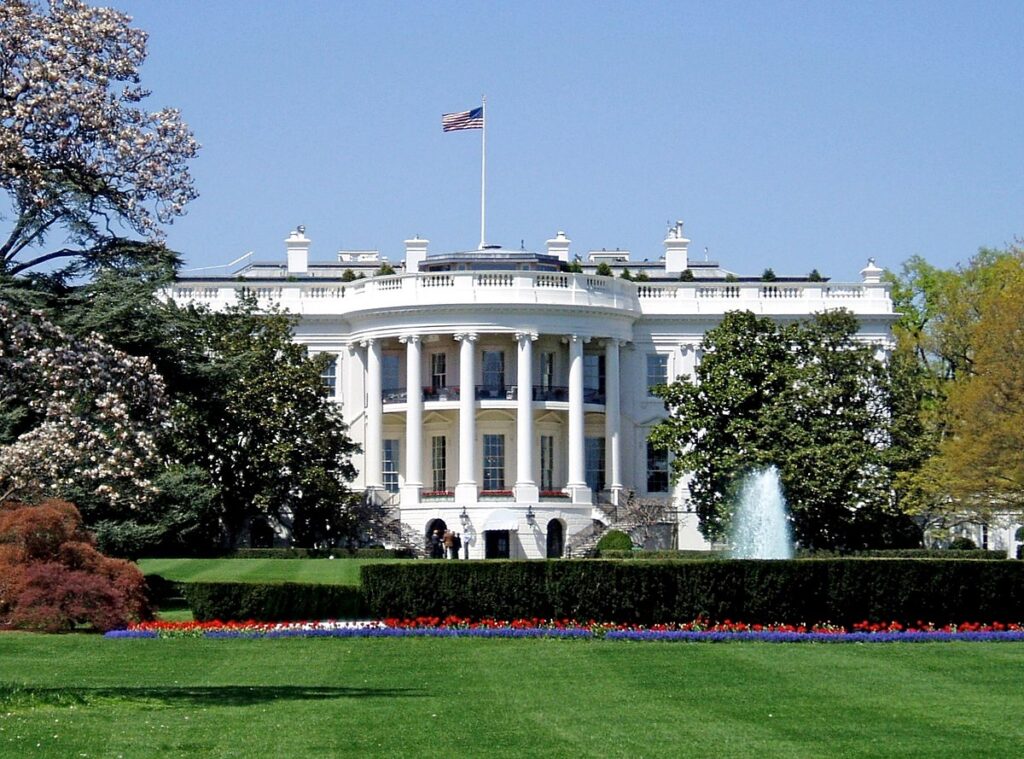
 Matt H. Wade, Wikimedia Commons
 If contrariness were an academic discipline, American colleges would lead the world in its study.
Such is the lesson of the Trump administration’s higher-ed “compact,” a 10-point bargain offered to nine elite universities earlier this month. Citing American colleges’ “extraordinary relationship with the U.S. government,” the document asks universities to practice admissions fairness, encourage civil discourse on campus, tackle grade inflation, and undertake several other modest but conservative-coded reforms. In exchange, signatories would receive “priority access to federal funds and looser restraints on overhead costs,” as the New York Times and other outlets have reported.
Trump might as well have defecated on the quad for all the outrage his proposal has generated. Trump might as well have defecated on the quad for all the outrage his proposal has generated. Calling the measure “a deal that would end universities’ independence,” the Atlantic warned of presidential ambitions to “impose ideological dominance” on higher education. The Washington Post editorial board scoffed that “no serious university could ever agree” to such demands. (Indeed. Therein lies higher ed’s problem.)
As is so often the case, the Left’s response to the president reveals far more about leftist values than it does about his. Colleges themselves “overwhelmingly panned” the offer, as Inside Higher Ed reported last week. According to the presidents of Trinity Washington University and Wesleyan University, Trump’s communiqué represents “extortion.” A joint statement from the AFT and the AAUP complained that the proposal “stinks of favoritism, patronage, and bribery in exchange for allegiance to a partisan ideological agenda.”
Already, blue states have begun to warn their institutions against complying. In what has become his typical, Trump-aping style, California governor Gavin Newsom threatened, “IF ANY CALIFORNIA UNIVERSITY SIGNS THIS RADICAL AGREEMENT, THEY’LL LOSE BILLIONS IN STATE FUNDING.” (Must every political declaration be visible from space?) Pennsylvania Democrats are preparing a measure to prevent state-funded schools from climbing aboard. So may Democrats in New York.
If one merely read newspaper headlines, one might assume that the administration’s offer is brazenly fascist, a bald attempt to remake the nation’s colleges as Trump U. In fact, very little in the compact is even remotely offensive to American ideals of fairness, integrity, and truth-seeking. As is so often the case, the Left’s response to the president reveals far more about leftist values than it does about his.
A point-by-point assessment of the compact is instructive (readers may consult the document itself to judge the faithfulness of my summaries):
- Equality in Admissions. Universities must obey the Supreme Court’s ruling in Students for Fair Admissions v. Harvard and refrain from privileging some applicants on the basis of race. Admissions decisions must be based on “objective criteria published on the university’s website,” and applicants must submit standardized test scores to allow for rational comparison.
- Marketplace of Ideas & Civil Discourse. Universities must maintain an “intellectually open campus environment.” They must protect authentic academic freedom, deny protest mobs a “heckler’s veto,” and prohibit incitement to “murder or genocide” on campus, presumably within the bounds of relevant First Amendment jurisprudence. Academic units that “purposefully” punish conservative ideas must be “transformed” or “abolished.”
- Nondiscrimination in Faculty and Administrative Hiring. Universities must actually abide by the Civil Rights Act of 1964. Hiring decisions must be based on merit, not race.
- Institutional Neutrality. While “all university members … are encouraged to comment on current events in their individual capacities,” universities must prevent employees and academic units from making political pronouncements as institutional representatives.
- Student Learning. Universities must fight grade inflation. Recommendations include “publishing grade distribution dashboards with multiyear trendlines.”
- Student Equality. Universities must treat students “as individuals” rather than as representatives of racial groups. They must base institutional policies on biological (rather than ideological) definitions of “woman” and “man.” Disciplinary standards on campus must be equally enforced.
- Financial Responsibility. Universities must “control their costs,” in large part by “eliminating unnecessary administrative staff,” cutting expenses, and thus reducing tuition. In what is perhaps the compact’s sole departure from basic, one-size-fits-all wisdom, signatories must freeze tuition for five years and “refund tuition to students who drop out during the first academic term of their undergraduate studies.”
- Foreign Entanglements. Universities must actually comply with existing foreign-donation reporting requirements. They must limit foreign-student enrollment to 15 percent of matriculating classes going forward.
- Exceptions. Religious and single-sex institutions may keep their existing compliance carveouts, and any institution “may maintain preferences in admissions for American citizens.”
- Enforcement. Universities must annually certify their compliance. Institutions found to have violated the terms of the compact must return “all monies advanced by the U.S. government during the year of any violation” and, if donors so request, all monetary gifts.
If many of these reforms sound familiar, that is because the Martin Center and other conservative policy organizations have been calling for them for years. Even among right-of-center figures who have expressed reservations about the compact, the emphasis has often been on strategy rather than substance. A representative essay by the American Enterprise Institute’s Frederick M. Hess argues, for example, that the compact’s “means” are “profoundly problematic.” Nevertheless, its “ends are admirable.” While the Cato Institute unsurprisingly slams the bargain as a “ramping up of federal control,” our libertarian friends are unable to deny that “many of the provisions of the compact might be desirable school policies.”
Universities are being offered what the president loves best: a deal. Were the Trump administration merely dictating new rules for colleges, these concerns from the right might be more persuasive. Yet that is not what is happening. Instead, universities are being offered what the president loves best: a deal. As Heritage Foundation visiting fellow (and frequent Martin Center contributor) Adam Kissel told the Wall Street Journal, “It is reasonable to offer additional benefits of partnership to institutions that voluntarily agree to higher standards of merit and efficiency than most of academia offers.”
Conservatives needn’t imagine Democrats taking up our tools, because Democrats invented those tools in the first place. At its heart, conservative opposition to the proposed compact is based on one of two concerns. The first, amusingly laid out by Hess in a follow-up post, asks the Right to envision similar dealmaking on the part of future Democratic administrations. (“I hope you’re having as much fun as I am,” says Hess’s imagined secretary of education, Rachel Maddow.) The second, embraced by Cato et al., posits the general unacceptability of government coercion of higher ed.
The last of these objections is easily dealt with. While I salute the philosophical consistency of anyone whose libertarianism extends to wishing the federal government wouldn’t enforce federal anti-discrimination laws, that is likely to remain a minority position. As for the rest of the compact’s stipulations, well, universities ought not to have fattened themselves on taxpayer largesse for generations. Institutions wishing to ignore Uncle Sam on principle need only resist the lure of federally backed student-loan dollars.
The first objection is smarter but similarly flawed. Conservatives needn’t imagine Democrats taking up our tools, because Democrats invented those tools in the first place! Moreover, the “Dear Colleague” letters made famous by the Obama administration didn’t threaten to withhold expanded federal benefits, as the Trump compact does, but federal dollars of any kind. I might like to live in a world in which Uncle Sam’s money came with very few of Uncle Sam’s strings. Better still would be a dispensation in which Uncle Sam was far more jealous of his loot in the first place. Whatever we might wish, however, that world is gone and will not be returning in our lifetimes. The choice now is between uni- and bilateralism. Will Democrats alone use federal dollars to influence higher-ed institutions’ behavior, or will Republicans join them?
For a certain kind of old-school conservative, the sight of GOP officials robustly exercising government power provokes abashment and dismay. This, I think, is an increasingly unhelpful habit of mind. Let both parties do their best to reform those universities that take or want federal dollars. Then let the voters decide.
Graham Hillard is editor at the James G. Martin Center for Academic Renewal.
Author
Graham Hillard