
 Sandra Seitamaa, Unsplash
 If you’ve been a longtime reader of the Martin Center’s work, then you know we collect books. Our library now holds nearly 1,000 titles, although our recent move means that we’ve lost track of exactly how many. Most of our library is still boxed up, waiting to be shelved in our new office.
In the meantime, we’re still collecting. We do so because we believe that books—real, paper ones that we can touch, smell, and hold in our hands—are best. (And research backs this up, as I wrote here.)
We’re especially interested in old books. I try (but often fail) to live by C.S. Lewis’s recommendation: “It is a good rule, after reading a new book, never to allow yourself another new one till you have read an old one in between. If that is too much for you, you should at least read one old one to every three new ones.” The entire essay in which that quote appears is well worth reading.
This year, I’m applying Lewis’s logic (with a generous definition of what qualifies as “old”) to my list of books I would like to see under the Martin Center Christmas tree. Here are 10 of our most-wanted titles (in order from newest to oldest):
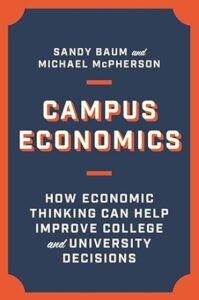 1. Campus Economics: How Economic Thinking Can Help Improve College and University Decisions by Sandy Baum and Michael McPherson (2023)
From the publisher:
Campus Economics provides college and university administrators, trustees, and faculty with an essential understanding of how college finances actually work. [The authors] explain the concepts needed to analyze the pros, the cons, and the trade-offs of difficult decisions, and offer a common language for discussing the many challenges confronting institutions of higher learning today, from COVID-19 to funding cuts and declining enrollments.
Campus Economics helps faculty, administrators, trustees, and government policymakers engage in constructive dialogue that can lead to decisions that align finite resources with the pursuit of the institutional mission.
2. The Wisdom of Our Ancestors: Conservative Humanism and the Western Tradition by Graham James McAleer, Alexander S. Rosenthal-Pubil, and Daniel J. Mahoney (2023)
From the publisher:
In this book, Graham McAleer and Alexander Rosenthal-Pubul offer a renewed vision of conservatism for the twenty-first century. Taking their inspiration from the late Roger Scruton, the authors begin with a simple question: What, after all, is the meaning of conservatism? In reply, they make a case for a political orientation that they call “conservative humanism,” which threads a middle way between liberal universalism and its ideological alternatives. This vision of conservatism is rooted in the humanist tradition (that is, classical humanism, Christian humanism, and secular humanism), which the authors take to be the hallmark of Western civilizational identity. At its core, conservative humanism attempts to reconcile universal moral values (rooted in natural law) with local, particularist loyalties. In articulating this position, the authors show that the West―contra various contemporary critics―does, in fact, have a great deal of wisdom to offer.
3. Not for Profit: Why Democracy Needs the Humanities by Martha Nussbaum (2016)
From the publisher:
In this short and powerful book, celebrated philosopher Martha Nussbaum makes a passionate case for the importance of the liberal arts at all levels of education.
Historically, the humanities have been central to education because they have rightly been seen as essential for creating competent democratic citizens. But recently, Nussbaum argues, thinking about the aims of education has gone disturbingly awry both in the United States and abroad. Anxiously focused on national economic growth, we increasingly treat education as though its primary goal were to teach students to be economically productive rather than to think critically and become knowledgeable and empathetic citizens.
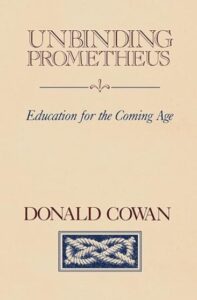 4. Unbinding Prometheus: Education for the Coming Age by Donald Cowan (2011)
From the publisher:
The collection of essays by a distinguished physicist and educator unites a cultural and technological imagination of education. Essays include “Imagination, Redundancy, and the Act of Learning,” “The Three Moments of Learning,” “The Uncertainty Principle in Education,” “Scientific Discovery and Gratitude,” and “The Economics of Taste.”
5. Teaching as a Subversive Activity by Neil Postman (1971)
From the publisher:
A no-holds-barred assault on outdated teaching methods—with dramatic and practical proposals on how education can be made relevant in today’s world.
“This challenging, liberating book can unlock not only teachers but anyone for whom language and learning are not dead.”—Nat Hentoff
6. The Emergence of the American University by Laurence R. Veysey (1970)
From the publisher:
The American university of today is the product of a sudden, mainly unplanned period of development at the close of the nineteenth and the beginning of the twentieth centuries. At that time the university, and with it a recognizably modern style of academic life, emerged to eclipse the older, religiously oriented college. Precedents, formal and informal, were then set which have affected the soul of professor, student, and academic administrator ever since.
What did the men living in this formative period want the American university to become? How did they differ in defining the ideal university? And why did the institution acquire a form that only partially corresponded with these definitions? These are the questions Mr. Veysey seeks to answer.
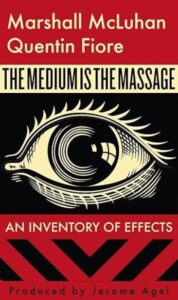 7. The Medium is the Massage by Marshall McLuhan (originally published in 1964)
From the publisher:
With every technological and social advancement, McLuhan’s proclamation that “the media work us over completely” becomes more evident and plain. In his words, so pervasive are they in their personal, political, economic, aesthetic, psychological, moral, ethical and social consequences that they leave no part of us untouched, unaffected, or unaltered.
McLuhan suggests modern audiences enjoy MainStream media as soothing, enjoyable, and relaxing; however, the pleasure we find in the MainStream media is deceiving, because/as/since the changes between society and technology are incongruent, perpetuating an Age of Anxiety.
McLuhan’s remarkable observation that “societies have always been shaped more by the nature of the media by which men communicate than by the content of the communication” is undoubtedly more relevant today than ever before.
8. The House of Intellect by Jacques Barzun (originally published in 1959)
From the publisher:
In this international bestseller, originally published in 1959, Jacques Barzun, acclaimed author of From Dawn to Decadence, takes on the whole intellectual—or pseudo-intellectual—world, attacking it for its betrayal of Intellect. “Intellect is despised and neglected,” Barzun says, “yet intellectuals are well paid and riding high.” He details this great betrayal in such areas as public administrations, communications, conversation and home life, education, business, and scholarship.
In this edition’s new Preface, Jacques Barzun discusses the intense—and controversial—reaction the world had to The House of Intellect.
9. Politics by Aristotle (c350 BC)
From the publisher:
Politics, written by Aristotle in 350 BC, is an essential guide to understanding the foundations and principles of government. This classic text explores the characteristics of a good society, the purpose of government, the role of citizens, the different types of constitutions, and the importance of justice and education. By examining the different forms of government and the effects of each, Aristotle provides valuable insight into the structure and functioning of a healthy society. With its timeless and thoughtful analysis, Politics is a must-read for anyone interested in the foundations of political philosophy and the principles of democracy.
 10. Isocrates, Volume II: On the Peace. Areopagiticus. Against the Sophists. Antidosis. Panathenaicus by Isocrates (c400 BC)
From the publisher:
The importance of Isocrates for the study of Greek civilization of the fourth century BC is indisputable. From 403 to 393 he wrote speeches for Athenian law courts, and then became a teacher of composition for would-be orators. After setting up a school of rhetoric in Chios he returned to Athens and established there a free school of “philosophia” involving a practical education of the whole mind, character, judgment, and mastery of language. This school had famous pupils from all over the Greek world, such as the historians Ephorus and Theopompus and orators Isaeus, Lycurgus, and Hypereides. Isocrates also wrote in gifted style essays on political questions, his main idea being a united Greece to conquer the Persian empire. Thus in his fine Panegyricus (written for the 100th Olympiad gathering in 380) he urged that the leadership should be granted to Athens, possibly in conjunction with Sparta. In the end he looked to Philip of Macedon, but died just as Philip’s supremacy in Greece began.
Will you help stock our library this Christmas? If you would like to make an end-of-year book donation to the Martin Center, you can buy any of the ones listed above (or another of your choice) from the Martin Center’s Amazon Wish-List. Or, you can donate below to help us build our library.
Thank you for reading our work and supporting us throughout the year.
Merry Christmas to all, and to all a good night—from all of us at the Martin Center.
Jenna A. Robinson is president of the James G. Martin Center for Academic Renewal.
Author
Jenna A. Robinson
