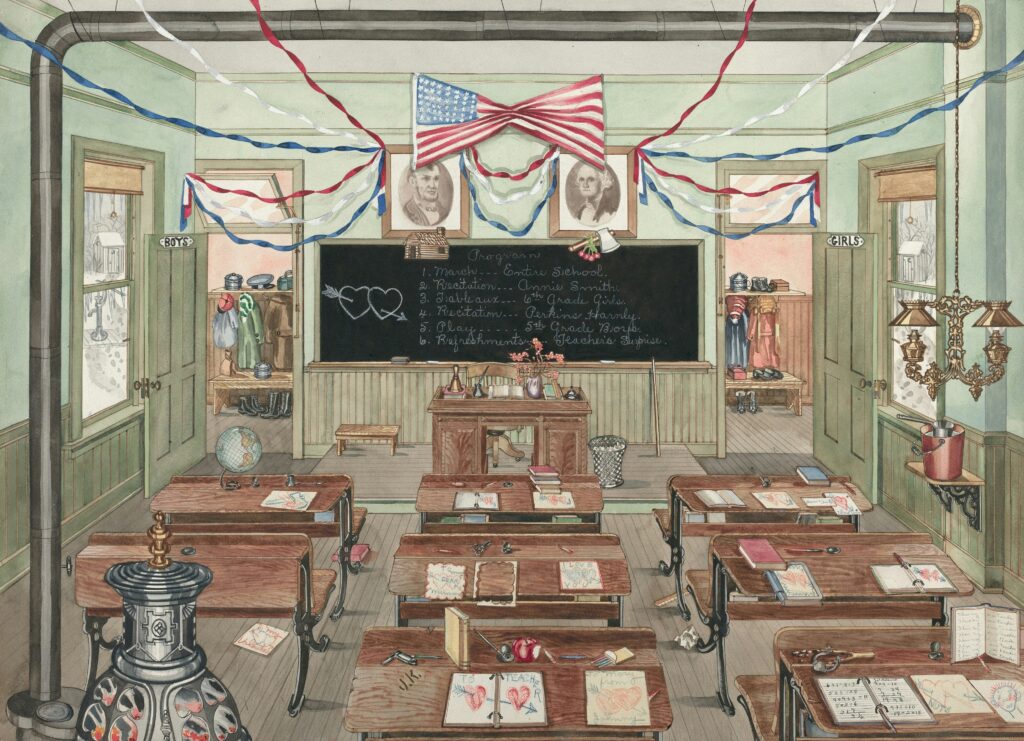
 National Gallery of Art, Unsplash
The Phoenix Declaration: An American Vision for Education, introduced in February 2025 through the Heritage Foundation, offers a vision for renewing American education. Its seven principles emphasize parental responsibility, transparency and accountability, truth and goodness, cultural transmission, character formation, academic excellence, and citizenship. Together, they describe an education concerned not merely with academic achievement or career preparation but with transmitting a cultural inheritance and forming knowledgeable, responsible citizens.
These aspirations place substantial demands on teachers. Transmitting a cultural inheritance requires understanding what is worth preserving and why. Cultivating character requires thoughtful engagement with questions of virtue, responsibility, and human flourishing. Preparing students for citizenship requires historical and political understanding of the principles and practices of self-government.
The Declaration therefore raises a question that deserves greater attention: What kind of education prepares teachers to fulfill these purposes? If teachers are expected to cultivate knowledge, character, and judgment in their students, their own preparation must be equal to that responsibility.
From Declaration to Policy
Florida has begun translating Phoenix’s principles into policy. In November 2025, its State Board of Education became the first in the nation to adopt the Declaration as guiding principles. Revised professional standards took effect in August 2026, while new uniform teacher-preparation curricular requirements are scheduled for implementation beginning in August 2027.
If teachers are expected to cultivate knowledge, character, and judgment in their students, their own preparation must be equal to that responsibility.These requirements address both substantive knowledge and instructional competence. Florida’s uniform core curriculum includes coursework in cognitive science and learning, effective instruction and classroom management, and the historical, philosophical, and civic foundations of Western civilization. Its educator standards likewise emphasize subject-matter knowledge and effective professional practice. The state is therefore attempting to strengthen both what prospective teachers know and what they can do.
Contemporary reformers Daniel Buck and Samuel Abrams have raised related concerns about teacher preparation. Both have criticized the prominence of ideological frameworks in schools of education and called for renewed attention to substantive knowledge and effective teaching. These are important directions for reform. Yet even when teacher-preparation programs adopt worthwhile curricular content and strengthen instructional competencies, a further question remains: How does what prospective teachers study become part of the intellectual resources through which they understand educational purposes and exercise professional judgment?
The challenge, then, is not to abandon instructional competencies or reject current reforms. Rather, it is to recognize that professional preparation involves more than the acquisition of knowledge and the demonstration of techniques. Teacher education must also cultivate the intellectual resources that enable teachers to bring knowledge and skill together in the exercise of informed professional judgment.
The Missing Dimension of Professional Preparation
Nearly half a century ago, philosopher of education Harry S. Broudy asked, “What do professors of education profess?” His concern was whether teacher education possessed the intellectual substance necessary to prepare genuine professionals. His work illuminates a dimension of professional preparation that contemporary reforms risk overlooking.
Teachers need knowing that: substantive knowledge of their subjects, how students learn, and the purposes of education. They also need knowing how: the practical capacities to plan instruction, assess learning, manage classrooms, and respond effectively to students. Both are indispensable. Yet Broudy insisted in “Whys and Wherefores of Competency Based Teaching” (1983) that the issue was not “skill versus no skill.” The danger arises when teaching is reduced to prescribed techniques without sufficient attention to the judgment required to employ them.
Professional preparation also requires what Broudy called knowing with. This describes knowledge that becomes more than information to be recalled or procedures to be followed. Concepts, historical understanding, and ways of seeing become intellectual resources through which teachers interpret experience, recognize what is at stake, and exercise judgment. History, literature, philosophy, and the sciences provide such “context-building resources,” including what Broudy called “cognate knowledge”: knowledge teachers may never directly teach but nevertheless teach with.
Consider a teacher whose students struggle to understand a lesson. Instructional competence offers techniques for responding: additional explanation, guided practice, questioning, or assessment. But choosing among them requires interpreting the difficulty. Are students missing background knowledge? Have they misunderstood a concept? Does the material challenge existing assumptions? Disciplinary, psychological, historical, and philosophical understanding can inform these judgments.
This insight matters for Phoenix’s aspirations. Teachers expected to transmit a cultural inheritance must understand it rather than merely repeat it. Cultivating character requires reflection on virtue, authority, freedom, and responsibility. Preparing students for self-government requires historical and political understanding. Liberal and foundational studies should therefore cultivate habits of interpretation: recognizing assumptions, locating controversies in historical context, and distinguishing educational means from ends. Foundations are not ornaments attached to practical preparation but resources for developing professional judgment.
Preparing Teachers for Phoenix’s Aspirations
What would it mean to take this understanding seriously in teacher preparation?
First, programs should preserve and strengthen substantive liberal and disciplinary learning. Future teachers need sustained engagement with history, literature, philosophy, the sciences, and the subjects they will teach. Yet a course in Western civilization or constitutional government, however valuable, can become another requirement, its content recalled for an examination and soon forgotten. Intellectual formation requires that such learning become a resource for understanding educational purposes and responsibilities. Consequently, programs should organize liberal learning and professional preparation as an integrated course of study. One possibility is a four-year teacher-education program that begins with a two-year liberal arts and cognate core, followed by two years of professional coursework that deliberately draws upon and applies that earlier learning to educational problems and practice.
Future teachers need sustained engagement with history, literature, philosophy, the sciences, and the subjects they will teach.Second, programs should deliberately connect liberal learning with professional study. Educational philosophy can help candidates examine questions of authority, freedom, virtue, and responsibility. Educational history can help them locate contemporary controversies in context. Disciplinary study can inform their judgments about what is worth teaching and how students come to understand it. These connections should not be confined to a single foundations course but should inform teacher preparation more broadly.
Third, prospective teachers need opportunities to exercise professional judgment. Broudy advocated studying cases involving recurring problems of teaching, drawing upon theory and research to interpret situations and consider alternative responses. Analysis of curricular decisions, sustained discussion of educational purposes, and reflection on clinical experiences can serve similar ends. Such exercises cannot guarantee intellectual formation, but they can help prospective teachers practice bringing what they know to bear on the complexities of teaching.
Recovering the Professional Teacher
The Phoenix Declaration, Florida’s reforms, and the proposals advanced by Buck and Abrams offer an opportunity to renew teacher education around substantive knowledge, liberal learning, and effective instruction. Broudy’s contribution is not an alternative to these reforms but a way of understanding what their fullest realization requires. Intellectual formation is not an optional enrichment of teacher preparation; it is essential to developing the informed judgment that distinguishes genuinely professional teaching.
The ultimate measure of reform is not simply whether programs adopt new readings, requirements, or competencies. It is whether future teachers leave their preparation knowing more, teaching more capably, and possessing richer intellectual resources with which to understand what they are doing and why. The question, then, is not only what teachers should know and be able to do. It is also what they should learn to know with and teach with.
Timothy L. Simpson, Ph.D., is Professor of Education and Chair of Teacher Education and Foundational and Graduate Studies in Education at Morehead State University in Kentucky.
Jayson Evaniuck, Ed.D., is Department Chair of Educational Specialties in the College of Education at Anderson University in South Carolina.
Author
Timothy Simpson
Author
Jayson Evaniuck