
 Staatliche Museen zu Berlin, Kupferstichkabinett
Authoring a textbook for a new course on the history of education at the University of Austin keeps sending me back to the medieval university. One of its customs, the quodlibet, deserves a revival, not for students, but for professors.
For a century, American universities have hired and promoted faculty mainly by weighing what they publish. The metric was crude, but it rested on the facts that a book or article took months or years of hard work to publish and that few people had an incentive to write publications for others. A solid CV therefore usually indicated a solid scholar who in classrooms could at least be counted on not to repeat absurdities or myths.
Today, for just a few bucks, a frontier AI model can write passable papers or chapters in minutes. Editors have noticed. Organization Science reports that its submissions rose 42 percent after ChatGPT appeared. The preprint server arXiv now bans authors for a year for submitting obvious AI slop.
How, then, does a search, promotion, tenure, or contract renewal committee know that the “brilliant” candidate is really any good? Job talks will not settle the question. Candidates choose their own topics, rehearse for weeks, and can polish every slide with the same machine that polished their CVs. Q&A typically runs just fifteen to thirty minutes and tends to be larded with soft or pedantic questions, soliloquies, and disquisitions. Candidates can get through them at minimal cost with long-winded responses to easy questions and deflection of difficult ones.
Medieval masters faced a much harder test.
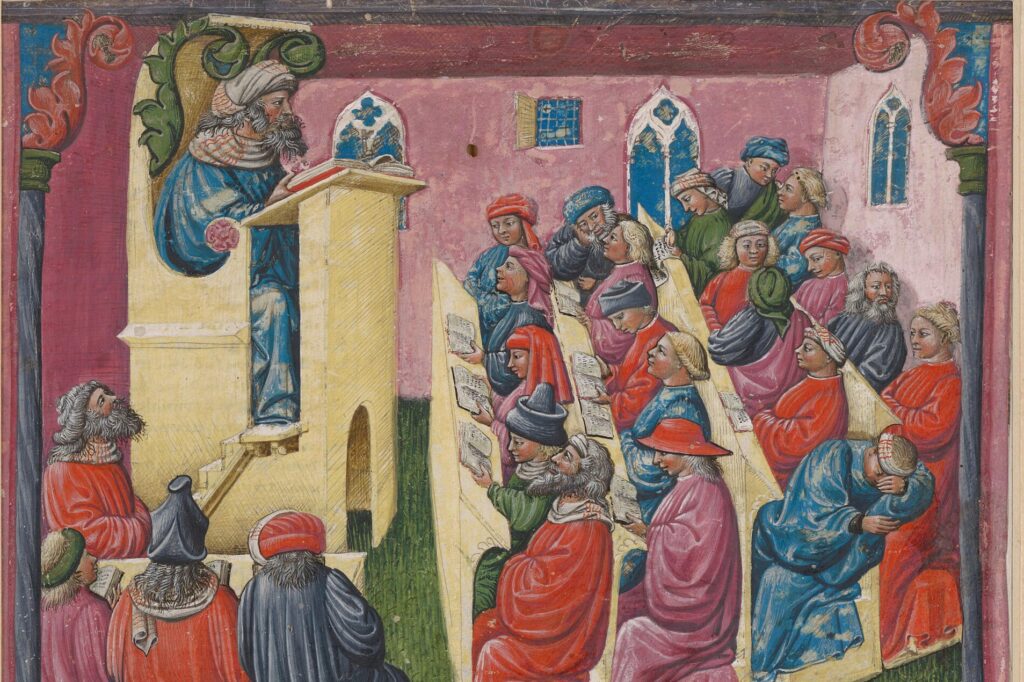
Medieval masters faced a much harder test. Beginning at Paris in the 1230s, the theology faculty held disputations de quolibet a quolibet: about anything, from anyone. Twice a year, during Advent and Lent, the university suspended ordinary lectures so that anyone present, whether student, rival master, or visitor, could put a question to a master who did not know the questions in advance. On the first day, arguments for and against each were aired on the spot. On a later day, the master “determined” the questions, putting them in order and giving his considered answers, which he typically then revised for publication.
The questions ranged widely. Thomas Aquinas, who held twelve quodlibets, was asked whether truth is stronger than wine, the king, or woman. Truth, he decided, after granting each rival its own domain.
Masters were not required to hold quodlibets. Many seldom did, likely because a scholar who answers any question from anyone, in public, shows exactly what he knows and what he doesn’t. The quodlibet was not a licensing exam; it was a test of reputation. The best masters, Aquinas and Henry of Ghent among them, chose to take it again and again.
A faint echo of the medieval disputation survives in the doctoral defense and in the professors who have returned to oral exams, even, as the Chronicle of Higher Education reports, in calculus. At Cornell, a biomedical engineering professor and his teaching assistants have stopped grading written problem sets and now grade only oral defenses. Penn and Cornell train faculty to give such exams. A business professor at New York University says he no longer trusts written work to reflect student thinking.
If the logic holds for a 19-year-old facing a grade, it holds with more force for a 35-year-old seeking a lifetime appointment worth millions in pay and benefits. We ask students to show what they know without a machine whispering in their ear, so we should ask at least as much of the people who grade them.
So I propose that every finalist for a tenure-track job, and every candidate for tenure, promotion, or contract renewal, should hold a quodlibet. Make it public and at least two hours long, before the department, students, and faculty from neighboring fields. Anyone may ask anything within the discipline, defined more or less broadly depending on institutional type. No slides, LLMs, or other crutches allowed on either side of the podium.
Keep the second day, too. The candidate returns the next day to give fuller, ordered answers to the three or four hardest questions, again unaided by slides or notes. This round, though, she may use books and even AI to prepare because real scholars use tools. But the committee will have seen the first, unaided answers and can judge whether the green shoots stemmed from a sound root. Record both sessions so external reviewers who now skim publications can watch the candidate think instead.
A quodlibet may favor the quick and the glib over the deliberative and pensive, but a glib answer to a hard question from a sharp colleague will likely come off as glib. Moreover, teaching, at least for now, remains an oral art. A professor who freezes when a sophomore asks something unexpected has a problem the department should learn about before granting tenure, not after. Some questioners may be hostile or ignorant. The second day was the medieval remedy because it allowed the master to set aside a foolish question or to show why a hostile one was badly posed, a skill worth seeing.
Some will say it takes too much time. Two afternoons are nothing compared to the months committees spend reading files that AI may have padded, or the cost of a bad tenure decision, which a university might have to pay for half a century.
The masters of Paris had no chatbots, but they faced the same problem we face again.
The masters of Paris had no chatbots, but they faced the same problem we face again: how to discern true masters from poseurs. They answered it by making masters think in public. We should, too.
Robert E. Wright teaches history at the University of Austin, where nobody is tenured, and is the (co)author of 25 books.
Author
Robert E. Wright
