
V-Day: Stripping Away Modesty and Dignity
Ask a random stranger what “V-Day” is. You might get some interesting answers. Some will probably confuse it with VE-Day or VJ-Day, the days marking the end of World War II in Europe and Japan. Perhaps some will think it’s simply an abbreviation of Valentine’s Day. However, no incorrect guesses could possibly be as interesting, or as shocking, as the truth. V-Day stands for “Vagina Day” and takes place the same day as the more traditional Valentine’s Day.
The University of North Carolina at Chapel Hill is one of 17 universities in North Carolina hosting “The Vagina Monologues” on or around Valentine’s Day this year. Nationally, “Vagina Warriors” at over 1000 universities will participate in the unusual festivities.
Big Education Conference Misses the Boat
Every year since 1986, the Institute for Emerging Issues has held a highly publicized conference devoted to some current policy issue. For 2007, the theme was “Transforming Higher Education: A Competitive Advantage for North Carolina.” Sadly, there was very little said about actually transforming higher education in the state over the two days of the event – that is, how it might be made a better and more valuable experience for students. Instead, the speakers were mostly fixated on the supposed need for North Carolina (and the United States as a whole) to put more students into and through college.
In other words, it was about quantity rather than quality. What needs to change, according to most of the speakers, is the number of young Americans entering and graduating from college, not the educational worth of the courses they take. This made for a rather monochromatic conference, rather like attending a concert where every piece was just a variation on the same theme.
The main theme was that America’s higher education system is “underperforming.” Whereas in the past the United States had the highest percentage of its workforce holding college degrees of any nation, today a number of countries now surpass the U.S. and more are catching up. Several speakers, including Governor Mike Easley, asserted that this situation poses a threat to our standard of living. Businessman Thomas Tierney stated that there is a “direct relationship between completion of higher education and economic growth,” and since the U.S. is losing its “lead” over other nations, our standard of living is in jeopardy.
Bowles leads accountability charge in first year
CHAPEL HILL – When Erskine Bowles took over as president of the University of North Carolina system in 2006, his top priorities were to make the system more accountable to taxpayers and to make the system more efficient. His interest in those goals was among the reasons that Bowles, a former business executive and Clinton administration chief of staff, was the top choice as a replacement for then-president Molly Broad.
In his first year, Bowles lived up to his promises in these areas. Throughout the year, Bowles and the Board of Governors initiated policies that focused on ways to “manage this organization in the most efficient, effective manner we possibly can,” as he told the Board of Governors in his first address. “We are going to do everything we can to make sure we operate this place in a manner that you can be proud of, that any organization could be proud of,” Bowles said in January 2006.
Is Law School a Waste of Time?
Strange as it may seem, it is quite possible for someone who has never gone to law school to be a good attorney.
An article that appeared recently in The Wall Street Journal makes that exact point. In “Meet the Clients,” (available here) New York attorney Cameron Stracher writes, “One of the biggest problems with the current state of legal education is its emphasis on books rather than people. By reading about the law rather than engaging in it, students end up with the misperception that lawyers spend most of their time debating the niceties of the Rule Against Perpetuities rather than sorting out the messy, somewhat anarchic version of the truth that judges and courts care about.”
Is Leftist Bias on College Campuses a Myth?
Conventional wisdom has long claimed that campuses are hotbeds of leftist thought with professors far more likely to be Marxists than Republicans. Recent research has taken steps to substantiate these claims. Eight separate studies of faculty politics and campus climate have demonstrated that professors with a leftist philosophy vastly outnumber those with a conservative or libertarian philosophy at four-year universities across the nation. The various studies address two major themes: that faculty members are liberal and that their liberal inclinations can affect classroom performance.
Now, a new study conducted by John B. Lee for the American Federation of Teachers concludes that those studies documenting liberal bias on campus might be incorrect, or at least inconclusive. “The ‘Faculty Bias’ Studies: Science or Propaganda,” takes eight of the recent studies on faculty politics and judges them by five general tests of social science research. According to Lee, “basic methodological flaws keep a critical reader from accepting the conclusions suggested by the authors.”
Unfortunately, Lee misses the point. Instead of refuting the results, Lee devotes his time to dissecting the methods employed by the researchers who have found evidence of leftist domination. Quibbling over details shouldn’t detract from the seriousness of the problem. Whether the number of professors who use their classrooms to peddle their own socio-political views is in the millions or in single digits, it shouldn’t be tolerated at all.
Legislative agenda centered on PACE study
RALEIGH – Legislators return to Raleigh today for the start of the 2007 regular session, with Democrats holding stronger majorities in both the state House (68 Democrats to 52 Republicans) and Senate (31 Democrats to 19 Republicans). Within a week, legislators will begin to wade through wish-list items from the University of North Carolina system. The list includes policy changes and a large spending request to give more money for faculty salaries.
The first General Assembly session of the new year will be held at noon. Today’s sessions are primarily ceremonial, with swearing-in ceremonies and the official transfer of the Speaker of the House chair to Orange County Democrat Rep. Joe Hackney. Democrats elected Hackney to replace the embattled Rep. Jim Black. Senate Democrats elected Sen. Marc Basnight to serve an unprecedented eighth term as Senate President Pro Tem.
Duke’s Curtis Crisis
Last spring, 88 Duke faculty members signed a public statement stating unequivocally that something “happened” to the accuser in the Duke lacrosse case. They promised to “turn up the volume” regarding the “social disaster” the lacrosse players had unleashed. And the professors said “thank you” to widely publicized protesters who had put up “wanted” posters with the lacrosse players’ photos while carrying signs reading “Time to confess” and “Castrate” outside the lacrosse players’ house.
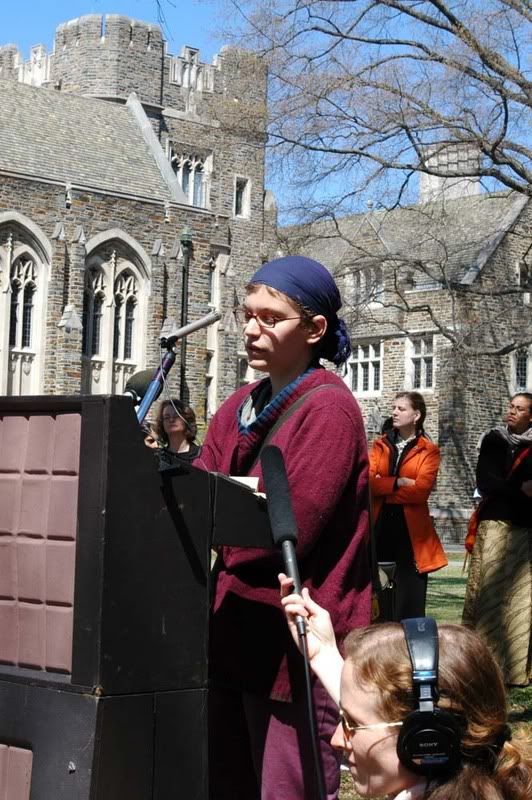
The “Group of 88” included Kim Curtis, who before late March had compiled a lengthy if unspectacular tenure as a longtime visiting political science professor. Then came the lacrosse incident. For faculty members predisposed to an extreme version of the race/class/gender trinity, the case was too tempting not to exploit. Before signing onto the Group of 88’s statement, Curtis attended rallies denouncing the players (background, in this photo). On March 29, she emailed fellow Durham activists expressing outrage that defense attorneys had (correctly) stated that no DNA match would occur to any lacrosse player. “The self assurance,” wrote Curtis,
in the statement issued yesterday by the team that they will be exonerated by the results of the DNA testing makes me wonder if we’ve gotten the full story about who was at the house that night. Were there others present who in fact carried out the rape and who are being protected by everyone else who was there? How do we know who was there?
UNC to propose minimum admissions standards
The University of North Carolina is considering a minimum admission standard for all campuses, Harold L. Martin, senior vice president for academic affairs, told a meeting of the education planning committee of the Board of Governors Jan. 11. Such a standard could be proposed as early as June.
Currently, the requirement for attending any UNC campus is high school graduation and a minimum number of specified courses (such as 4 units of English and 4 units of math). A tougher admission standard could take the form of a minimum high school grade point average, class rank, and/or a minimum SAT score.
Can You Find the Fake Course?
What follows are descriptions of four college courses. Three of them are real courses and one is not. Can you identify the fake?
A. The Adultery Novel. Students will read a series of 19th and 20th century works about adultery and watch several films about adultery. They will apply critical approaches to place adultery in its aesthetic, social and cultural context, including: sociological descriptions of modernity, Marxist examinations of the family as a social and economic institution, and feminist work on the construction of gender.
B. Queer Musicology. This course explores how sexual difference and complex gender identities in music and among musicians have incited productive consternation during the 1990s. Music under consideration will include works by Franz Schubert, Holly Near, Benjamin Britten, Cole Porter, and Pussy Tourette.
C. Whiteness: The Other Side of Racism. This course will spark critical thinking on these questions: What is whiteness? How is it related to racism? What are the legal frameworks of whiteness? How is whiteness enacted in everyday practice? And how does whiteness impact the lives of both whites and people of color?
D. Foodways, Heteronormativity, and Hungry Women in Chicana Lesbian Writing. This course will analyze foodways in recent Chicana lesbian literature, examining writings that illustrate the cultural endurance of heteronormative constructions of gender even as they demonstrate how these beliefs are disrupted, destabilized, and transformed in queer literary kitchens.
North Carolina State Faculty Challenge Potential Donation
Outspoken faculty members with a strong political agenda have once again interfered in discussions about a potential donation to a North Carolina university.
Toby Parcel, dean of the College of Humanities and Social
Sciences at North Carolina State University, had quietly approached the Pope Foundation to explore funding for academic programs. But in a stormy public meeting in early December, some faculty members loudly and rudely made it clear that they don’t want their college to get any money from Pope.
Apparently opposing the Pope Foundation for its conservative political philosophy, several faculty members used over-the-top language, calling the money “dirty money” and saying that to accept funds would be “a very dangerous step.” (The discussions had involved support of a study abroad program and French and German language programs.)